Oxygen Saturation Temperature Calculator
Estimate dissolved oxygen saturation, usable reserve, and temperature sensitivity for freshwater, brackish, marine, and high-altitude aquariums.
🐟Real Aquarium Presets
🌡Water and Air Conditions
Dissolved Oxygen Estimate
📊Temperature Oxygen Comparison Grid
🌡Temperature Saturation Reference
| Temperature | Freshwater 0 ppt | Brackish 15 ppt | Marine 35 ppt |
|---|---|---|---|
| 59°F / 15°C | 10.1 mg/L | 9.2 mg/L | 8.1 mg/L |
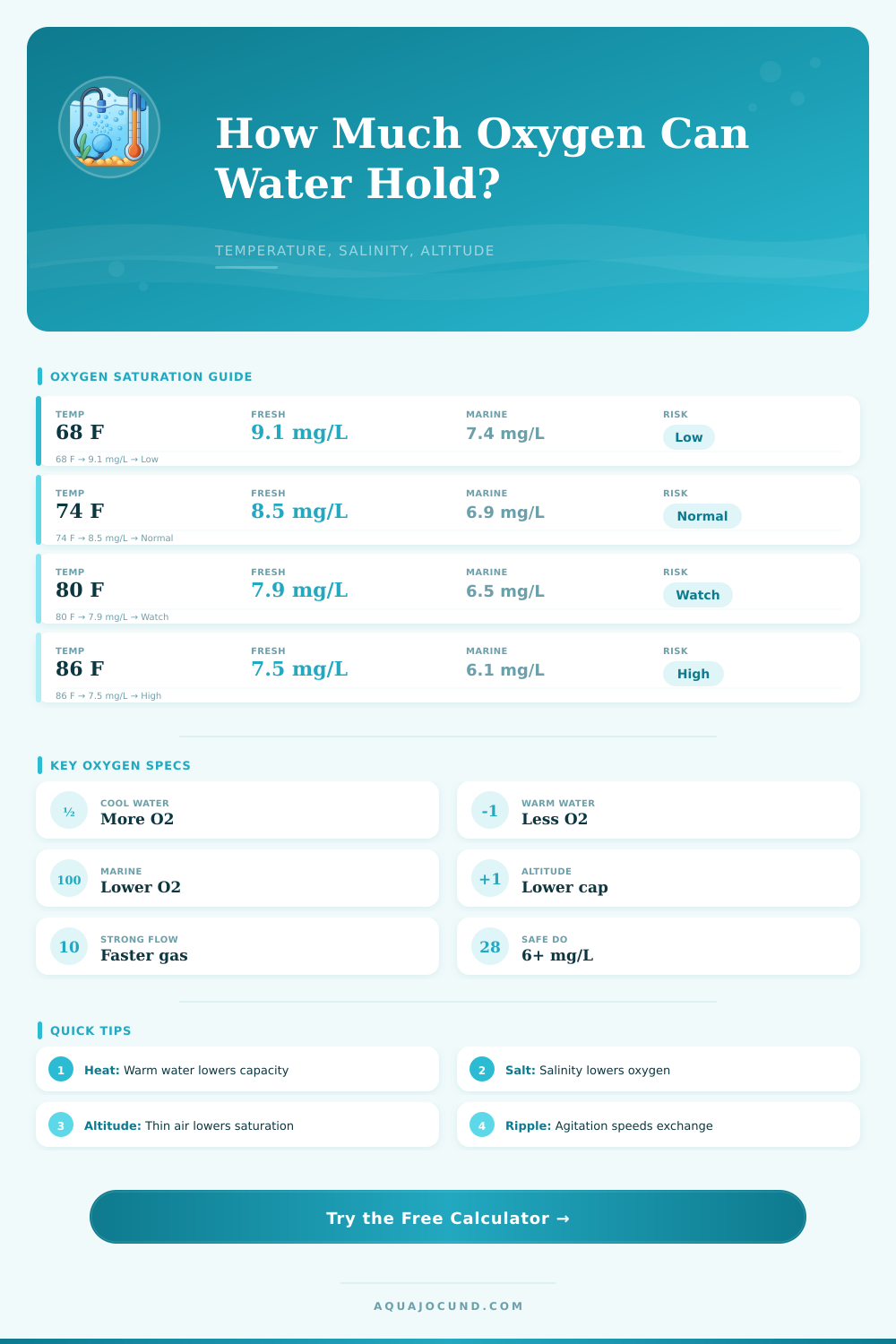
| 68°F / 20°C | 9.1 mg/L | 8.3 mg/L | 7.4 mg/L |
| 77°F / 25°C | 8.3 mg/L | 7.6 mg/L | 6.7 mg/L |
| 86°F / 30°C | 7.5 mg/L | 6.9 mg/L | 6.1 mg/L |
| 95°F / 35°C | 7.0 mg/L | 6.4 mg/L | 5.6 mg/L |
⛰Altitude Pressure Adjustment
| Altitude | Pressure factor | Fresh 77°F saturation | Planning note |
|---|---|---|---|
| Sea level | 100% | 8.3 mg/L | Full air pressure |
| 2,500 ft / 760 m | 91% | 7.6 mg/L | Small reserve loss |
| 5,000 ft / 1,524 m | 83% | 6.9 mg/L | Aeration matters more |
| 7,500 ft / 2,286 m | 75% | 6.2 mg/L | Warm tanks need caution |
🌊Agitation and Stocking Interpretation
| Factor | Low value | High value | Calculator effect |
|---|---|---|---|
| Surface agitation | Still water | Skimmer or overflow | Moves practical DO toward saturation |
| Stocking demand | Shrimp or nano fish | Goldfish or growouts | Raises target reserve pressure |
| Plant load at night | Sparse plants | Dense plants or algae | Subtracts from usable oxygen buffer |
| Current saturation | Below 80% | 95-100% | Shows present DO versus capacity |
📐Typical Aquarium Oxygen Targets
| Livestock profile | Useful target | Watch closely below | Common trigger |
|---|---|---|---|
| Shrimp and betta | 5.0-6.0 mg/L | 4.5 mg/L | Still water or heat |
| Community tropical | 6.0-7.0 mg/L | 5.0 mg/L | Overstocking or dirty filter |
| Goldfish and koi | 7.0+ mg/L | 6.0 mg/L | Warm water and high biomass |
| Marine reef | 6.0-7.0 mg/L | 5.5 mg/L | High salinity or overnight dip |
| Hillstream fish | 7.0+ mg/L | 6.5 mg/L | Low flow or elevated temperature |
Crisis usualy strikes silently. There’s no splash, no sudden loss of water clarity, yet there is your fish at the top of the tank, gasping for air as you watch TV. The buffer protecting it has dissapears.
Why is dissolved oxygen so important to understand? Very few hobbyists understands it. It isn’t just a matter of keeping their livestock alive… it’s also about creating an environment in which life can thrive as opposed to simply survive.
Why Your Fish Need Oxygen
And the math behind it is done for you with calculator above…but understanding why temperature (and salinity) are silent killers will help you avoid crises before they occur. This one’s basic physics, warm water has lower oxygen content. Even seasoned keepers makes the mistake of assuming they still has enough filter flow rate all year long.
However, as water warms, its molecules space themselves apart. Fewer gas molecule are able to dissolve into the liquid phase. In addition, warmer water increase metabolic rates. At the time when the water can’t hold as much oxygen, you’ve got your bacteria and fish burning through it faster. This will quickly decrease your safety margin.
This is why a tank that was stable in winter can suffocate you during a summer heatwave, even with no change in stocking levels or equipment. The other consideration that puts limits on it is salinity, since salt ions also takes up space within the water’s structure. This crowds out oxygen molecules, and a marine reef tank will have less oxygen available at any given temperature different than a freshwater planted aquarium of the same temperature. You’re working off a lower oxygen ceiling.
Keeping fish from the brackish side of the spectrum (scats, puffers, etc.) will put you on a tighter leash, and the reference table on the page makes that very clear. As salinity increases, saturation drops sharply, and you can’t assume that all water bodies should be treated alike when considering their breathing requirements.
For those who live at higher elevations, Altitude adds an extra wrinkle, as low barometric pressure mean reduced “force” of oxygen being pushed down in the water column. What works flawlessly at sea level may have trouble keeping up with demand in Boise or Denver, and it recognizes the pressure differential and adjusts its saturation target to compensate. But pretending that elevation doesn’t exist is like attempting to blow up a balloon with only half the air. No matter how much effort you put forth, it just won’t fill up.
Still water exchange gas slowly. You need to constantly break up the stagnant boundary layer between water and atmosphere to allow fresh air to be in continuous contact with the water. Rippling the water’s surface breaks the boundary layer and allows a constant supply of fresh air to meet the water. Turbulence created by overflow boxes and air stones force oxygen into solution more rapidly then just simple diffusion would. It is worth taking time to think about what level of actual gas exchange occur on your set-up when making reserve calculations.
Just having an internal pump circulating water doesn’t necessarily mean there will be higher levels of dissolved O2. Daytime is a tricky dynamic with plants, which are large oxygen consumers at night. Heavy algae loads or dense plantings will respire constantly and pull down dissolved levels after the lights go out. This is the reason why many hobbyists get caught off guard when a tank that looked perfect in the afternoon falls below safe thresholds by dawn. It’s all about knowing the cycle and setting realistic targets.
Don’t count on measuring your tank mid-day; it may be deceptively healthy. Bettas & Shrimp: Bettas and shrimp can handles less, but they need it stable. If it’s not, they still require stability.
Goldfish and active tropical fish produces a lot of waste and are metabolically active, so they require stronger aeration. The calculator will take into account stocking density, plant load, and other temp stress scenarios to help you calculate if your current situation meet any of these requirements.
So what does it do? It provides a number for “usable reserve” which tells you how much buffer you have before oxygen depletion becomes dangerous. Water quality is not the same as water clarity. Don’t rely on guesswork with an invisible variable. What you see may be just fine but without oxygen, it’s a disaster in the making.
Use the data to tell you what to do. If things are appearing thin, add some agitator or lower the temp. This is how you manage things proactively. Don’t get into reactive panic. Watch the trends and listen to the numbers. Before one of those fish surfaces and starts to gasp for air, you should of followed their lead and make a decision.