Surface Area Oxygen Calculator
Estimate water surface area, gas exchange capacity, fish oxygen demand, and reserve margin for aquarium oxygen planning.
🐟Real Tank Presets
📏Tank Surface Geometry
💧Oxygen Demand Conditions
Surface Oxygen Estimate
⚙Species Oxygen-Demand Comparison
📊Surface Area per Volume Targets
| Surface ratio | Typical reading | Best use | Action |
|---|---|---|---|
| Under 8 sq in/gal | Low exchange | Light stock only | Add aeration or reduce stock |
| 8-12 sq in/gal | Moderate exchange | Standard community tanks | Keep surface moving |
| 12-18 sq in/gal | Strong exchange | Warm or active tanks | Good reserve range |
| 18+ sq in/gal | Excellent exchange | Breeders, hillstream, growouts | Maintain flow and cleanliness |
🌡Temperature and Dissolved Oxygen Reference
| Temperature | Freshwater saturation | Marine estimate | Oxygen note |
|---|---|---|---|
| 68°F / 20°C | 9.1 mg/L | 8.4 mg/L | Cool water holds more oxygen |
| 74°F / 23°C | 8.6 mg/L | 7.9 mg/L | Good community range |
| 80°F / 27°C | 7.9 mg/L | 7.3 mg/L | Warm tanks need more movement |
| 86°F / 30°C | 7.5 mg/L | 6.9 mg/L | High heat reduces reserve |
🌊Aeration and Surface Exchange Multipliers
| Aeration type | Exchange level | Typical setup | When to use |
|---|---|---|---|
| Still surface | Very low | No visible ripple | Only for very light stock |
| Light ripple | Low | Gentle hang-on filter | Small tanks with low biomass |
| Moderate ripple | Medium | Canister spray bar or HOB | Most community aquariums |
| Air stone / sponge | High | Rising bubbles move water | Growouts, warm tanks, outages |
| Overflow / skimmer | Very high | Continuous surface renewal | Reefs and heavy stocked tanks |
📐Common Tank Surface Footprints
| Tank name | Footprint | Surface area | Oxygen planning note |
|---|---|---|---|
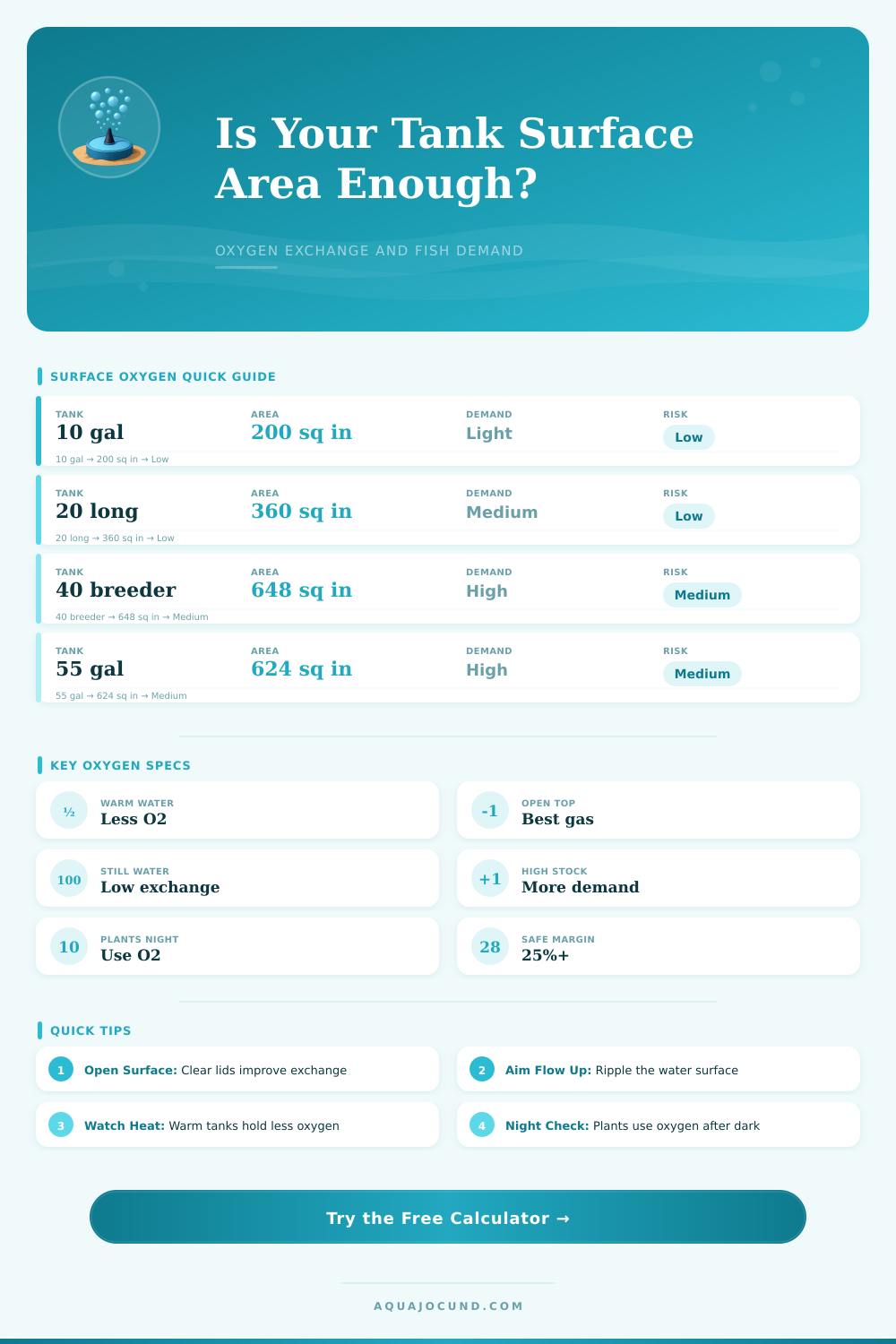
| 10 gallon | 20 x 10 in | 200 sq in | Best with light stock or ripple |
| 20 long | 30 x 12 in | 360 sq in | Excellent oxygen ratio |
| 29 gallon | 30 x 12 in | 360 sq in | Taller tank, same surface as 20 long |
| 40 breeder | 36 x 18 in | 648 sq in | High exchange footprint |
| 55 gallon | 48 x 13 in | 624 sq in | Long surface, modest width |
| 75 gallon | 48 x 18 in | 864 sq in | Strong margin for large fish |
When you purchase a tank, there’s one thing you probably care about, its volume. If you’re looking to house some fish, you’re checking the glass for the gallons because you believe that volume is the only thing that matters for their well being. In most cases, it isn’t. Most of the time, the limiting factor in a marine or freshwater environment is not what size tank you own but rather amount of surface area available for gas exchange. Gas (oxygen) can absorbs into your system from the top edge, where air meets water.
As such, a shallow wide tank will generally hold more active livestock than a tall narrow aquarium of equal volume. That’s the difference between a thriving ecosystem and a slow, lingering death by suffocation. It’s easy stuff, but the physics can be harsh. Tropical fish keepers gets tripped up on this each summer; warm water simply contains far less dissolved oxygen then cool water. When temperature rises into the eighties Fahrenheit (or higher), the saturation level decreases while biological demand increases at the same time. In other words, your fish need to breathe more in warmer water and food they eat decays faster, leading to increased bacterial consumption of whatever scant supply remains.
Why Surface Area Is More Important Than Tank Size
To reflect the combined stressors involved, the above calculator allows you to input an estimate of your biomass and then enter a particular range of water temperatures. It doesn’t solely consider size of your tank, it factors in its contents as well, recognizing their metabolic truth. Note that tool prompts you about plant load and surface agitation, as both variables changes the baseline capacity radically.
The former is pretty self-explanatory, but the latter is different: a still surface affects renewal much like a layer of skin that restricts it, regardless of tank size. Introduce some type of surface ripple such as an air stone or spray bar and you’ve effectively reset the gas exchange cycle with each bubble burst. A dense plant load brings a tricky variable into play. Daytime plants gives off O2 through photosynthesis (a bonus). However, they flip into respiration mode at night, when they start to compete head-to-head with your livestock for leftover dissolved oxygen. New planted tank owners makes the mistake of ignoring this daily swing and waking up one morning to find their fish gasping in a tank with pristine water parameters just hours earlier.
What you get is safety margin percent, your early warning system. If it’s high, that means there’s some wiggle room (literally and figuratively). Maybe you can take your time adding meds that drop DO down a little bit or bump the temp up or down by a degree or two. If it’s low/negative, you’re in danger of pushing it over the edge with only slight changes. Don’t expect perfection here. But don’t ignore red zone either. The reference tables on the page will give you an idea of how the ratios play out practicaly, i.e., what they mean based off different tank shapes and their efficiencies.
Know the footprint of your tank. Although a bow-front aquarium might look awesome from the outside, it’s frequently at the expense of useable surface area in favor of visual depth. Similarly, cylinder tanks tends to have smaller footprints than similarly sized rectangle ones. This means they will have narrower widths available for open space. You can either work around this by having more robust filtration turnover and/or some sort of aeration device. Use the calculator to find out how much you need so you don’t guess at your filter strength.
But really, it’s not so much about volume as it is about maintaining the invisible boundaries in an aquarium. So instead of reacting by trying to solve problems, you should of plan a system for maximum surface interaction with the air/water interface. This way, your fish can maintain their comfort level regardless of lights going off or the heater coming on. There is enough reserve built into them to do so without your intervention. You pay attention to that surface area, and rest of the tank tends to do the same.