🐟 Fish Swimming Length Ratio Calculator
Measure tank length against adult fish size, activity level, group load, and usable open swimming space.
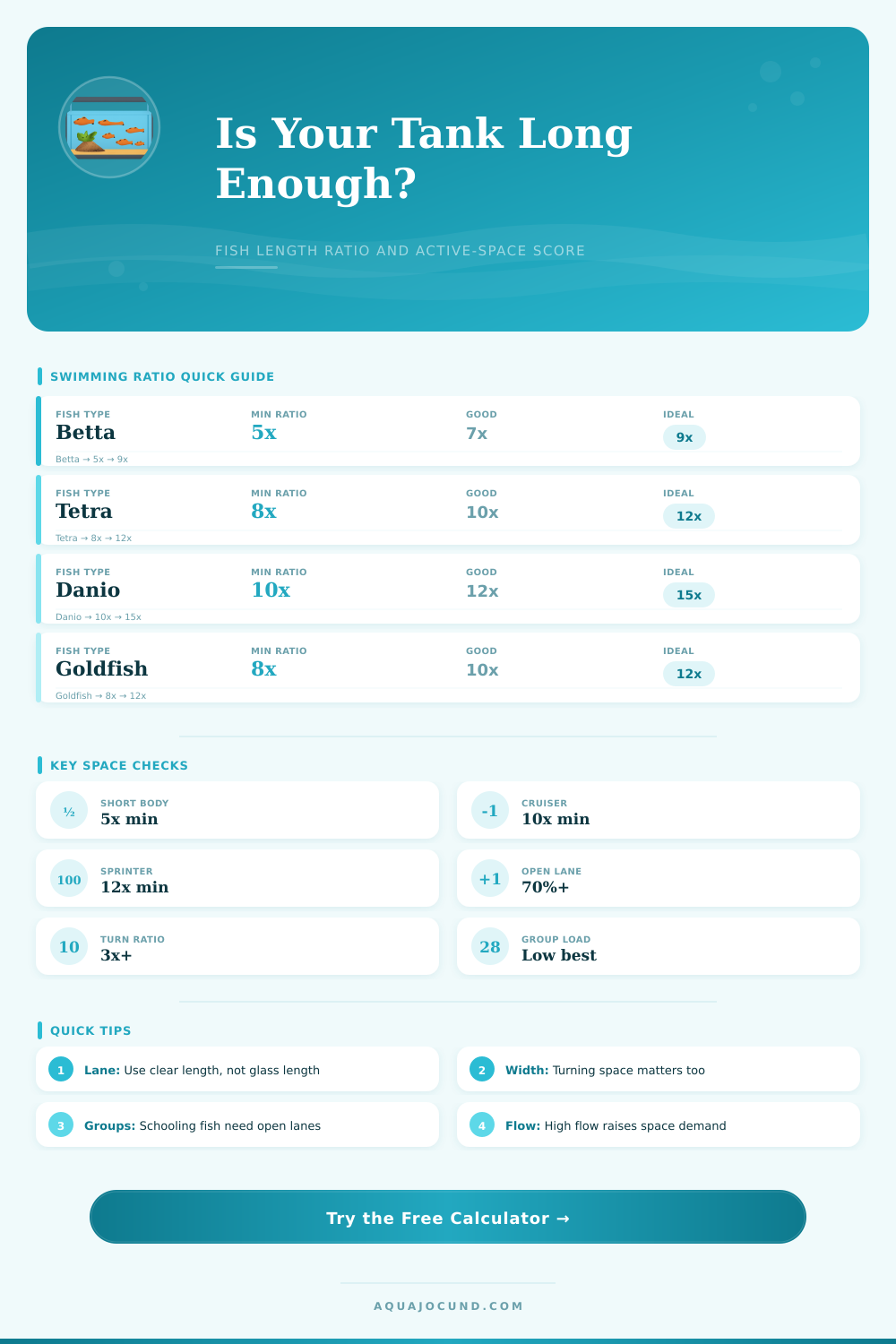
| Fish Style | Examples | Minimum Ratio | Comfort Ratio | Ideal Ratio |
|---|---|---|---|---|
| Compact low activity | Betta, honey gourami | 5x | 7x | 9x |
| General community | Tetra, rasbora, platy | 8x | 10x | 12x |
| Active schooler | Danio, barb, rainbowfish | 10x | 12x | 15x |
| Deep body cruiser | Angelfish, discus | 7x | 9x | 11x |
| Heavy pond fish | Goldfish, koi | 8x | 10x | 14x |
| Body Shape | Turn Width Target | Lane Penalty | Best Tank Footprint |
|---|---|---|---|
| Compact / Flexible | 2.5x body length | Low | Standard rectangle |
| Torpedo / Streamlined | 3.0x body length | Medium | Long tanks |
| Deep Bodied | 3.5x body length | Medium | Wide rectangles |
| Long Bodied | 4.0x body length | High | Long shallow tanks |
| Heavy Bodied | 3.5x body length | High | Wide pond-style tanks |
| Tank | Typical Length | Good For | Fish Length at 10x |
|---|---|---|---|
| 10 gallon | 20 in / 51 cm | Betta, small rasboras | 2.0 in |
| 20 long | 30 in / 76 cm | Tetras, cory groups | 3.0 in |
| 29 gallon | 30 in / 76 cm | Guppies, danios | 3.0 in |
| 55 gallon | 48 in / 122 cm | Angels, barbs | 4.8 in |
| 75 gallon | 48 in / 122 cm | Rainbows, goldfish | 4.8 in |
| 125 gallon | 72 in / 183 cm | Silver dollars | 7.2 in |
| Modifier | Low Impact | Medium Impact | High Impact |
|---|---|---|---|
| Decor openness | 90% lane | 75% lane | 45% lane |
| Current strength | Calm | Normal | River style |
| Group load | 1-6 fish | 7-15 fish | 16+ fish |
| Safety margin | 5% reserve | 15% reserve | 35% reserve |
- A 10x ratio means the fish has ten body lengths of clear forward swimming lane.
- Use adult length, not purchase size. Juvenile fish can outgrow an acceptable score quickly.
- For fast schooling fish, the longest open lane matters more than total water volume.
- Move tall hardscape toward the back corners to preserve a front swimming lane.
- Choose long tanks over tall tanks for danios, barbs, rainbows, goldfish, and koi.
- If turning ratio is low, reduce group size or choose smaller adult species.
How much space does it require? It requires more than you consider when you purchase a fish. It requires more than you realize because you’re lured by a shiny colored specimen in a store tank. Don’t just assume that if a tank fits on your shelf, it’s a good choice. All that matters is that it fits on that shelf in a little cube tank at your house.
But realy, the problem isn’t so much how much water it will have in total. The problem are the shape of the tank. Fish don’t swim by liters. They swim by width and length; they need to be able to turn around and extend their bodies lengthwise to go forward.
Why Tank Shape Matters More Than Size
More gallons = More room for fish.” That’s what most hobbyists thinks when they is looking at tanks. They’re right…usually. A 30 gallon tank could be long and thin. But with only a dozen inches across on the top, your active fish will not have enough space to swim freely. The calculator break down real space from just gallons of water. It makes you consider how far apart the glass walls are, not just the overall volume of water.
Length ratio is the main metric, and it reflects the distance in body lengths an adult fish travels until it hits a barrier. For example, if your fish is a three inch tetra, you’d like at least (ideally) thirty inches of space between them. Of course, since they’re not alone but are part of a school, keeping multiple fish rapidly escalates space requirements. Each one should of been afforded their own personal space so as not to stress each other out.
To adjust the basic requirement, consider the activity level. Running around all day? A zebra danio is a running fish. It need a space at least ten times its own length to feel comfortabley. Patrolling a small area? A betta has no problem with a five-to-seven times ratio. There is forward motion and enough room to turn.
Fish have momentum and won’t stop on a dime. Many aquarists overlook the fact that because fish cannot brake, they ends up colliding with things. They can move straight ahead, but not always turn easy. In a long tank that’s quite narrow, it’s a tight-cornering situation that stresses their fins and makes collisions more likely. The turning ratio in the results help determine if your tank width allows safe turning moves for the type of body shape you choose. Streamlined shapes don’t require as much lateral space to pivot than deep-bodied ones (e.g., angelfish).
Too much decor will also take up lots of swimming room. Yes, that forty-eight inch tank may seem spacious, but how much of that is realy available? If your middle section has a thick jungle of plants and towering rockwork, then maybe your actual open swim lane is just fifteen inches long. The input on the open swimming lane takes this into consideration. A seventy-five percent is saying you’ve cleared out most of the front section. A forty five percent suggest your tank is heavily decorated. Swimming is more like weaving around stuff.
Current strength also impacts space needs. Turbulent water dictate larger, unimpeded runs for fish to hold position while weak flow allows them to cruise more slowly around small spaces. For sensitive species such as breeding fish, it’s good practice to provide some leeway. That is, create additional space as a buffer just in case you miscalculate your decor layout or one of your fish outgrows its enclosure.
All of this gets combined into one number, the verdict score. This tell you whether or not your set up is appropriate for the life stage of the fish you’re housing. If the score is low, that doesn’t necessarily indicate a bad tank. Instead, it shows a mismatch between your tank and how the animal move. The solution isn’t always to buy a larger tank. It’s sometimes as simple as removing view from front and placing large rocks in the far corners.
The conclusion is that a contented fish will be both relaxed and active. He’ll swim with purpose; he won’t dart around. You have matched the natural behavior of the animals to the geometry of your tank by quantifying the real clear space in it. Not simply counting the gallons. The fish don’t read the gallon number on the glass. The fish only care about how far apart the walls is.