Aquarium Territory Space Calculator
Estimate territorial footprint, line-of-sight breaks, floor area, and aggression buffer before fish start defending space.
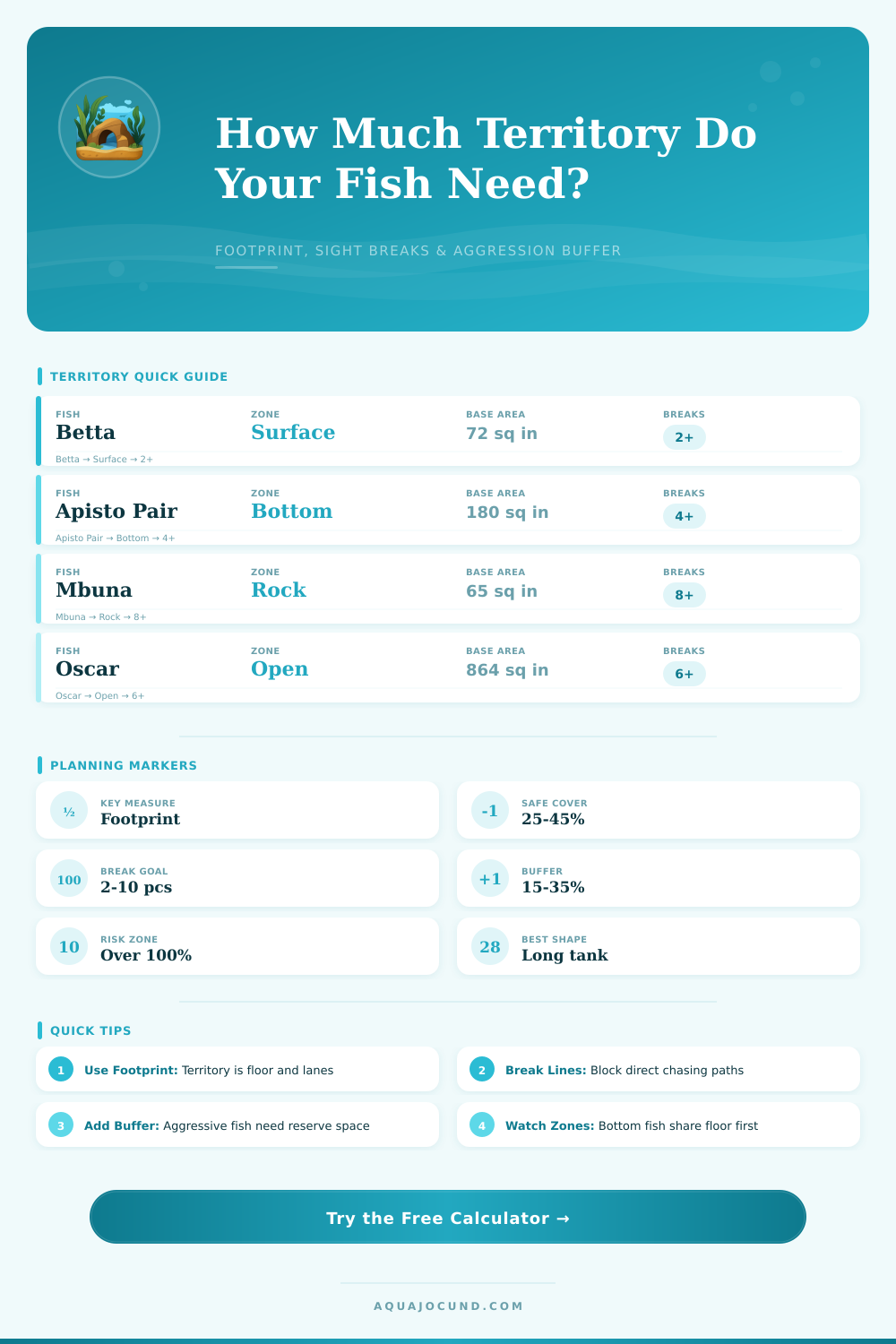
| Profile | Territory Basis | Minimum Breaks | Best Layout |
|---|---|---|---|
| Betta or dwarf gourami | 72-90 sq in per male | 2-3 floating or vertical breaks | Plant clusters near surface |
| Apistogramma pair | 160-220 sq in per pair | 4 caves/wood breaks | Separated cave entrances |
| Shell dwellers | 45-65 sq in per fish | Shell fields in clusters | Open sand between colonies |
| Corydoras group | 28-36 sq in per fish | Soft cover, not barriers | Long open bottom lanes |
| Mbuna cichlids | 55-80 sq in per fish | 8+ rock sight blocks | Stacked rock territories |
| Angelfish pair | 430-520 sq in per pair | 4 tall vertical breaks | Broad plants and tall wood |
| Oscar or large cichlid | 800-950 sq in per fish | 6 heavy landmarks | Open swim lane plus refuge |
| Tank | Footprint | Floor Area | Territory Note |
|---|---|---|---|
| 10 gallon | 20 x 10 in | 200 sq in | One small territory |
| 20 long | 30 x 12 in | 360 sq in | Better than tall tanks |
| 29 gallon | 30 x 12 in | 360 sq in | Volume helps, floor is same |
| 40 breeder | 36 x 18 in | 648 sq in | Strong territory footprint |
| 55 gallon | 48 x 13 in | 624 sq in | Long chase lanes need breaks |
| 75 gallon | 48 x 18 in | 864 sq in | Good large cichlid base |
| 125 gallon | 72 x 18 in | 1296 sq in | Excellent lineal territory |
| Break Type | What It Blocks | Best For | Planning Value |
|---|---|---|---|
| Tall plants | Surface and midwater view | Bettas, gouramis, angels | Soft break |
| Rock stack | Direct bottom chase line | Mbuna, shell dwellers | Hard break |
| Driftwood root | Diagonal line through tank | Apistos, community fish | Medium break |
| Cave cluster | Claimed shelter entrances | Dwarfs, plecos, cichlids | Territory anchor |
| Open sand lane | Nothing; it separates zones | Shell dwellers, corydoras | Neutral buffer |
| Situation | Space Multiplier | Extra Breaks | Warning Sign |
|---|---|---|---|
| Calm juvenile group | 0.85x | Normal target | Brief posturing only |
| Adult mixed community | 1.00x | One per territory edge | Short chases at feeding |
| Breeding pair | 1.18x to 1.35x | Two near nest zone | Guarding one corner |
| High aggression species | 1.35x | Multiple hard breaks | Repeated pursuit |
| Persistent bully | 1.55x | Rebuild layout or separate | Fish pinned at surface |
The first thing is the tank. You’re going to buy the tank. It’s the one thing in your mind that represents all the hope you place into this hobby. It gleams like a rectangular prism of potential as it stands on its grand stand in the corner of your room. And somewhere inside your mind, you picture yourself with fish swimming around in it…fighting for what? You don’t even consider that yet.
That’s another error many aquarists make when getting an aquarium. Volume. That’s the wrong word. Aquarium keepers calculate how many liters/gallons there tank holds. How much water is in there. They believe more water = more space. But the truth of it is, territorial fish don’t give a flying f#@k about cubic capacity. They care deeply about floor area.
Why Floor Space Matters More Than Water Volume
Thirty gallon tanks comes in all shapes and sizes. A tall, narrow tank might hold thirty gallons of water, but if base is only twelve by twelve inches, it offers no more room for a betta to stake his claim then a shallow dishpan with the same footprint. The height are just empty space above activity. That might be good for oxygen exchange, but it does nothing to prevent two cichlids from staring each other down on an empty stretch of sand.
And the calculator above do all of the math for you. Simply input the inches of your tank’s size. You’ll notice it calculates usable territory zones based off actual size of the tank, not the number of gallons. Then, pick which shape it is and choose your species profile. Then the calculator spits out a number. The maximum amount of territories you can safely keep for that particular type of fish based on its normal behaviors.
Why? Because different species defend space differently. Mbuna cichlids from Lake Malawi defend rock piles along the bottom. A betta requires vertical cover towards the top and some surface area. So if you place a betta in a tank made for bottom dwelling fish, or vice-versa, regardless of how much water you have, math isn’t going to work. That’s why this tool consider the differences in zones so you aren’t left with stressed fish pacing around a space that they feel is too small for them.
The other half of the equation are sight lines. When a fish gets spooked in the wild, it can hide in some complex rock work or thick vegetation. It has somewhere to hide. In your bare bottom aquarium with white sand and gravel, what does it have? Nothing. There’s no place to hide, the whole tank becomes one long chase lane. What do you think happens then?
There are breaks in those sight lines. These include things like clumps of tall plants, root masses on driftwood, and rocks. Become barriers. Fish can’t always see each other, and this stops aggression. A fish won’t start a fight if it doesn’t know the other fish is even there. This is where table on the page comes in. It shows you how many break pieces you should of had based on your floor area. Just for aggressive species, you may require eight or ten distinct barriers to maintain peace.
It’s not just about space, however. There’s also issue of buffer space. Hormones change during breeding season. Fish will grow. And, well… Fish change. The tank you think is plenty big enough now may seem like a sardine tin in three months. That is why there is an aggression buffer slider on the tool. If you have a breeding pair, know some bully fish? Add some extra reserve space. Ten percent more space then what’s needed can mean the difference between your community being a bunch of happy campers versus going to war each night over who gets to use which end of a cave.
Don’t confuse quantity with quality. Just because you siphon off half the water doesn’t mean that five gallon bucket is anything but a bucket. Pay attention to length and what’s on the floor. Count those sight breaks. You should plan for the worst behavior. You’ll dump ‘em in that tank when you get home from the store and they ain’t gonna appreciate having a lot of water over their heads. They’re gonna appreciate having somewhere to go when it gets tense. Territory has nothing to do with the amount of emptiness; it has everything to do with the number of places to go by yourself.