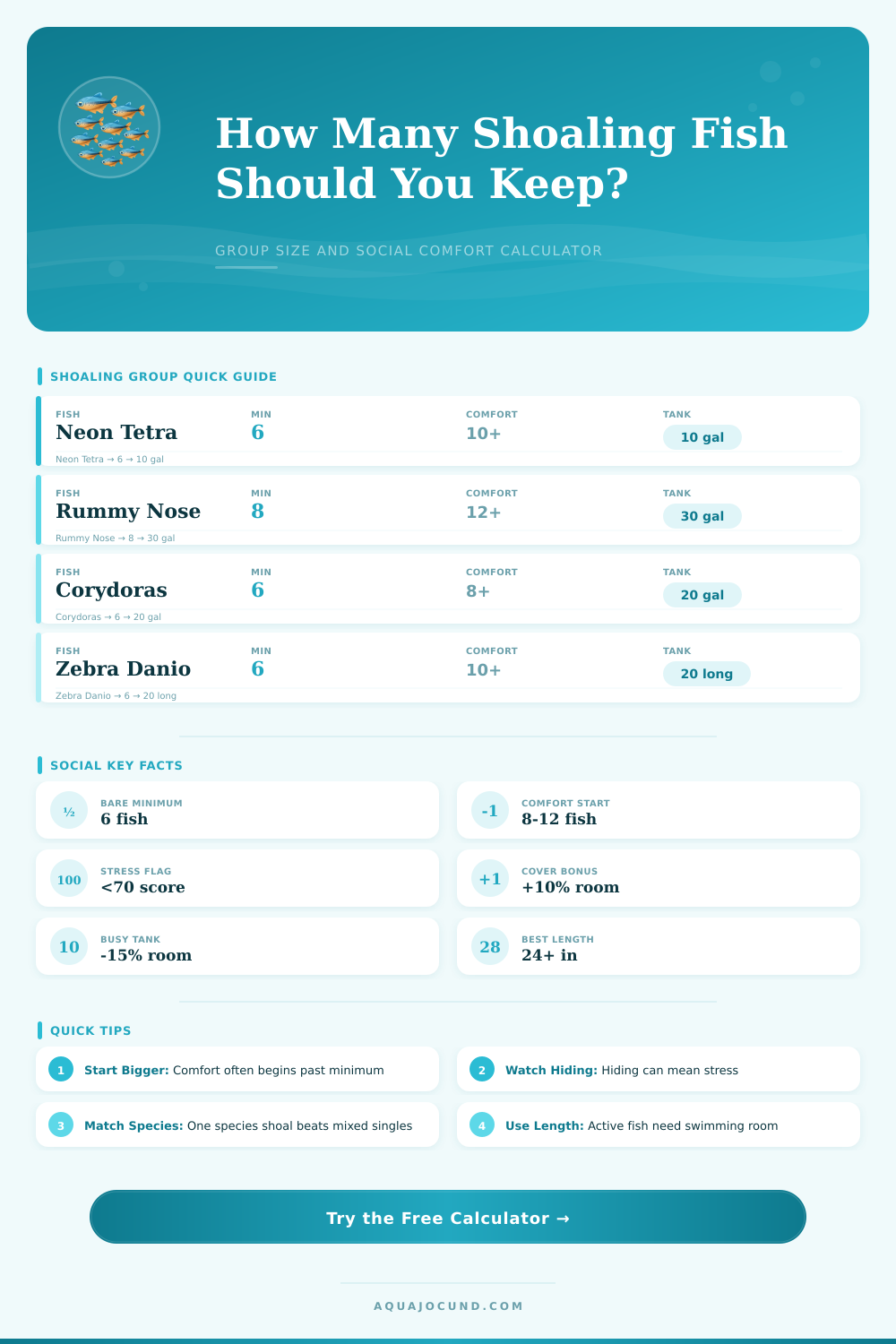
Shoaling Group Size Calculator
Size a peaceful group by species, tank space, swimming room, cover, and social pressure.
Social Comfort Result
| Species | Social Style | Minimum | Comfort Target | Best Tank Style |
|---|---|---|---|---|
| Neon Tetra | Tight midwater shoal | 6 | 10 to 14 | Planted 10 to 20 gal |
| Cardinal Tetra | Tight midwater shoal | 6 | 10 to 16 | Warm planted 20+ gal |
| Rummy Nose Tetra | Very tight active shoal | 8 | 12 to 18 | Long 30+ gal |
| Harlequin Rasbora | Peaceful loose shoal | 6 | 10 to 14 | Planted 15+ gal |
| Zebra Danio | Fast active shoal | 6 | 10 to 14 | Long cool 20+ gal |
| Corydoras Catfish | Bottom social group | 6 | 8 to 12 | Soft-bottom footprint |
| Cherry Barb | Loose mixed shoal | 6 | 8 to 12 | Planted 20+ gal |
| Otocinclus Catfish | Quiet grazing group | 4 | 6 to 8 | Mature planted tank |
| Tank Size | Common Dimensions | Social Use | Small Tetra Group | Active Fish Note |
|---|---|---|---|---|
| 10 gal | 20 x 10 x 12 in | One small shoal | 6 to 10 | Avoid very fast swimmers |
| 20 high | 24 x 12 x 16 in | One comfort shoal | 10 to 14 | Moderate length only |
| 20 long | 30 x 12 x 12 in | Better swim lane | 12 to 16 | Good for danios |
| 29 gal | 30 x 12 x 18 in | One large shoal | 14 to 20 | Watch surface area |
| 40 breeder | 36 x 18 x 16 in | Large shoal or bottom group | 18 to 26 | Excellent footprint |
| 55 gal | 48 x 13 x 21 in | Display shoal | 22 to 32 | Strong swimming length |
| Comfort Score | Group Reading | Likely Behavior | Best Correction | Risk Level |
|---|---|---|---|---|
| 90 to 100 | Excellent | Open swimming, natural spacing | Keep stable routine | Low |
| 75 to 89 | Good | Normal shoaling with minor caution | Add cover if exposed | Low to moderate |
| 60 to 74 | Borderline | Hiding, loose group, skittish turns | Add fish or reduce pressure | Moderate |
| Below 60 | Uncomfortable | Stress, chasing, panic, weak feeding | Upgrade group or tank plan | High |
| Adjustment | Effect | When It Matters | Calculator Impact | Practical Limit |
|---|---|---|---|---|
| Dense cover | Reduces perceived risk | Small tetras, rasboras, barbs | Raises capacity and score | Still leave swim lanes |
| Busy tankmates | Raises social stress | Community tanks with boisterous fish | Lowers score and capacity | Do not crowd to compensate |
| Long footprint | Improves schooling movement | Danios and rummy nose tetras | Raises swim-room factor | Height cannot replace length |
| Mature filtration | Improves stability | Large groups and delicate species | Raises safe ceiling | Water changes still matter |
If you have seen a school of neon tetras suspended in your tank, they may appear more as disconnected marbles than a tight grouping. It’s not a comfortable sight. Tetras, like all fish, are designed to be social animals. How they clusters says something about how they is feeling in their own nervous systems. Tight clusters indicate safety. If they cling to the glass or scatter, they are looking for a threat they cannot see. Body language precedes trouble if you know what to read.
Know the size of your group. When you input your tank sizes and what type of species you want, the calculator will do all the math for you (see below). You don’t have to guess at your social space based off volume. That’s where the hobby starts, understanding what your inputs represent. Your fish aren’t swimming through cubic feet. They’re swimming along lanes.
How to Make Fish Happy in a School
For instance, an active swimming danio has more swimming space in a 20g long than it does in a 20g cube of equal size. That’s why length is weighted heavily in the tool. Fish can school naturaly along the horizontal plane; they can’t do it vertically as well.
When many people begin, they settles for the absolute minimum number of fish suggested by their local pet store. It may legally allow you to have six fish in your tank but that doesn’t mean that’s comfortable for those fish. Dilution effect and confusion are two ways larger numbers offers protection from predation in the wild. Apply that to your home aquarium and you’ll notice less stress hormones and increased color displays. Many times when you push beyond the minimum and into the comfort range, you’ll notice a clearly happier shoal. Having ten tetras is about more than just having more fish then six; it is the difference between a confident community and skittish individuals.
Social supportable fish, Environment matters significantly as well. Cover helps break lines of sight and this lowers the perceived threat level for fish. Without cover, fish are more likely to be threatened so they require greater buffer distances to feel comfortable. The calculator accounts for cover because densely planted tanks supports tighter groupings than those with no cover. This allows for more fish without causing higher stress from crowding.
Even in a large tank, adding rambunctious tankmates increases social pressure. Even a well-behaved shoaling species can still experience problems if forced to shares the water with aggressive, fast moving tankmates that disrupt its flow. More than folks realize, water quality and filtration stability are key. Because your biofilter is established, it can handle heavy feeding consistently and prevent ammonia spikes. Even a small group will show its stress by not eating or just being lethargic when the filtration isn’t up to par. Consistency promotes social stability so the maintenance routine is a factor for this tool. How can they be comfortable in a shoal if the environment is unstable?
The reference table above brings all this back to reality. Some species can be kept in smaller numbers but others needs large numbers to behave naturaly. For example, rummy nose tetras are well known for being very skittish if kept in a pair. They will hide and/or fade in color. However, when they reach a certain number, they no longer act as shy lurkers; rather, they become active swimmers, a visible difference that tells you you’ve reached the tipping point.
Keeping a shoal requires observation and patience. The numbers are your beginning reference point but the fish will ultimately be the judge. They tell you if you’ve done it right. Do they freely move about and interact with their own kind? Then yes! Are they hiding and chasing each other? That’s a no and something must adjust. Typically tinkering with one variable at a time will uncover the issue quicker than completely overhauling everything. Start with space, perfect the cover, and let social cues show how big the community should of been. You’re striving for an environment that allows them to thrive together.