Nerite Snail Egg Calculator
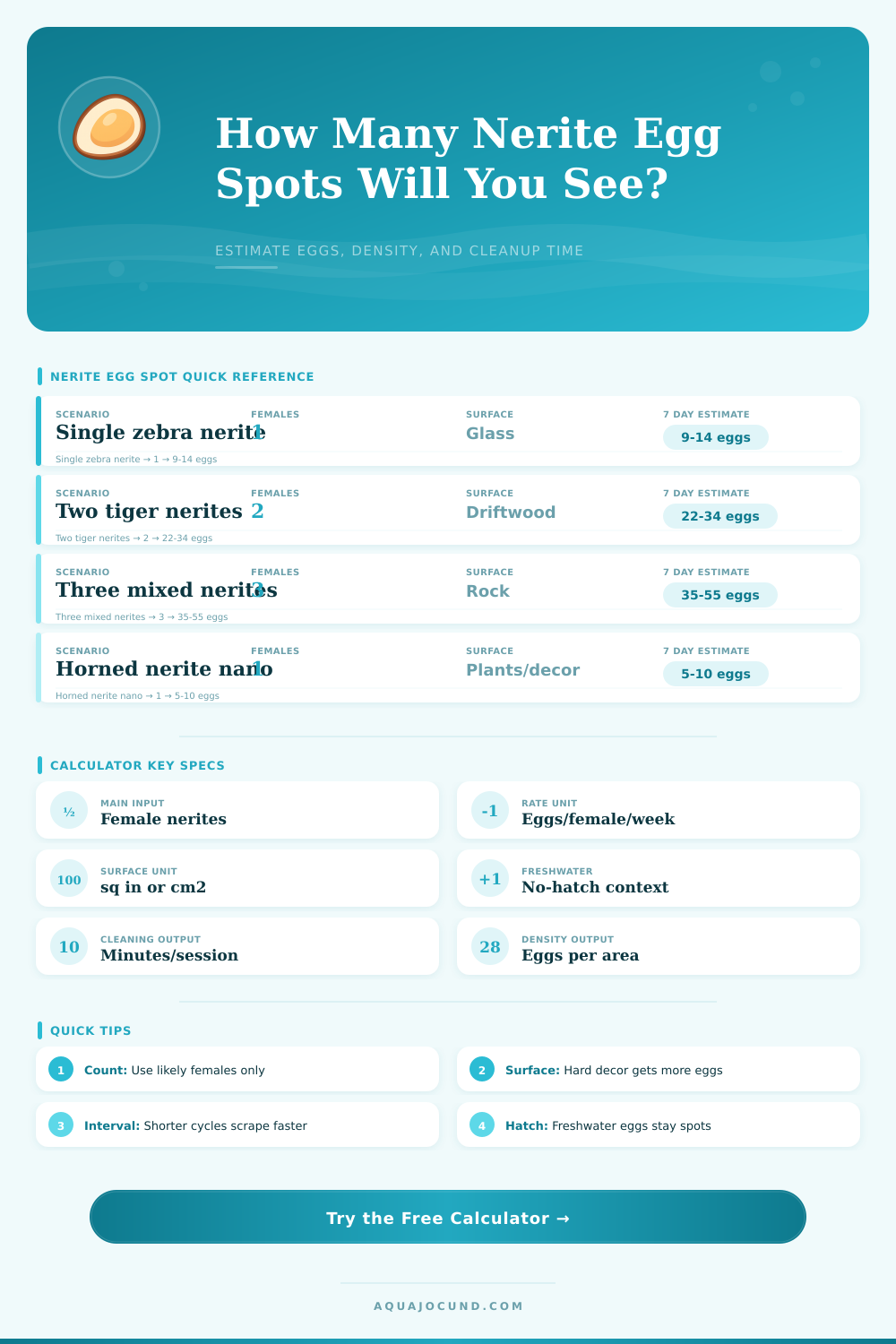
Estimate egg spot buildup, surface density, no-hatch context, and cleaning time from females, surface choice, temperature, salinity, and interval.
| Species / Pattern | Planning Rate | Common Egg Placement | Calculator Note |
|---|---|---|---|
| Zebra nerite | 12 eggs/female/week | Glass, stone, wood | Balanced default for common aquarium nerites. |
| Tiger nerite | 11 eggs/female/week | Glass and hardscape | Often similar to zebra in cleanup planning. |
| Horned nerite | 8 eggs/female/week | Small decor and leaves | Lower planning rate for smaller adults. |
| Black racer nerite | 14 eggs/female/week | Open glass and stone | Higher planning rate for active larger grazers. |
| Red racer nerite | 13 eggs/female/week | Smooth hard surfaces | High-visibility egg spotting in displays. |
| Olive nerite | 9 eggs/female/week | Decor and low glass | Moderate planning rate. |
| Spotted nerite | 10 eggs/female/week | Mixed rock and wood | General mid-rate estimate. |
| Mixed/unknown | 11 eggs/female/week | Mixed surfaces | Use when sex or exact species is uncertain. |
| Surface | Deposit Multiplier | Visible Share | Removal Difficulty |
|---|---|---|---|
| Front/side glass | 0.90x | 80% | Fast with scraper or magnet. |
| Smooth rock | 1.10x | 65% | Moderate brushing. |
| Rough lava/dragon stone | 1.25x | 45% | Slow because eggs sit in pits. |
| Driftwood | 1.35x | 50% | Slow; texture hides spots. |
| Ceramic cave/tile | 1.05x | 70% | Moderate if removable. |
| Plastic decor/intake | 1.00x | 75% | Fast when removable. |
| Broad plant leaves | 0.55x | 60% | Usually wipe gently or leave. |
| Mixed hardscape | 1.15x | 58% | Average of glass, rock, and decor. |
| Context | Range | Egg Estimate Effect | Hatch Context |
|---|---|---|---|
| Cool freshwater | 68-72°F, 0-1 ppt | Lower activity estimate | Egg capsules usually remain as spots. |
| Tropical freshwater | 74-80°F, 0-1 ppt | Normal activity estimate | No-hatch context for typical tanks. |
| Warm freshwater | 81-84°F, 0-1 ppt | Slightly higher activity estimate | Still no-hatch context for freshwater. |
| Low brackish | 2-5 ppt | Similar egg spotting estimate | Larval success still unlikely. |
| Brackish window | 5-15 ppt | Estimate flags hatch context | Possible larval context, not a success prediction. |
| Marine strength | 30-35 ppt | Estimate is for spotting only | Outside normal freshwater cleanup planning. |
| Interval | Best Use | Expected Buildup | Planning Note |
|---|---|---|---|
| 2-3 days | Display glass | Low visible density | Best for keeping new spots soft and obvious. |
| 7 days | Normal weekly maintenance | Moderate visible density | Good default for most tanks with one or two females. |
| 14 days | Hardscape checks | High spot count | Plan extra brushing on rock and wood. |
| 30 days | Decor removal session | Heavy accumulation | Use removable decor assumptions for time estimates. |
Nerite snail egg capsules contains the eggs of female nerite snail and contain tiny white capsules that are laid on various surfaces in a water tank. The freshwater environments in which nerite snails lives will not allow the egg capsules to hatch. Because the egg capsules do not hatch in these environments, the presence of the capsules has no relation to population control for the nerite snail tank.
The presence of the egg capsules can, however, help determine the number of capsule that will appear in the tank and the time required to remove the capsules. The number of female nerite snails that live in the water tank are the first input into the estimation process. Because there are no physical difference between male and female nerite snails, one can determine the total number of nerite snails and divide by two as an estimation of the number of females.
How to Estimate and Remove Nerite Snail Egg Capsules
Additional factors that can impact the number of egg capsules that the female nerite snails lay include the temperature of the water, the feeding level of the snails, and the salinity of the water. However, while salinity has an impact upon whether the larvae from the eggs survive in the water, it doesnt have any impact upon the number of capsules that the female nerite snails produce. The type of surfaces that are present in the water tank will also impact the number of egg capsules that can be visible in the tank.
For instance, if the tank feature smooth glass surfaces, the capsules will be visible on each of the snails. In contrast, rougher type of decor, such as lava rock or driftwood can hide many of the capsules made by the female nerite snails. The estimation process accounts for these difference to calculate the number of visible capsules rather than the total number of capsules produced by each female nerite snail.
The time that is required to remove the egg capsules can be calculated from the number of visible capsules and the type of decorative surfaces in the tank. For instance, one can easily calculate the number of capsules that can be removed from flat piece of glass using a magnet. However, the snails may hide more capsules within the grain of driftwood that can be clean using a toothbrush, which will require more time.
In addition to manually removing the capsules, you can soak the tank in water to remove the capsules from removable decorations. However, soaking the decorations will take more time than using a magnet. The shorter the intervals during which the tank is clean, the more easy the removal of the capsules will be.
However, the longer the intervals between cleaning the tank, the more difficultly the effort to remove the capsules will be. Many people may believe that the more female nerite snails that are present in the tank the more work that must be performed to remove there eggs. However, the visibility of the capsules has a much greater impact upon the effort that must be expended to care for the tank.
For instance, a tank that contains many crevices where the capsules may hide will contain fewer visible capsules than a tank that only has one pane of clean glass. Thus, the amount of labor that is required to care for the tank is relate to the number of visible capsules. An estimate takes these factor into consideration to provide an accurate estimate of the effort that will be required to manage a tank with nerite snails.
The presence of the egg capsules does not have any impact upon the water quality of the tank. The removal of the capsules is based off the aesthetics of the tank rather than the need to control the population of the nerite snails. However, the type of surfaces within the tank can produce more capsules than others if the level of biofilm on those surfaces are high.
Based upon these factors, it is possible to use an estimate of the number of nerite snail egg capsules that will appear to make decisions regarding the management of the tank. For instance, it is possible to use such estimates to determine the impact that adding more female nerite snails will have upon the number of visible capsules. Similarly, it is also possible to determine the impact that changing the decor of the tank to one with rougher texture will have upon the number of capsules.
Finally, it is also possible to utilize such estimates to determine the impact that increasing the length of time between water tank cleanings will have upon the effort that is required to perform such a task. Through the use of such estimates it is possible to plan for the presence of the capsules from the female nerite snails and to avoid having to guess as to when the snails will lay their egg in the tanks glass.