Snail Population Growth Calculator
Project freshwater aquarium snail numbers from species, food level, temperature, egg survival, and regular control removals.
Projected Population
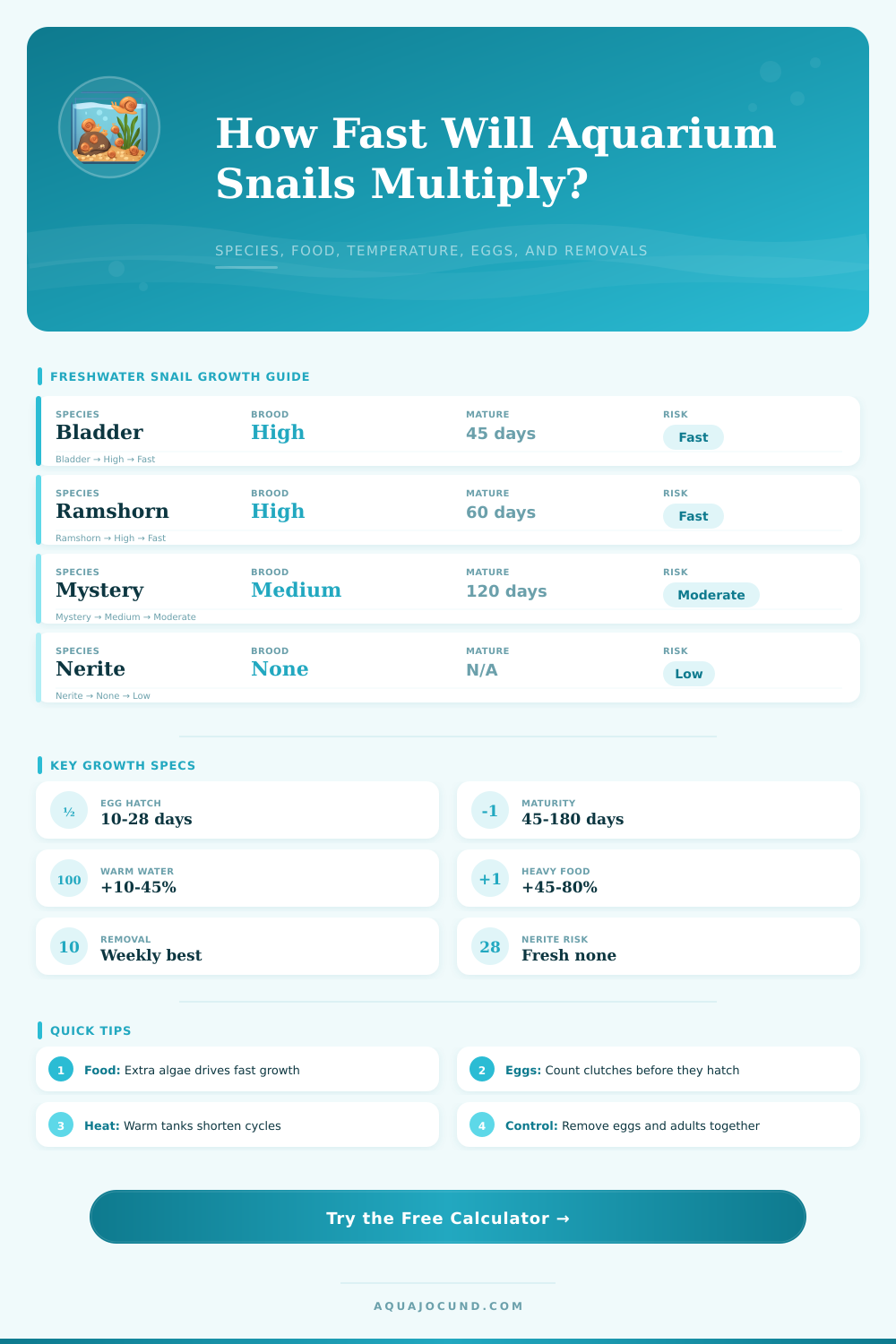
| Species | Typical brood | Maturity | Freshwater growth note |
|---|---|---|---|
| Bladder snail | 10-30 eggs | 45 days | Very fast when food is high |
| Ramshorn snail | 10-25 eggs | 60 days | Fast egg-layer in planted tanks |
| Pond snail | 15-40 eggs | 55 days | Responds strongly to extra food |
| Malaysian trumpet snail | Live young | 90 days | Hidden substrate colony growth |
| Mystery snail | 50-120 eggs | 120 days | Needs viable above-water clutch |
| Nerite snail | Eggs only | N/A | Eggs do not hatch in freshwater |
| Rabbit snail | 1-2 young | 180 days | Slow live-bearing growth |
| Assassin snail | 1-4 eggs | 150 days | Slow breeder, often used for control |
| Factor | Lower growth | Baseline | Faster growth |
|---|---|---|---|
| Food and algae | Sparse grazing | Balanced feeding | Heavy feeding or waste |
| Temperature | Below range slows hatch | Mid species range | Warm stable water |
| Egg survival | 0-15% | 25-45% | 55% or higher |
| Density | Near capacity slows growth | Room to expand | Large tank, low starting count |
| Tank | Volume | Watch level | Control trigger |
|---|---|---|---|
| 5 gal nano | 19 L | 5-10 snails | 15+ visible |
| 10 gal betta | 38 L | 10-20 snails | 30+ visible |
| 20 gal planted | 76 L | 20-45 snails | 60+ visible |
| 40 breeder | 151 L | 40-90 snails | 120+ visible |
| 55 gal community | 208 L | 55-120 snails | 165+ visible |
| 75 gal display | 284 L | 75-160 snails | 225+ visible |
| Control style | Best for | Model effect | Limit |
|---|---|---|---|
| Adults first | Visible large snails | Cuts active breeders | Eggs may still hatch |
| Mixed sizes | Routine trap checks | Removes adults and juveniles | Misses hidden clutches |
| Eggs plus adults | Glass and hardscape checks | Reduces next hatch wave | Requires frequent inspection |
| Extra monthly percent | Predators or manual thinning | Applies steady pressure | Cannot fix heavy overfeeding alone |
Aquarium snail populations can often multiply at a rate that exceeds the expectation of the individual owner. Once the aquarium conditions are suitable for breeding, the snails will begin to multiply. A few snails may be visible on the aquarium glass, but the populations will grows to the point where clusters of snails can be seen within a few week.
The increase in snail populations within an aquarium is often unexpected, as the snail populations typically reach there number sooner then the owner may have planned. There are several factors that play a role in the growth of the snail population within an aquarium. The owner can all account for these factors in the calculator if the owner enters the current numbers of snails in they aquarium.
Why snails multiply fast in your aquarium
The type of snail species in the aquarium will play a key role in the rate of the snail population growth. Species like bladder snails and pond snails will produce numerous clutches of eggs. Additionally, bladder snail and pond snail populations reaches the breeding size quick.
Thus, their population within the aquarium will increase rapidly. Other species, like ramshorn snails, will also add to the number of snails in the aquarium if there is an abundance of the algae that they eat. Mystery snail species will take longer to mature into the reproductive life stage.
Additionally, the snails must position the eggs that they lay above the waterline in the aquarium. Thus, their population will increase more slow than other snail species. Nerite snail species lay eggs that do not have the ability to hatch in the aquarium using freshwater.
Thus, nerite snails are the only type of snail included in the aquarium that will not contribute to the growth of the snail population by itself. These difference between snail species impact the population growth in the aquarium as defined in the calculator. Factors like the food supply for the snails in the aquarium and the water temperature will also impact the rate of the snail population growth.
An abundance of algae will lead to the snails producing more clutches of eggs, as they require the food to mature. The same factor of abundant algae will increase the chances of the snail eggs hatching. Additionally, cooler water temperature will impact the snail life cycle, as each of the stages in the life cycle of the snail will be lengthened.
These factors are included in the snail population calculator for the owner to account for both the food supply and the water temperature in there aquarium. Additionally, the percentage of egg clutches that hatch will also impact the snail population. The owner can also manipulate this percentage in the calculator to account for the number of snail clutches that are seen in the aquarium and protect from being eaten.
The volume of the aquarium and the population of snails that are already present will play a role in the rate at which the snail population increase. Small aquariums will fill to the point of a population outbreak of snails much more quickly than larger aquariums of the same species. The snail population calculator will also account for the target that is established for the owner for comfort.
This target for the number of snails in the aquarium will allow for the calculator to indicate whether the population will remain within the comfort target of the owner, or if it will grow beyond that established target. This factor will allow the owner to determine if the current snail population requires only weekly checking for their numbers, or whether an snail control plan should be established. The style of and the frequency of the snail removal from the aquarium will also factor into the snail population numbers within the aquarium.
Should the owner only remove adult snails from the aquarium, then the egg clutches will hatch at their own determined rate. However, if the owner also checks for and removes the egg clutches, along with the adult snails, then fewer snails will be added to the aquarium in the following period. These different types of snail removal can be accounted for in the snail population calculator.
Should no snail removal take place, there will be an increase in the snail population. However, by introducing additional removal efforts for the snail populations, the owner will control the snail growth. Although there are numerous factors that may impact the snail population within an aquarium, the snail population calculator does not account for all the variable that may impact the actual snail population.
Variables like where the snail eggs are located in the aquarium substrate, how much food may suddenly become available in the aquarium, or how many aquarium predators may suddenly appear will impact the snail population. However, the calculator does account for all the variables that will provide an indication of the direction of the snail population. By running the snail population calculator with the current snail population in the aquarium, the owner can determine if the snail population will remain within the acceptable range for the aquarium.
Additionally, if the snail population in the aquarium should become problematic, the snail population calculator will also allow the owner to determine if any change should be made to the aquarium in relation to the snail population. The goal in establishing snail populations within an aquarium is not to remove all snails from the tank. However, the visible population of snails should be within a number that is positive for the aquarium’s environment.
If the snail population is increasing, changes to the feeding of the snails or the regular checking for snail clutches can bring the snail numbers within an acceptable range. If the snail numbers are too high, the calculations will provide indications of where changes can be made to the aquarium in relation to the snail populations. Thus, the snail population calculator allow for the owner to transform a potentially problematic snail population into a manageable population of snails in their aquarium.
You should of used the calculator to avoid alot of trouble with your snail populations.