🦐 Shrimp Molt Cycle Calculator
Estimate molt interval, next molt window, growth stage pressure, mineral risk, and a colony observation schedule for shrimp tanks.
Flexible, Faster Growth
Often molts a little faster in warm, stable tanks with GH 6-8 and moderate feeding.
Softwater Sensitive
Needs a steadier TDS and GH pattern; sudden rises can create failed molt pressure.
Large Adult Cycle
Larger shrimp tend to show longer intervals, especially once adult growth slows.
Warm Mineral Water
Warm tanks may shorten cycles, but stability matters more than pushing temperature.
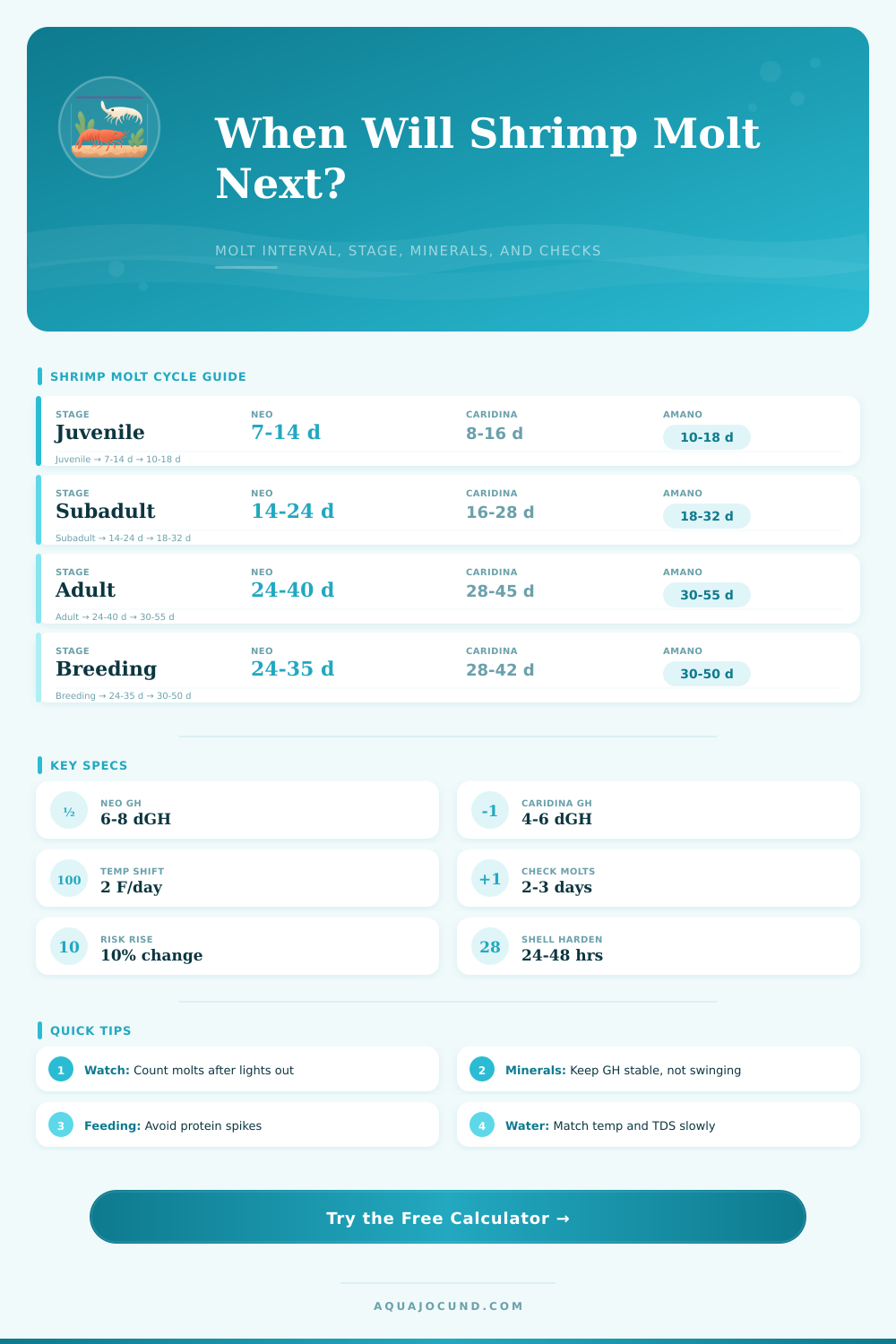
| Species Group | Juvenile | Adult | Best Stability Focus |
|---|---|---|---|
| Neocaridina davidi | 7-14 days | 24-40 days | GH 6-8, KH 2-5, modest TDS swings |
| Crystal and Taiwan bee | 8-16 days | 28-45 days | Low KH, steady GH, slow TDS changes |
| Amano shrimp | 10-18 days | 30-55 days | Broad GH tolerance, clean oxygenated water |
| Sulawesi shrimp | 10-20 days | 30-50 days | Warm mineral-rich water with low swing |
| Stage | Interval Effect | Observation Clue | Schedule Note |
|---|---|---|---|
| Juvenile growth | Fastest, about 45% shorter | Small shells, rapid size changes | Check daily in dense grow-out tanks |
| Subadult growth | About 20% shorter | Color deepens, saddles may appear | Check every 2-3 days |
| Adult maintenance | Baseline interval | Molts appear in stable monthly waves | Check twice weekly |
| Breeding females | Slightly shorter after hatch | Post-hatch molt and re-saddle | Watch mineral stability closely |
| Parameter | Low Concern | Rising Concern | Molt Risk Reason |
|---|---|---|---|
| TDS shift in 24 hrs | 0-20 ppm | 40+ ppm | Fast osmotic change can trigger weak molts |
| Temperature shift | 0-2°F / 0-1°C | 4°F+ / 2°C+ | Metabolism speeds up before shells are ready |
| Water change size | 10-25% | 40%+ | Large changes magnify GH, KH, and TDS mismatches |
| GH outside profile | Inside target range | 2+ dGH away | Shell formation depends on stable mineral access |
| Situation | Check Cadence | What To Count | What To Avoid |
|---|---|---|---|
| Stable adult colony | Every 3-4 days | Molts, deaths, berried females | Chasing one missing shell |
| Juvenile grow-out | Daily or every 2 days | Tiny molts, growth rate, leftovers | Overfeeding to force growth |
| After water change | Next 24-48 hrs | Erratic swimming and partial molts | Repeating big corrections |
| Mineral adjustment | Daily for 3 days | GH, TDS, new shells, grazing | Adding more minerals before retest |
Shrimp grows continuously throughout there entire lives. Since shrimp grow continuously, they must periodically shed their old shell to form new shells. The process of shedding old shells and forming new shells is referred to as molting.
While the process of molting is generaly invisible to the individual observer, the process of molting helps to determine how often empty shrimp shells will be seen in the tank and how healthy the shrimp in that aquarium are likely to be. A molt cycle calculator is used to determine the various data point related to the shedding of the shells of shrimp and how often that shedding process will occur. The calculator allow for the determination of which factor in the shrimp’s environment may impact its molting process.
Using a Molt Cycle Calculator for Shrimp
Many different variable impact the ability of shrimp to grow and form their shells. A profile of the species of shrimp can help to determine the metabolic rate of those shrimp; different shrimp species have different metabolic rate. Additionally, different stage of growth have shrimp shedding their shells at different rate; juvenile shrimp shed their shells more frequently than adult shrimp of the same species.
Other factor include the temperature of the water in which the shrimp live, the feeding habit of those shrimp, the levels of change in the water of the tank in which the shrimp live, and the mineral value of that water, specifically the amount of calcium and magnesium that is present in the water. These different variable can be entered into a molt cycle calculator to help determine how often those shrimp will shed their shell. The estimated interval in which the shrimp will shed their shell will allow the shrimp owner to determine the expected window during which the shrimp will molt.
The expected window for visible molt will help the shrimp owner to know when to look for shrimp molting; however, it will not indicate the window during which the shrimp owner must intervene in the shrimp’s environment. Additionally, if fewer empty shrimp shells than the expected window are observed, it is possible that the shrimp are eating their shed shells or that their shedding cycle is more short than calculated. However, if more empty shrimp shells than the expected window are observed, it is likely that the shrimp’s environment has change recently.
Another factor to consider in shrimp tanks is the mineral risk. Many individual dont consider this factor to be important in shrimp tanks, but mineral risk becomes important should the shrimp experience a failed molt. Mineral risk increases if the General Hardness (GH) level for the tank are outside of the target range for that species of shrimp.
Additionally, mineral risk score increases if the Total Dissolved Solids (TDS) change more than twenty or thirty points within a single day. Finally, mineral risk score increases if a large water change occurs within the same time period as a shift in the temperature of the water. Each of these factor, even if they are not significantly adjusted in the tank, may lead to a failed molt.
The molt cycle calculator allows the shrimp owner to understand these variable and to adjust care of the shrimp accordingly. The observation schedule of the shrimp owner should follow the information provided by the calculator. Juvenile shrimp shed their shells more frequently than adult shrimp, so any tank containing many juvenile shrimp will require a different observation schedule than a tank that contains mostly adult shrimp.
Additionally, small shells are often missed during observation of the aquarium, thus a closer observation of shrimp tanks containing juvenile shrimp. If an adjustment has been made to the water parameter for the shrimp in the tank, the mineral risk score will rise, so increased observation for empty shells should occur in the tank for a few day. Therefore, the molt cycle calculator will direct the care of the tank owner to closely observe the shrimp tank; however, it will not replace that observation effort.
While the molt cycle calculator is a helpful tool for understanding how often shrimp shed their shell, many people make mistake with these calculations. For instance, many people adjust the GH and the temperature of the water in which the shrimp live, but do not consider that the shrimp may not change on such a schedule. Additionally, the estimated interval of shedding for the shrimp is an average, so there are other variable that may impact that estimate.
Another error is in the effort to find every empty shell that is shed by shrimp; many shrimp will eat those shells within a few hour of the shed shells being created. Therefore, finding empty shells after the lights are turned off, or keeping a count of the total number of shells that are found during a specific time period each week, will provide more accurate information about the shedding of their shells. By understanding the cycle of shedding of shrimp shells, an individual can begin to recognize pattern in the behavior of their shrimp.
Using the information from the molt cycle calculator, such as estimating the length of time it takes for the shrimp to shed their shell and the mineral risk score for the tank, an owner may be able to better recognize the pattern of the shrimp. Thus, the goal in using a molt cycle calculator is to avoid surprise in the process of shedding of their shells by those shrimp and to ensure that the water is not change in a way that the shrimp cannot handle.