🦐 Caridina Water Parameter Calculator
Plan GH, KH, TDS, pH, temperature, tank volume, remineralizer dose, and safe adjustment stages for Caridina shrimp strains.
| Caridina strain | GH | KH | TDS | pH | Temperature | Notes |
|---|---|---|---|---|---|---|
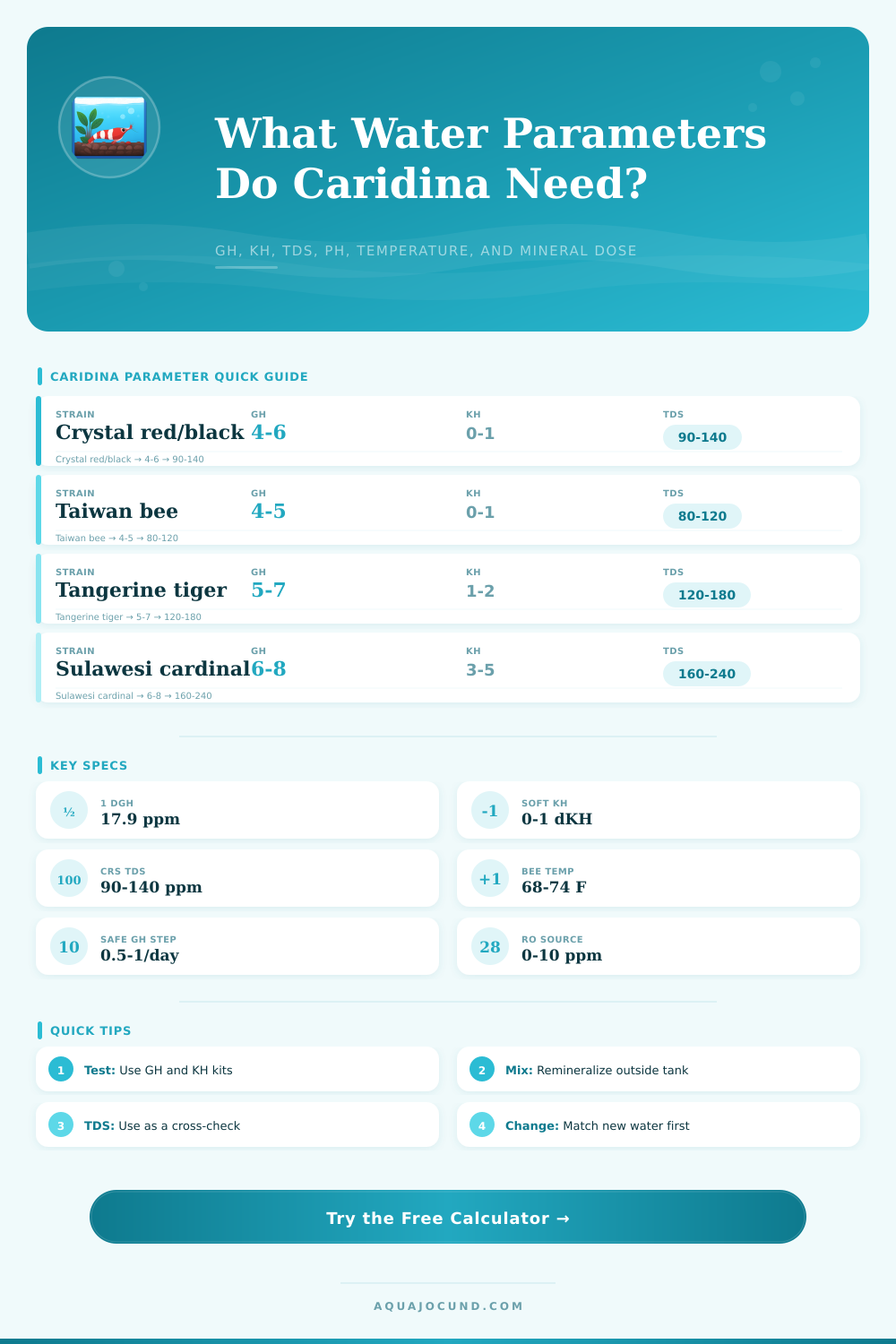
| Crystal red / black bee | 4-6 dGH | 0-1 dKH | 90-140 ppm | 5.8-6.6 | 68-74°F / 20-23°C | Soft Active soil, RO, GH+ only |
| Taiwan bee / pinto | 4-5 dGH | 0-1 dKH | 80-120 ppm | 5.6-6.4 | 68-72°F / 20-22°C | Soft Keep changes very steady |
| Blue bolt / shadow bee | 4-5.5 dGH | 0-1 dKH | 85-125 ppm | 5.6-6.5 | 68-72°F / 20-22°C | Soft Low KH profile |
| Tangerine tiger | 5-7 dGH | 1-2 dKH | 120-180 ppm | 6.4-7.2 | 70-76°F / 21-24°C | Moderate Slight KH is common |
| Aura blue tiger | 5-7 dGH | 0-2 dKH | 110-170 ppm | 6.2-7.0 | 70-75°F / 21-24°C | Moderate Stable TDS matters |
| Amano shrimp | 5-10 dGH | 1-5 dKH | 120-250 ppm | 6.5-7.6 | 68-78°F / 20-26°C | Flexible Adult freshwater holding |
| Caridina babaulti | 5-9 dGH | 1-4 dKH | 130-230 ppm | 6.5-7.5 | 70-78°F / 21-26°C | Flexible Moderate mineral water |
| Sulawesi cardinal | 6-8 dGH | 3-5 dKH | 160-240 ppm | 7.6-8.4 | 78-84°F / 26-29°C | Alkaline Use Sulawesi minerals |
| Type | Calculator basis | Best fit | KH effect | TDS behavior |
|---|---|---|---|---|
| Bee shrimp GH+ powder | 0.65 g per 5 gal per +1 dGH | Crystal, Taiwan, blue bolt | Very low | About 18-22 ppm per dGH |
| Liquid GH+ drops | 2.5 ml per 5 gal per +1 dGH | Small tanks and nano changes | Very low | Similar to powder GH+ |
| GH/KH+ mineral blend | 0.75 g per 5 gal per +1 dGH | Tigers, Amano, babaulti | Adds KH | Higher than GH-only salts |
| Tiger mineral blend | 0.80 g per 5 gal per +1 dGH | Tangerine tiger, aura tiger | Small KH increase | Moderate TDS increase |
| Sulawesi 7.5 mineral | 1.30 g per 5 gal per +1 dGH | Cardinal shrimp at pH 7.5-8.0 | Raises KH | High alkalinity profile |
| Sulawesi 8.5 mineral | 1.55 g per 5 gal per +1 dGH | Warm alkaline Sulawesi tanks | Raises KH strongly | High TDS and pH profile |
| Calcium / magnesium salts | 0.60 g per 5 gal per +1 dGH | Custom Ca:Mg planning | No buffer unless added | Depends on salt mix |
| Custom label rate | Your entered rate | Any measured product | Use product label | Retest after dissolving |
| Use case | Dimensions | Net volume estimate | Typical Caridina target | Example GH+ dose from RO |
|---|---|---|---|---|
| 3 gal change bucket | Direct measured | 3 gal / 11.4 L | GH 5, KH 0, TDS 115 | About 2.0 g powder at full dose |
| 5.5 gal nano | 16 in x 8 in x 10 in | 4.8 gal / 18.2 L | GH 4.5, KH 0, TDS 100 | About 2.8 g powder from RO |
| 10 gal colony | 20 in x 10 in x 12 in | 8.8 gal / 33.3 L | GH 5, KH 0, TDS 115 | About 5.7 g powder from RO |
| 15 gal breeder-style | 24 in x 12 in x 12 in | 12.7 gal / 48.1 L | GH 5, KH 0, TDS 115 | About 8.3 g powder from RO |
| 20 long shrimp rack | 30 in x 12 in x 12 in | 15.8 gal / 59.8 L | GH 5, KH 0, TDS 115 | About 10.3 g powder from RO |
| 29 gal display | 30 in x 12 in x 18 in | 23.7 gal / 89.7 L | GH 6, KH 1, TDS 150 | About 18.5 g tiger blend from RO |
| Parameter | Conservative step | Fastest practical step | Calculator warning point | Best check |
|---|---|---|---|---|
| GH | 0.5 dGH/day | 1.0 dGH/day | Plan exceeds chosen max step | Liquid GH test kit |
| KH | 0.5 dKH/day | 1.0 dKH/day | Bee shrimp target above 1 dKH | Liquid KH test kit |
| TDS | 20-25 ppm/day | 35 ppm/day | Target gap exceeds chosen max step | Calibrated TDS meter |
| pH | 0.1-0.2/day | 0.3/day | Current pH outside strain range | pH meter or fresh reagent |
| Temperature | 1-2°F/day | 3°F/day | Outside strain temperature range | Thermometer in tank water |
Caridina shrimp requires specific water parameters in their tanks because they is sensitive to changes in the minerals and acidity in there water. Caridina shrimp live in specific streams and pool in their native homes. In order to thrives, Caridina shrimp must be maintained in water that resembles that which they naturaly encounter.
Water parameters are important for Caridina shrimp because the parameters influences the shrimps ability to molt, breed, and live for extended periods in their aquarium. In order to use the water parameter calculator, you must enter specific information about you’re aquarium into the calculator to produce a suggested plan for water change. You will need to enter the size of your aquarium, your current level of GH, KH, TDS, and pH, as well as the temperature of the water.
Using a Water Calculator for Caridina Shrimp
Additionally, you will need to enter the amount of water you would like to change and the types of remineralizer that you will use. This information will allow the calculator to provide you with the amount of remineralizer that you need to add to your water to reach your target water parameters. Additionally, the calculator will inform you of how many stage your water changes must occur over in order to reach those parameters without going beyond the recommended level of any given parameter.
Many individuals that care for Caridina shrimp use RO (reverse osmosis) or distilled water to begin their aquariums. The reason for the use of RO and distilled water is that it is the cleanest form of water. However, RO and distilled water does not contain the minerals that Caridina shrimp require in order to survive.
Therefore, you add remineralizer to the RO or distilled water prior to add it to the aquarium. There are two main type of remineralizer that you may use to supplement RO or distilled water. One type of remineralizer will raise the GH of the water without changing the KH, and it is used for soft water shrimp strain.
The alternative type will raise both the KH and GH of the water, and it is used for tiger shrimp or Sulawesi cardinal shrimp. If your aquarium contains only Caridina shrimp, you can choose the type of remineralizer that you will use in the calculator. Two main parameters for aquariums are the temperature and pH of the water.
Both of these factor can affect the comfort of the shrimp living in the tank. For instance, changing the temperature of the water at a slow rate of 1 or 2 degree over several days is generally okay for the shrimp. However, suddenly changing the temperature of the water by 5 degrees can be detrimental to the health of the Caridina shrimp, as it can cause them to fail during their molting process.
The same is true for pH. The calculator will take into account your target pH so that you can understand if the amount of remineralizer that you are to add to the aquarium will help to adjust the pH. The calculator helps to determine the stages that you need for your water change.
A single water change may not be able to achieve the difference between your current water parameters and those that you wish to have in your aquarium. The calculator will show you into how many stage the water change process must occur. Additionally, the calculator will warn you if the KH or TDS parameters will be changed too quick for the specific strain of shrimp that you are using.
This warning is of importance in that it will prevent you from adding the minerals at the rate that could potentially endanger the life of your Caridina shrimp. The actual parameters of your aquarium may never match those calculated by the calculator. For instance, many different types of substrate, hardscape, and biological element live within the tank and can alter the parameters of the water.
For instance, substrate with high level of biologic activity can continuously pull the minerals out of the water. Therefore, you must frequently test the water in your aquarium to ensure that the calculator is still accurate. Additionally, you may wish to create a log of the GH, KH, and TDS measurement to compare actual measurements of water parameters to those calculated.
The main goal of using this calculator is to create a process for changing the water in your aquarium that is repeatable and ensures that the parameters of the water remains within the range that your Caridina shrimp require. By using the calculator to determine the amount of remineralizer to add and the stages for water changes, the parameters will remain within the range that your shrimp require. You should of used it to make sure the water stays moddern and healthy.