🦐 Shrimp GH Target Calculator
Choose a shrimp species target, dose remineralizer, split calcium and magnesium, and match replacement water for safer GH changes.
Crystal Shrimp
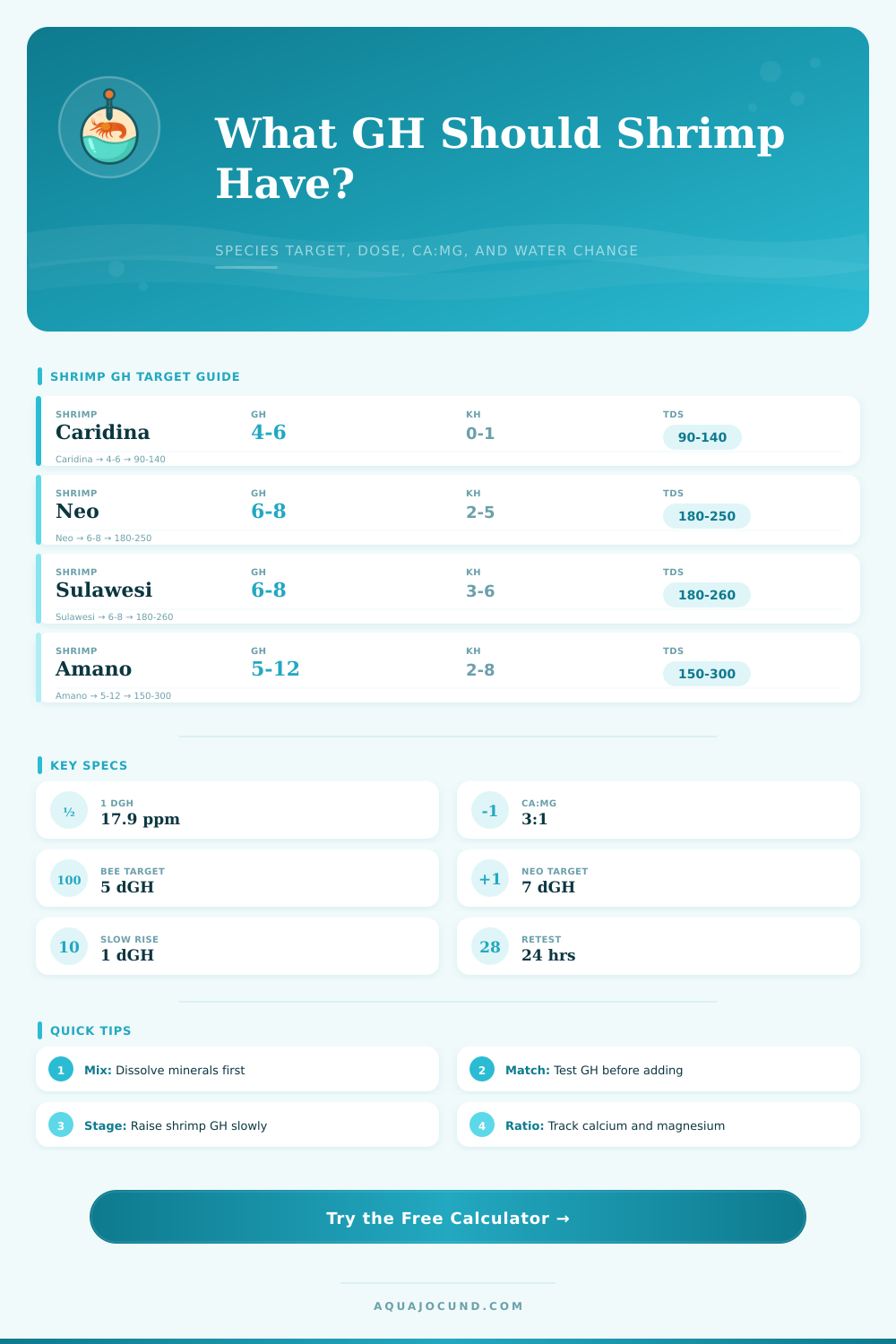
Common target is 4-6 dGH with very low KH and controlled TDS for active substrates.
Taiwan Bee
Often kept near 4-5 dGH, where small mineral changes can show up quickly in TDS.
Neocaridina
Usually tolerates 6-8 dGH well, especially with steady calcium and moderate magnesium.
Amano Shrimp
Handles a broad GH range, making it useful as a hardy community-tank profile.
Sulawesi Shrimp
Needs a more mineralized, alkaline-style setup than bee shrimp, with stable parameters.
Bamboo Shrimp
Filter-feeding shrimp are often planned closer to community fish mineral ranges.
Ghost Shrimp
Usually accepts moderate hardness, but unstable water changes still cause stress.
Selective Lines
Use breeder notes when a line has been maintained outside the broad species average.
| Species profile | Typical GH target | KH context | Planning note |
|---|---|---|---|
| Crystal red / crystal black | 4-6 dGH | 0-1 dKH | Use a GH-only remineralizer with active substrate or RO water. |
| Taiwan bee / fancy tiger | 4-5.5 dGH | 0-1 dKH | Small dosing errors matter because the target band is narrow. |
| General Caridina | 4-6.5 dGH | 0-2 dKH | Match the breeder water when moving sensitive lines. |
| Neocaridina davidi | 6-8 dGH | 2-5 dKH | Stable moderate GH is usually more useful than chasing a single value. |
| Amano shrimp | 5-12 dGH | 2-8 dKH | Broad tolerance, but replacement water should still be mixed consistently. |
| Sulawesi shrimp | 6-8 dGH | 3-6 dKH | Keep mineral profile stable and confirm the full water chemistry target. |
| Method | Calculator rate | Best fit | Important check |
|---|---|---|---|
| Shrimp GH+ powder | 0.60 g / 20 L / dGH | General shrimp remineralizing | Use product label if it gives a different rate. |
| Low-TDS GH+ blend | 0.50 g / 20 L / dGH | Bee shrimp and active substrate tanks | Retest TDS and GH after the powder dissolves. |
| Neocaridina mineral blend | 0.70 g / 20 L / dGH | Cherry, blue dream, yellow, and similar lines | Watch KH separately if the product also buffers alkalinity. |
| Calcium chloride + magnesium sulfate | Element split | Custom Ca/Mg control | Weigh dry salts accurately and dissolve before use. |
| Calcium sulfate + magnesium sulfate | Element split | Low-chloride mineral plan | Calcium sulfate dissolves more slowly than chloride salts. |
| Liquid GH concentrate | ml per 10 gal per dGH | Small tanks and easy measuring | Shake concentrate and confirm the label strength. |
| Change size | Use when | GH matching rule | Shrimp caution |
|---|---|---|---|
| 10% | Very sensitive colonies | Replacement can be close to target | Best for slow correction and breeder-line moves. |
| 20-25% | Routine shrimp tank changes | Replacement GH may need to be above target if tank GH is low | Mix, aerate, and temperature-match before adding. |
| 30-40% | Correcting drift or preparing a reset | Replacement GH has stronger effect on final tank GH | Split changes if final GH would rise more than the chosen limit. |
| 50%+ | Emergency or controlled rebuild | Replacement GH dominates the final tank value | Use only when other parameters are also matched carefully. |
| Tank size | Common dimensions | 25% change | Typical GH target |
|---|---|---|---|
| 5 gal nano | 16 x 8 x 10 in / 41 x 20 x 25 cm | 1.25 gal / 4.7 L | 4-7 dGH |
| 10 gal standard | 20 x 10 x 12 in / 51 x 25 x 30 cm | 2.5 gal / 9.5 L | 5-8 dGH |
| 20 long | 30 x 12 x 12 in / 76 x 30 x 30 cm | 5 gal / 18.9 L | 5-8 dGH |
| 29 gal | 30 x 12 x 18 in / 76 x 30 x 46 cm | 7.25 gal / 27.4 L | 5-10 dGH |
| 40 breeder | 36 x 18 x 16 in / 91 x 46 x 41 cm | 10 gal / 37.9 L | 6-8 dGH |
| 75 gal rack sump | 48 x 18 x 21 in / 122 x 46 x 53 cm | 18.75 gal / 71 L | 4-8 dGH |
General hardness measure the total amount of minerals in a water. Specific to shrimp, general hardness is the measurement of the amount of calcium and magnesium in the water. General hardness is important to shrimp because it direct affects there ability to form shell and molt.
If the general hardness are too low, the shrimp will struggle to form their shells. However, if the general hardness is too high, the shrimp may experience stress from the water that does not reflect there natural environment. Due to the impact that general hardness has upon both shell formation and shrimp health, it is important to monitor the general hardness of the water to ensure the health of the shrimp in the tank.
Keep Water Hardness Stable for Shrimp
The type of shrimp that you keep in your tank will require different levels of general hardness in the water. For instance, species like crystal shrimp and Taiwan bee shrimp require low level of general hardness. In contrast, shrimp like Neocaridina shrimp and Amano shrimp can handle different levels of general hardness in there water.
Sulawesi shrimp, however, require a specific range of general hardness in their water, as well as specific level of alkalinity. By using a calculator, you can select the profile of the shrimp that you wish to keep in your tank. Based off that profile, the calculator will adjust for the proper ratio of calcium to magnesium to suit that species of shrimp.
The minerals that make up the general hardness in the water is calcium and magnesium. Calcium is required for the shrimp to form their shells, while magnesium is required for the enzymatic functions within the shrimp’s body. Many shrimp owner aim to have these two minerals in a specific ratio within the tank.
The majority of shrimpkeepers target a ratio of three part of calcium to one part of magnesium. If the calculator dont maintain this ratio in the tank, the shrimp may exhibit dull coloration, or they may struggle to molt. The calculator accounts for the ratio of calcium to magnesium in the replacement water to ensure that it is provide in the proper amount to meet the shrimp’s requirements.
The source of the water that you will use to keep the tank water refreshed will affect the amount of minerals that need to be add to the water to establish the desired general hardness. For instance, tap water contains some minerals within it, but water that is processed through a reverse osmosis system contains few if any minerals. It is important to account for these minerals in the water source.
If you dont account for the minerals that is naturaly contain within the source water, the general hardness calculations may suggest adding too much remineralizer to the tank. Adding too much remineralizer will increase the general hardness and the total dissolved solids in the water. Too much dissolved solid for shrimp isnt good for their health.
Therefore, the calculator accounts for the amount of minerals that are starting within the source water, enabling the shrimp owner to add the correct amount of remineralizer to achieve the target general hardness. If the general hardness of the water that is being refreshed in the tank is very different than the target general hardness that should of be maintain within the tank, staged water changes will be required. Staged water changes are important to prevent the shrimp from failing at the process of molting their shells.
If there is a sudden change in the general hardness of the water, the shrimp may experience stress. Therefore, changes to the general hardness should be slow to allow the shrimp to acclimate. The calculator will determine the number of steps that the shrimp owner requires to refresh the water to the target hardness, based upon the maximum amount of change to the general hardness that can occur with each stage of water change.
By using this method of staged water changes, you can better maintained the health of shrimp. It is more important for shrimp to maintain a general hardness that is stable rather than perfect to the target number. Once established, the general hardness should remain within the range that has been found to be most appropriate for that particular tank and ecosystem of shrimp.
If the replacement water has the same general hardness as the water within the tank at this time, the general hardness of the tank will remain stable. Furthermore, if the shrimp within the tank are active, if the females are carrying egg, and if the shrimp are successfully molting their shells without difficulty, then the general hardness of the water is appropriate for that species of shrimp.