Remineralization GH Calculator
Target RO or low-mineral water by dGH, ppm CaCO3, product strength, batch volume, and post-change tank GH.
Remineralization Results
| Product or Mineral | Default Strength | Typical Use | Notes |
|---|---|---|---|
| Shrimp GH+ powder | 3.4 g per dGH per 100 L | RO shrimp tanks | Raises GH with little KH |
| Shrimp GH/KH blend | 3.8 g per dGH per 100 L | Neocaridina and livebearers | GH rise may include buffer salts |
| Planted GH booster | 3.2 g per dGH per 100 L | Ca and Mg for plants | Often mixed with potassium salts |
| Softwater fish mineral | 2.8 g per dGH per 100 L | Small GH lifts | Use staged changes for sensitive fish |
| Hardwater mineral blend | 4.6 g per dGH per 100 L | High GH targets | May also raise KH and TDS |
| Calcium sulfate dihydrate | 3.1 g per dGH per 100 L | Calcium hardness | Poorly soluble; mix thoroughly |
| Magnesium sulfate heptahydrate | 4.4 g per dGH per 100 L | Magnesium hardness | Common Epsom salt form |
| Calcium chloride dihydrate | 2.6 g per dGH per 100 L | Calcium hardness | Dissolves fast; chloride adds TDS |
| Setup | Common GH Range | ppm CaCO3 Equivalent | Change Strategy |
|---|---|---|---|
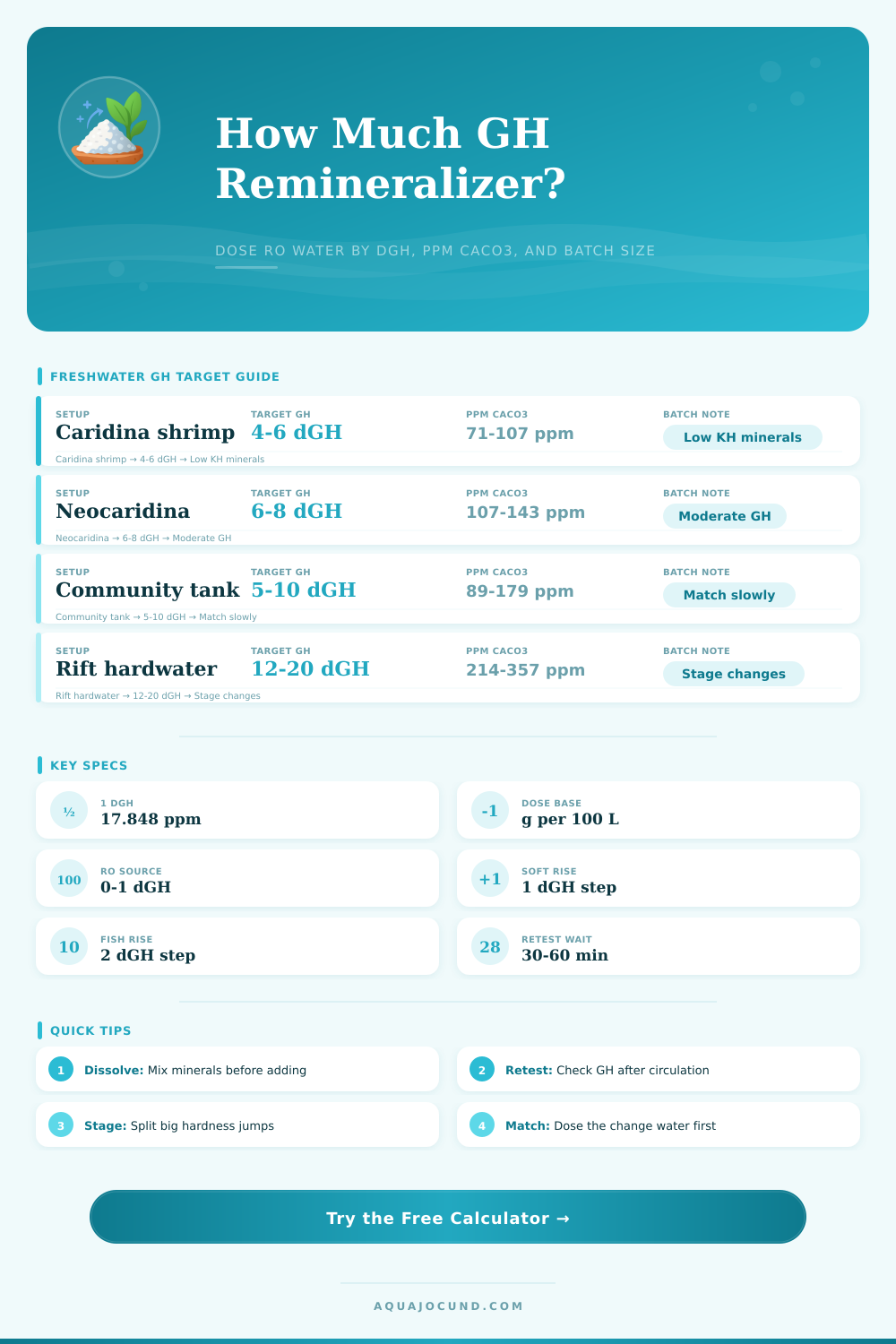
| Caridina shrimp | 4-6 dGH | 71-107 ppm | Small, consistent remineralized batches |
| Neocaridina shrimp | 6-8 dGH | 107-143 ppm | Match new water before the change |
| Softwater community | 3-6 dGH | 54-107 ppm | Avoid sudden upward jumps |
| General community | 5-10 dGH | 89-179 ppm | Keep weekly batches repeatable |
| Livebearers | 10-18 dGH | 178-321 ppm | Stage large corrections |
| Rift hardwater fish | 12-20 dGH | 214-357 ppm | Check GH, KH, and TDS together |
| Tank | 20% Change | Batch Liters | Dose To +6 dGH* |
|---|---|---|---|
| 10 gal / 38 L | 2.0 gal | 7.6 L | 1.55 g |
| 20 gal / 76 L | 4.0 gal | 15.1 L | 3.09 g |
| 29 gal / 110 L | 5.8 gal | 22.0 L | 4.49 g |
| 55 gal / 208 L | 11.0 gal | 41.6 L | 8.49 g |
| 75 gal / 284 L | 15.0 gal | 56.8 L | 11.59 g |
| 125 gal / 473 L | 25.0 gal | 94.6 L | 19.30 g |
| dGH | ppm as CaCO3 | meq/L | Use In Calculator |
|---|---|---|---|
| 1 dGH | 17.85 ppm | 0.357 | Small adjustment step |
| 4 dGH | 71.39 ppm | 1.43 | Soft shrimp target |
| 6 dGH | 107.09 ppm | 2.14 | Common RO remineralization target |
| 8 dGH | 142.78 ppm | 2.86 | Moderate freshwater target |
| 12 dGH | 214.18 ppm | 4.28 | Hardwater starting point |
Aquarium water hardness are an important factor for aquarium owners to manage. Aquarium water hardness is necessary for the health of the fish, shrimp, and plants in an aquarium. If you use reverse osmosis (RO) water or water that is very soft from you area, the aquarium water will lack the minerals that the fish, shrimp, and plants needs to thrive.
A lack of these minerals will lead to the development of weak shells in your shrimp and poor growth in your aquarium plants. To add these minerals to the tank water, you can use a remineralization GH calculator. The remineralization GH calculator make it easier for you to achieve the desired water hardness in your aquarium by performing the necessary calculations.
How to Use a GH Calculator for Aquarium Water
The measurement of general hardness is used with a remineralization GH calculator. General hardness is a measurement of water that is expressed in degrees of general hardness or ppm of calcium carbonate. One degree of general hardness is equivalent to 18 ppm of calcium carbonate.
The calculator uses this information, so you dont have to perform the calculations yourself. The remineralization GH calculator can calculate exactly how much product you need to adding to your water to achieve your desired general hardness level. The calculator also prevents you from adding too much or too little product to your water by removing the guesswork involved in the process.
To use the remineralization GH calculator, you must provide three groups of information. First, you must enter information about your aquarium and the water change. Second, you must enter information about your source water and the desired level of general hardness you would like to achieve in your aquarium.
Third, you must provide information about the mineral product you would like to use. This information include the strength of the minerals and the amount of the product that will fit on a teaspoon. Once you enter all of this information, the remineralization GH calculator will show you how much dry product to add to your water to achieve your desired general hardness level.
The general hardness level that you choose to use for your aquarium is the final number that you will need to monitor. If you change the general hardness of your water in your aquarium sudden, it will stress the animals that live in the tank. You can use the remineralization GH calculator to set a limit to how much the general hardness of your water will rise when performing a water change.
By doing so, you can split the change of water that you have to perform to achieve the desired general hardness for your aquarium. The remineralization GH calculator will alert you to the number of stages you can use to change the general hardness of your aquarium water to the desired level. Additionally, the remineralization GH calculator will tell you the amount of the mineral product you should use in each of these stages.
Most minerals used in aquariums contain calcium and magnesium salts; some also contain potassium that aquarium plants need. The remineralization GH calculator has a list of the most common mineral products. If the minerals you use are not on the list, you can enter the custom strength that you find on the label of the product.
Using the strength of minerals that is on the label guarantee that the math on the calculator is accurate. Using accurate math guarantees that the resulting hardness level of your aquarium water will be the general hardness level that you want to achieve. You should use the reference tables included with the remineralization GH calculator to ensure that the general hardness levels that you provide for your livestock matches the requirements of the species that you are keeping.
For instance, Caridina shrimp require soft water to thrive; however, the rift lake cichlids requires harder water. The livebearers require harder water then the community tetras. You must ensure that you are aware of the requirements for the animals you have in your aquarium.
By doing so, you will not add minerals that will result in a general hardness level that is incorrect for the animals in your aquarium. If the desired general hardness level for your aquarium is considerably different from the current hardness in your water, you should add the minerals in stages rather than all at once. Adding all the minerals at once will result in a rapid rise in the general hardness of your aquarium water, which can be harmful to the animals that live in the tank.
The remineralization GH calculator will alert you to how much the general hardness will rise with each addition of the minerals. If the rise in hardness is too great, the remineralization GH calculator will alert you to the number of stages you can use to change the general hardness levels of your aquarium water to the desired level. You must follow a few techniques in how you add the minerals to your aquarium water.
First, you must dissolve the minerals in the water that you will use to change the water in your aquarium. Adding the minerals directly to your aquarium water will result in harmful spikes in the general hardness of your water. Allow the water to circulate, then test the water prior to completing the water change in your aquarium.
The remineralization GH calculator is valuable because it allows you to turn a series of individual decisions into a single plan. By entering the facts about your aquarium and your chosen mineral product, the calculator will show you the effect that each choice will have on the general hardness level of your aquarium. This will allow you to decide if you need to change the target hardness level of your water or the schedule for changing the water in your aquarium.
With time, you will find the settings that work best for your aquarium using the remineralization GH calculator. These settings will remain the same for your aquarium, even if the number of gallons of water you change in your aquarium changes.