⏱ Aquarium Dwell Time Calculator
Estimate contact time through UV sterilizers, reactors, sumps, and media chambers from usable volume, corrected flow, bypass, and media displacement.
| Equipment | Typical Target | Porosity / Use | Flow Note |
|---|---|---|---|
| UV clarifier | 5-15 sec | Open tube | Often higher flow for green water control |
| UV sterilizer | 20-45 sec | Open tube | Measure flow after elbows and head height |
| UV protozoa target | 45-90 sec | Open tube | Usually needs slower flow or larger chamber |
| Carbon reactor | 20-60 sec | Packed media bed | Gentle tumble or even bed flow |
| GFO reactor | 30-90 sec | Fluidized media bed | Too much flow grinds media |
| Biomedia chamber | 60-180 sec | Porous media volume | Channeling lowers actual contact |
| Refugium chamber | 180-600 sec | Open chamber | Slow pass improves settling time |
| Sump baffle path | 30-180 sec | Open path | Water height sets real contact volume |
| Canister media tray | 30-120 sec | Tray media volume | Bypass around baskets can be significant |
| Chamber | Dimensions in (cm) | Gross Volume | Example Flow | Gross Dwell |
|---|---|---|---|---|
| Nano UV tube | 2 x 2 x 8 (5 x 5 x 20) | 0.14 gal / 0.5 L | 60 gph | 8 sec |
| Small reactor | 3 x 3 x 12 (8 x 8 x 30) | 0.37 gal / 1.4 L | 75 gph | 18 sec |
| Media basket | 4 x 6 x 10 (10 x 15 x 25) | 1.04 gal / 3.9 L | 120 gph | 31 sec |
| 20 gal sump section | 10 x 12 x 10 (25 x 30 x 25) | 5.19 gal / 19.6 L | 300 gph | 62 sec |
| 40 breeder refugium | 14 x 18 x 10 (36 x 46 x 25) | 10.91 gal / 41.3 L | 150 gph | 262 sec |
| Large baffle path | 18 x 18 x 12 (46 x 46 x 30) | 16.83 gal / 63.7 L | 500 gph | 121 sec |
| Item | Value | Use In Calculator | Practical Meaning |
|---|---|---|---|
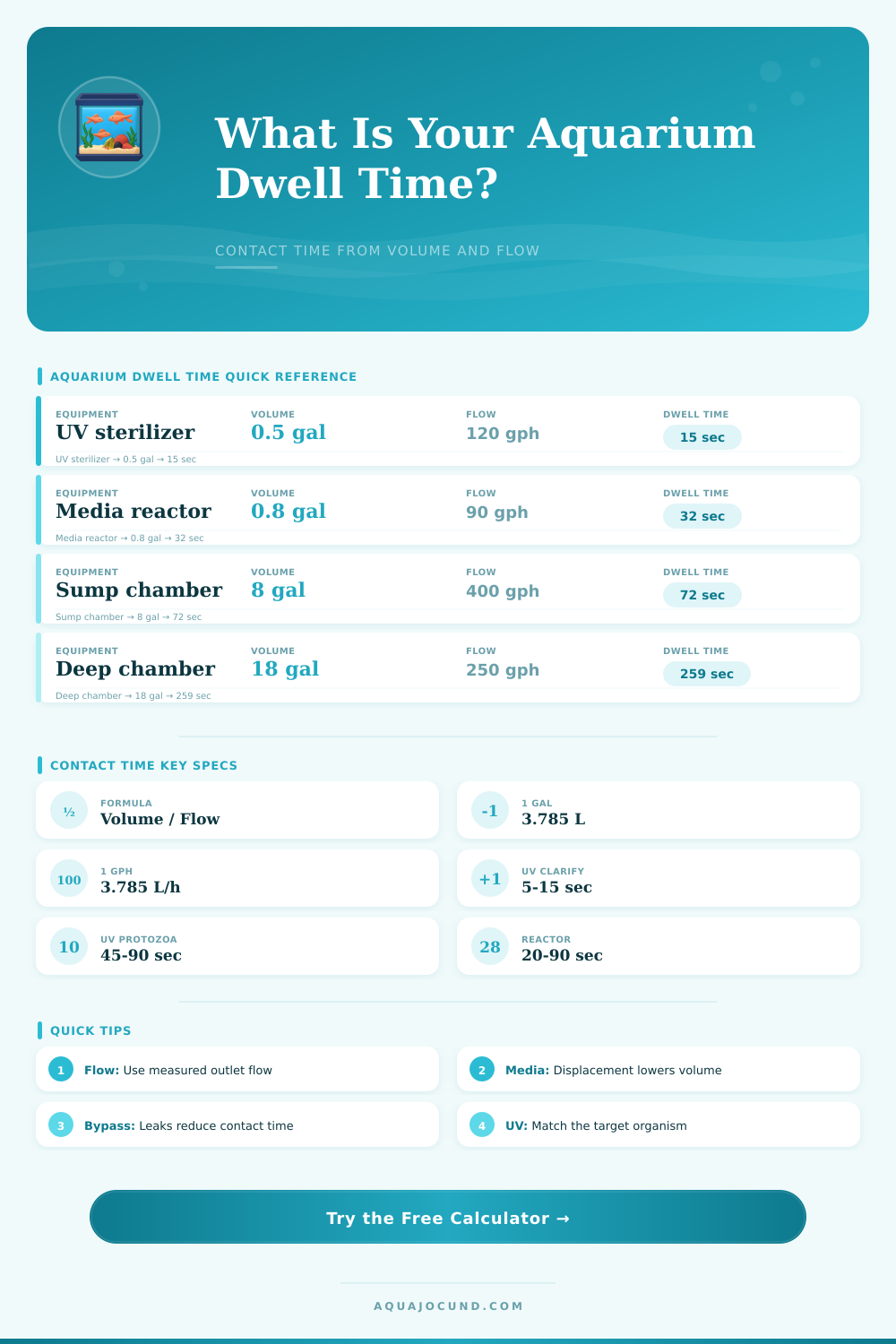
| Dwell time | Volume / Flow | Seconds = gal / gph x 3600 | Time water spends in the path |
| Flow conversion | 1 gph = 3.785 L/h | Metric and imperial results | Same dwell result in either unit |
| Volume conversion | 1 gal = 231 in³ | Box and cylinder volumes | Internal dimensions only |
| Media displacement | Fill x porosity | Reduces usable water volume | Packed media leaves less water space |
| Bypass correction | Flow x active fraction | Reduces contacting flow | Only water through media counts |
| Safety margin | Target x margin | Sets conservative flow limit | Useful for UV and channeling risk |
| Display Size | Low Flow | Moderate Flow | High Flow | Contact-Time Note |
|---|---|---|---|---|
| 20 gal / 76 L | 40 gph | 100 gph | 200 gph | Small chambers lose dwell quickly |
| 40 gal / 151 L | 80 gph | 200 gph | 400 gph | Reactors often need valves |
| 75 gal / 284 L | 150 gph | 375 gph | 750 gph | UV target determines pass rate |
| 125 gal / 473 L | 250 gph | 625 gph | 1250 gph | Large sumps can keep long dwell |
| 180 gal / 681 L | 360 gph | 900 gph | 1800 gph | Parallel loops help preserve contact |
Contact time is the length of time that the water spend within the UV sterilizer or media reactor. Contact time is the most important factor in determining the effectiveness of a given device. If the contact time within the device is too low, then bloom may occur within the tank, or the nitrates within the water may not be removed effective.
Contact time is determined by a few different factors. The three main factors that impact contact time is the usable chamber volumes, the actual flow rate, and the amount of bypass within the device. The flow rate stated on the back of most water pumps are not the actual flow rate of the pump.
Contact Time: What It Is and Why It Matters
Flow rates are lower due to head loss at the elbows in the system and due to the resistance of the media within the media reactor. Because the actual flow rate is lower than the stated flow rate, contact time will be more shorter than expected. To compensate for this, you must account for a head loss and bypass percentage to determine the actual flow rate that the device can provide.
The addition of media can alter the amount of usable volume within the chamber. When the bags and trays of media is added to the chamber, the media takes up some of the volume within the chamber. The water must pass through the pore of the media.
If too much of the media is added to the chamber, such as a high percentage fill rate and low porosity of the media, there will be a shortening of the usable volume in the chamber. Calculations must be made regarding the porosity of the media to determine the actual usable volume of the chamber. Bypass is one factor that will reduce the contact time within the media reactor.
If the water within the reactor finds an easier path through the device then the other paths, the water will take that route and not pass through the media. Bypass can occur if there is a gap around the media basket or if a channel open up after a backflush. Even a small percentage of bypass will reduce the contact time of the chamber.
To compensate for this, a bypass percentage can be entered into a contact time calculator. This will allow for the flow rate to remain accuracy and the contact time to be realistic. After determining the contact time for a device, it is necessary to determine whether or not that contact time will be sufficient for the desired target in the aquarium.
Contact time requirements will differ for different targets. For instance, contact time for green water will be different than the contact time required to remove certain type of protozoa. Additionally, the contact time for media reactors used to remove carbon or GFO will be different from other chambers in the aquarium.
By using an field and safety margin for the target, it is possible to ensure that the contact time for each target will be sufficient. The flow turnover within the display tank must also be considered. Although the device may provide the proper contact time for the flow rate of the device, that flow rate may be too slow to turnover the display tank effective.
Contact time must be determined at different flow rate to make sure that the system turns over each tank effective. System conditions change over time. The media within the media reactor can compact over time.
Additionally, the pumps can lose head over time due to the evaporation of the water and the clogging of the filter in the system. Because of these change in the system, the contact time will change. For these reasons, it is recommended that a conservative safety margin be used within the calculations for contact time.
This will allow for some breathing room in case the system and measurement isnt accurate. To ensure the effectiveness of the device, it is necessary to measure the actual flow of the system at the outlet of the system. Additionally, the dimension of the chamber and the usable volume must be entered into the contact time calculator.
By entering the flow rate and chamber dimensions into the contact time calculator, it is possible to determine the contact time for the system. If the contact time calculated by the device is too low, then it will be necessary to change the pump, the chamber, or the valve in the system in order to ensure that the livestock recieve the proper treatment from the system.