🌊 Display Tank Turnover Calculator
Combine return pump flow, filter flow, wavemakers, head loss, and aquascape obstruction.
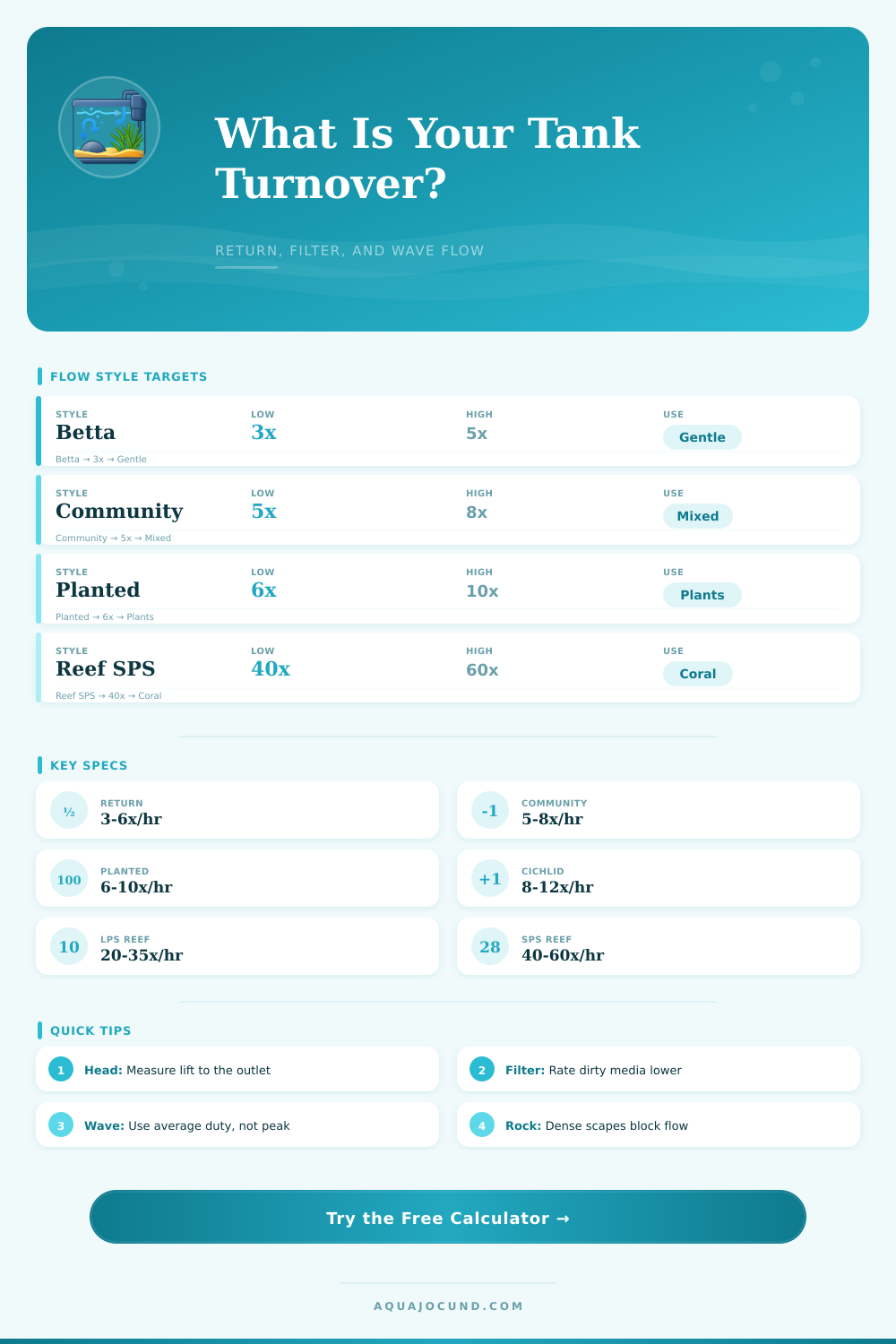
| Flow Style | Target x/hr | Flow Source Mix | Good Use |
|---|---|---|---|
| Betta / labyrinth fish | 3-5x | Mostly sponge or low filter flow | Gentle displays with calm surface zones |
| Shrimp / fry grow-out | 4-6x | Filtered flow with guarded intakes | Small animals that need stable, mild circulation |
| Community freshwater | 5-8x | Filter plus modest return flow | Mixed tetras, rasboras, livebearers, and similar fish |
| High-tech planted | 6-10x | Filter plus broad circulation | CO2 and nutrient distribution around plants |
| Goldfish / heavy waste | 8-12x | Strong filter flow, soft display pattern | High waste tanks that still need swimable flow |
| River or cichlid display | 8-12x | Return plus directional powerheads | Active fish and long displays with dead spots |
| LPS / soft coral reef | 20-35x | Return plus pulsed wavemakers | Broad random flow without blasting coral tissue |
| SPS reef | 40-60x | Multiple wavemakers and return flow | High energy reef zones with wide alternating flow |
| Tank | Dimensions | Volume | 5x Flow | 10x Flow |
|---|---|---|---|---|
| 10 Gallon | 20 x 10 x 12 in / 51 x 25 x 30 cm | 10 gal / 38 L | 50 gph / 189 lph | 100 gph / 379 lph |
| 20 Long | 30 x 12 x 12 in / 76 x 30 x 30 cm | 19 gal / 72 L | 95 gph / 360 lph | 190 gph / 719 lph |
| 29 Gallon | 30 x 12 x 18 in / 76 x 30 x 46 cm | 28 gal / 106 L | 140 gph / 530 lph | 280 gph / 1060 lph |
| 40 Breeder | 36 x 18 x 16 in / 91 x 46 x 41 cm | 40 gal / 151 L | 200 gph / 757 lph | 400 gph / 1514 lph |
| 55 Gallon | 48 x 13 x 21 in / 122 x 33 x 53 cm | 57 gal / 216 L | 285 gph / 1079 lph | 570 gph / 2158 lph |
| 75 Gallon | 48 x 18 x 21 in / 122 x 46 x 53 cm | 79 gal / 299 L | 395 gph / 1495 lph | 790 gph / 2990 lph |
| 125 Gallon | 72 x 18 x 22 in / 183 x 46 x 56 cm | 123 gal / 466 L | 615 gph / 2328 lph | 1230 gph / 4656 lph |
| Component | Typical Derate | Calculator Field | Why It Changes Turnover |
|---|---|---|---|
| Return pump head height | 10-60% | Head height and shutoff head | Vertical lift moves the pump down its flow curve |
| Return plumbing | 5-35% | Extra plumbing loss | Elbows, valves, small pipe, and manifolds add restriction |
| Dirty return pump | 5-25% | Return pump derate | Biofilm and impeller wear reduce actual output |
| Filter media loading | 15-50% | Filter media reduction | Sponges, pads, and canister trays slow rated flow |
| Wavemaker programs | 20-70% | Average wave duty | Pulse and random modes rarely run at peak rating full time |
| Aquascape blocking | 5-45% | Aquascape obstruction | Rock, plants, and wood convert pump rating into uneven flow |
| Layout | Obstruction | Typical Signs | Adjustment |
|---|---|---|---|
| Open swimming display | 5-12% | Long clear flow paths | Use low obstruction and lower wavemaker count |
| Moderate plants or rock | 12-25% | Some sheltered corners | Use the default range and check surface movement |
| Dense planted tank | 25-40% | Leaves trap debris and diffuse jets | Add wide circulation behind hardscape |
| Reef rock wall | 25-45% | Back corners and caves collect detritus | Use alternating pumps from multiple angles |
| Island reef scape | 15-30% | Flow wraps around open channels | Bias pumps across the front and behind islands |
An turnover calculator can assist a person in determining the actual water movement that will occur within the aquarium. Most aquarium keepers only consider the aquarium’s water movement in the event that they experience a problem within the tank. Dead spots of movement might be observed in some areas of the tank while other areas might ripple with the movement of the water.
However, the actual issue isnt necessarily the flow rate that is indicated on the tank pump box. The flow rate that is read from the tank pump is not the same as the actual movement of the water within the aquarium. This is due to the fact that the water movement has to pass through various filter media and numerous rocks and plant within the tank.
Use a Turnover Calculator to Find Real Water Flow in Your Aquarium
A turnover calculator can help to find the actual movement of the water within the aquarium by accounting for the flow rate indicated on the tank pump box. The various inputs into the turnover calculator indicate the different ways that the water movement within the tank can be lost. Water that is returned to the aquarium via return pump will lose some of its output by lifting the water from the aquarium.
Additionally, the return of the water through narrow pipes and elbows within the aquarium may also cause the water movement through the return pumps to be lost. The filter within the tank can also lose some of its movement as a result of the filter pads and sponges within the filter becoming dirty and covered in tank waste. Wavemakers may also not be able to reach the full water movement that is advertised for these pumps as the pumps alternate the movement of the water through the aquarium.
The turnover calculator helps to account for the loss of water movement due to these various factor. Aquascape obstructions within the aquarium are often an underestimated factor that can impact the movement of the water within the tank. The placement of large rocks or plants within the aquarium can split the water movement within the tank.
Instead of even water movement throughout the tank, the placement of these aquascapes can create dead spots in the tank where the water does not move. Two tanks with similar fish species and similar pumps may have different movement of the water within the tank due to the different aquascape obstructions within each tank. The obstruction input within the turnover calculator is one that helps account for the different ways that water movement can be lost in various aquarium layouts.
The type of livestock within the aquarium can impact the water movement within that aquarium. Aquariums with only gentle species can have lower rates of water movement. However, the water movement must still be sufficient to allow for the gentle species to perform gas exchange at the waters surface.
Conversely, aquariums with reef species may require high rates of water movement to facilitate the various behaviors of the reef animals. However, too much movement within the tank can be detrimental to the reef species. The selection of the style within the turnover calculator accounts for the type of species within the aquarium so that the water movement can be adjusted to meet the needs of that aquarium’s species.
The head height and plumbing loss within the aquarium are factor that reduce the water movement within the aquarium. The pump often rates the flow rates when the water is not required to be lifted to the height at which it will eventually be returned to the aquarium. If the pump is required to elevate the water to several feet above the tank, then the flow rates will be lower than the maximum movement that the pump can make.
Additionally, the flow rates will also be lower if the water passes through several filter fittings within the aquarium. In these cases, it is necessary to measure the vertical distance between the pump and the point of return of the water to the aquarium. The same applies to the aquarium filter.
The flow rates of the filter are often specified when the aquarium filter media is new. However, if the filter media has been running for a month, the movement of the water will be less than the specified rate. One of the most important features of a turnover calculator is the ability to view the way that small changes to the aquarium can impact the turnover of the water within the tank.
For instance, changing the duty cycle of the wavemaker will have a certain impact on the water movement within the tank. Changing the head height or the obstruction within the aquarium will also impact the turnover in the tank. These changes have a greater impact on the turnover movement within the tank than adding a new powerhead.
This feature is helpful in determining whether or not an aquarium owner will need to purchase a new pump for the tank or whether the placement of the aquarium’s current pumps can simply be changed. Dead spots within the tank are a variable that a turnover calculator cannot capture. Areas within the tank where water does not appear to move can form behind rocks or within the back corners of the tank.
However, the movement of tank debris while the fish are feeding can help reveal these dead spots. If the fish are continuously dropping the same type of food into the same spot within the tank, it indicates a dead spot within that portion of the tank. The problem in these instances is not the amount of water movement that is occurring in the tank, but rather the direction of the movement of the water and the placement of the aquarium’s pumps.
The main goal of incorporating a turnover calculator into the management of an aquarium is not to find the maximum rate at which the water can be circulated within the tank. Instead, the goal is to find the rate of water movement that best matches the needs of the livestock within the aquarium and the layout of the aquarium itself. If an aquarium owner understand the various factors within the tank that can impact the movement of the water, the turnover calculator can help to ensure that the aquarium functions in the desired manner.