🧽 Filter Cleaning Frequency Calculator
Estimate aquarium filter cleaning intervals from waste load, feeding, prefilter capture, media volume, nitrate trend, and flow drop risk.
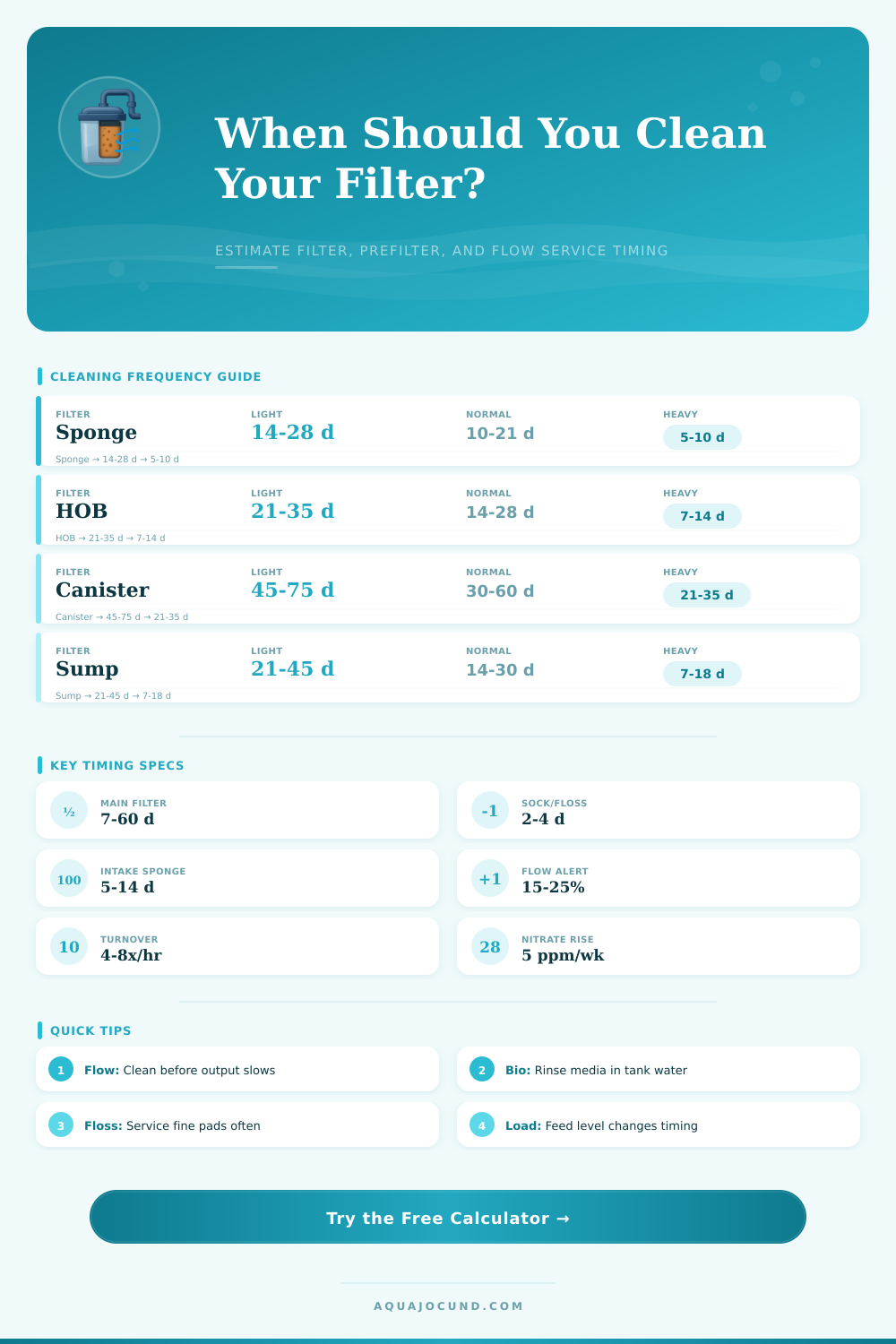
| Filter Style | Light Load | Normal Load | Heavy Load |
|---|---|---|---|
| Air sponge | 14-28 days | 10-21 days | 5-10 days |
| Hang-on-back | 21-35 days | 14-28 days | 7-14 days |
| Internal power filter | 14-28 days | 10-21 days | 5-12 days |
| Canister filter | 45-75 days | 30-60 days | 21-35 days |
| Sump cup or sock | 14-30 days | 7-21 days | 3-10 days |
| Matten foam wall | 60-120 days | 45-90 days | 21-45 days |
| Prefilter Type | Typical Service | Main Filter Relief | Watch Point |
|---|---|---|---|
| No prefilter | None | 0% | Main media catches all solids. |
| Intake sponge | 5-14 days | 20-35% | Squeeze before intake slows. |
| Coarse pad | 4-10 days | 25-40% | Rinse before water bypasses. |
| Fine floss pad | 2-4 days | 40-55% | Replace or rinse when browned. |
| Filter sock | 2-4 days | 50-65% | Overflow means service is due. |
| Roller fleece | 7-21 days | 60-75% | Check advance rate and bypass. |
| Media Type | Solids Trap | Bio Protection | Cleaning Approach |
|---|---|---|---|
| Coarse sponge block | Medium | High | Squeeze gently in removed tank water. |
| Fine foam stack | High | Medium | Rinse often; avoid compacting layers. |
| Floss or cartridge | Very high | Low | Service frequently as mechanical media. |
| Ceramic rings | Low | High | Swish only when flow paths clog. |
| Sintered glass | Low | Very high | Protect from sludge with prefiltering. |
| Bio balls | Low | Medium | Rinse trapped debris, keep surfaces active. |
| Signal | Low Concern | Service Soon | Service Now |
|---|---|---|---|
| Measured flow drop | Under 10% | 10-20% | Over 20-25% |
| Nitrate trend | 0-5 ppm/week | 6-15 ppm/week | Over 15 ppm/week |
| Visible detritus | Light film | Brown mulm | Sludge or bypass |
| Prefilter look | Evenly tinted | Dark patches | Overflow or collapse |
| Turnover after media | 4-8x/hour | 3-4x or 8-10x | Under 3x/hour |
Aquarium filter cleaning follows a specific schedule, and the specific schedule for cleaning the aquarium filter depend on the rate at which waste accumulates within the aquarium filter. The calculator will provide a mathematical result based off specific inputs to the calculator, including inputs of the stocking level of the aquarium, the feeding habit of the aquarium inhabitants, the type of prefilter that is installed in the aquarium filter, the volume of the media used within the aquarium filter, the nitrate levels within the aquarium, and thresholds for the drop in flow rate of the aquarium filter. The use of this calculator will allow you to avoid guesswork in determining the schedule at which the aquarium filter should be cleaned.
An understanding of each of these variable and how they relate to the aquarium filter is necessary in order to determine the length of time that each component of the filter should be cleaned. The production of waste within an aquarium filter is not a constant within the aquarium environment, but instead changes based upon the number of fish that is contained within the tank and the amount of food that is provided to those fish. For instance, a small number of small fish will produce less waste than a few large fish that are fed multiple time each day.
When to Clean Your Aquarium Filter Using a Calculator
Each of these variables is considered by the filter cleaning frequency calculator in that waste production is one of the main factor that will determine how quickly the mechanical media portion of the filter becomes clogged with waste. Furthermore, as the waste accumulates on the mechanical media, it may restrict the flow of water through the filter. Furthermore, the waste that is not able to pass through the mechanical media will continue through the filter towards the biological media of the filter.
As such, it is important for individuals to monitor the amount of waste that is produced within the filter to avoid the development of issues like cloudy tank water or increased nitrate levels within the tank. The type of prefilter that is used within the aquarium filter is another of the main factors that the owner of the aquarium should consider in the process of determining the frequency with which the filter should be cleaned. Prefilters are used to catch the majority of the solid waste that passes through the filter prior to allowing the water to reach the main media of the aquarium filter.
By having a prefilter, the biological media of the filter remains undisturbed by the solid waste that passes through the filter. As such, the fine pad and filter sock that are incorporated into the filter should be cleaned more frequently than the other media components of the filter, but the ceramic or sintered media should only be rinsed if the flow rate of the aquarium filter drops. The volume of the filter media and the type of media that is used within the aquarium filter are also two factor that should be considered.
The volume of the filter media and the type of media that is used within the filter will determine the biological capacity of that filter. For instance, the calculator will use the volume of the media of the filter to determine the length of time that different type of aquarium filters last. For example, a canister filter often will last longer than a hang-on-back filter if each filter contains the same amount of media.
The canister filter, however, will only last longer if its mechanical media is also cleaned according to a separate schedule from the biological media of the filter. The calculator will provide both intervals for the main filter and the prefilter so that the owner of the aquarium can easily determine the schedule for each component of the filter. The drop of the flow rate of the aquarium filter is one of the main indicators that the aquarium filter need to be cleaned.
A percentage of the flow rate will need to be selected as the threshold at which the aquarium filter needs to be cleaned; 20% is one of the most common threshold. A 20% drop is recognized as one of the thresholds that indicates the filter need to be cleaned because 20% is a threshold that prevents the filter from being cleaned too frequently, yet allows the filter to be cleaned in time to prevent issues caused by waste accumulation. In addition to using the predetermined percentage of flow drop to calculate when the filter needs to be cleaned, the number of gallons of the aquarium and the flow rate of the filter will also be used to calculate the rate at which the aquarium water is circulated, and whether or not it is circulated at an appropriate rate.
Another factor that can be used to determine when the aquarium filter should be cleaned is the trends in the aquarium nitrate levels. This information is not obtained through the mathematical calculation of the calculator. For instance, if the nitrates in the tank are consistently increasing at a rate of eight or ten parts per million per week, the biological media of the filter is likely being overloaded with the waste of the tanks fish.
This additional consideration with the filter can help to adjust the maintenance schedule of the aquarium filter according to these observations. Finally, there are several variables of the tank that may need to be considered other than those included in the filter calculation. Variables like trimming the aquarium plants, sifting the substrate at the bottom of the tank, or the death of an aquarium fish can have a major impact upon the load of waste in the aquarium.
Because of the way in which these variables can impact the waste load in the tank, a schedule for cleaning the aquarium filter will only provide a window of time during which the filter should be serviced. Based upon the actual waste production within the tank, the aquarium owner may be able to adjust the schedule of cleaning of the aquarium filter. By establishing a schedule for the aquarium filter that is related to the actual production of waste within that aquarium, the filter will remain effective for longer period of time.
As the filter remains effective, the biological media within that aquarium will remain stable, and the parameter of the tank will remain within the desired range. Finally, if the parameters of the aquarium water remain within the proper range, and the biological filter remains stable, the aquarium will become easier to maintain.