💧 Filter Intake Flow Velocity Calculator
Estimate aquarium intake screen velocity from pump flow, open area, strainer geometry, clog allowance, and livestock sensitivity.
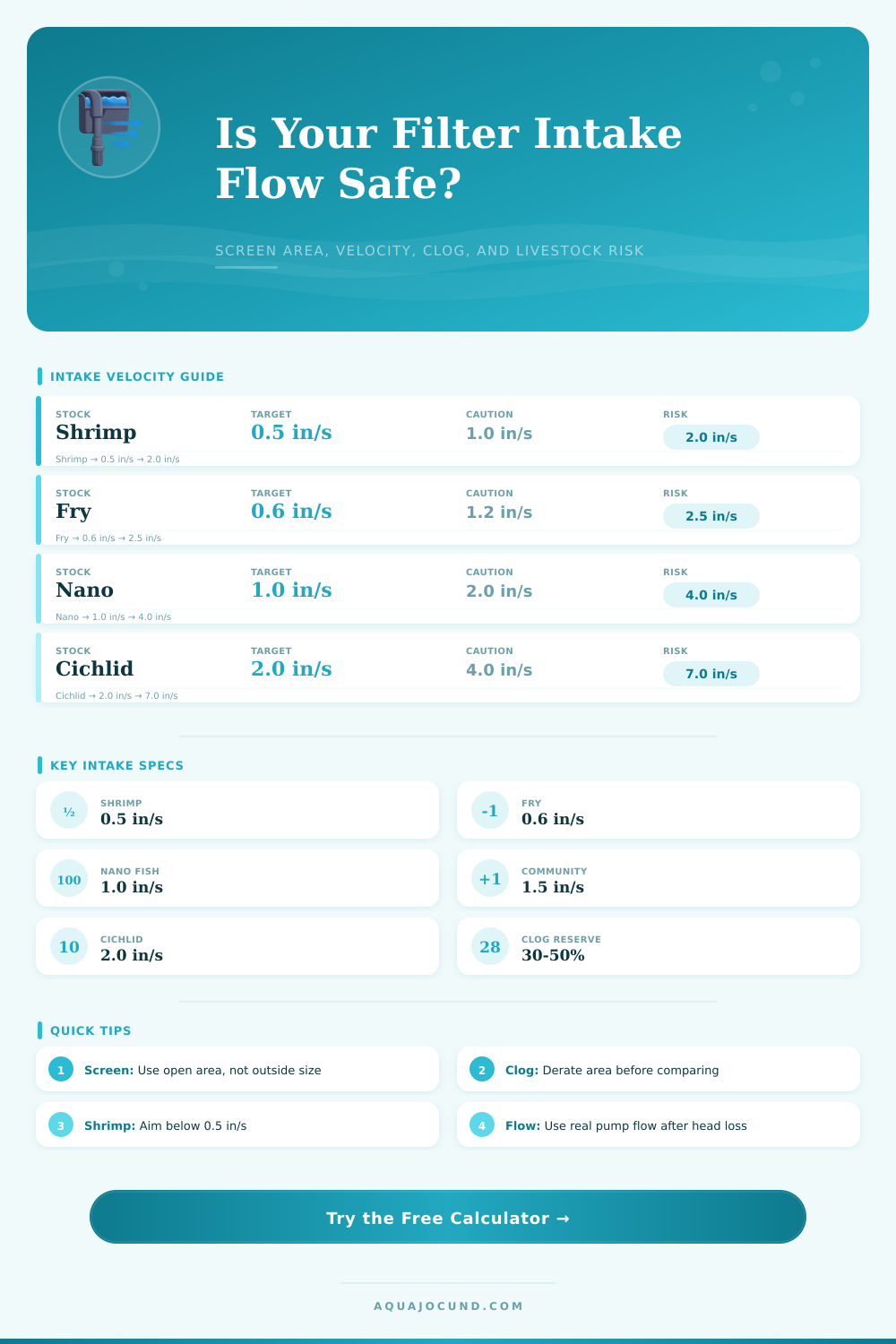
| Livestock Group | Target | Caution Range | High Risk |
|---|---|---|---|
| Shrimp, tiny snails, delicate larvae | 0.3-0.5 in/s (0.8-1.3 cm/s) | 0.5-1.0 in/s | Above 1.0-2.0 in/s, depending on guard texture |
| Fish fry and weak swimmers | 0.4-0.6 in/s (1.0-1.5 cm/s) | 0.6-1.2 in/s | Above 1.2-2.5 in/s |
| Nano fish and bettas | 0.7-1.0 in/s (1.8-2.5 cm/s) | 1.0-2.0 in/s | Above 2.0-4.0 in/s |
| Community fish | 1.0-1.5 in/s (2.5-3.8 cm/s) | 1.5-3.0 in/s | Above 3.0-5.0 in/s |
| Goldfish and robust fish | 1.5-2.0 in/s (3.8-5.1 cm/s) | 2.0-4.0 in/s | Above 4.0-6.0 in/s |
| Cichlids and strong swimmers | 1.5-2.0 in/s (3.8-5.1 cm/s) | 2.0-4.0 in/s | Above 4.0-7.0 in/s |
| Pond fish with guard basket | 2.0-3.0 in/s (5.1-7.6 cm/s) | 3.0-5.0 in/s | Above 5.0-8.0 in/s |
| Intake Shape | Gross Area Formula | Open Area Step | Best Use |
|---|---|---|---|
| Cylindrical strainer wall | pi x diameter x slotted length | Gross x open % x clean reserve | Canister, HOB, and pump strainers |
| Round flat screen | pi x radius squared | Gross x open % x clean reserve | Bulkhead screens and round pump covers |
| Rectangular grill or weir | width x height | Gross x open % x clean reserve | Overflow boxes, rear chambers, grill panels |
| Repeated slot comb | slot width x slot length x slot count | Already open slot area x clean reserve | AIO combs, weirs, custom slotted intakes |
| Custom measured area | measured or manufacturer value | Open area entered directly x clean reserve | Irregular guards, 3D printed cages, baskets |
| Guard Type | Typical Open Area | Clog Allowance | Notes |
|---|---|---|---|
| Bare factory strainer | 25-45% | 20-35% | Small area can make velocity high on large pumps. |
| Coarse plastic cage | 35-60% | 20-40% | Often safer because the cage spreads suction wider. |
| Foam prefilter sleeve | 15-35% | 35-60% | Use a larger sleeve when shrimp, fry, or snails are present. |
| Fine mesh shrimp guard | 20-50% | 35-65% | Low velocity is more important than total pump turnover. |
| Perforated stainless guard | 30-55% | 25-45% | Stays rigid and is easy to brush clean. |
| Overflow weir comb | 25-45% | 20-35% | Long combs usually have lower approach velocity. |
| Large pond basket | 40-70% | 40-70% | Oversize heavily for leaves and string algae. |
| Tank Example | Typical Flow | Safer Intake Area | Practical Guard |
|---|---|---|---|
| 10 gal shrimp tank | 35-80 gph | 3-8 sq in clean net area | Large foam sleeve or wide mesh guard |
| 20 long fry grow-out | 70-140 gph | 6-14 sq in clean net area | Dual sponge guards or long slot screen |
| 29 gal community tank | 120-220 gph | 8-18 sq in clean net area | Coarse cage plus prefilter if needed |
| 55 gal cichlid tank | 300-500 gph | 15-35 sq in clean net area | Large canister cage or two strainers |
| 75 gal reef sump return | 300-600 gph | 20-45 sq in clean net area | Overflow weir, screen box, or guard basket |
| 300 gal pond box | 1200-2500 gph | 80-220 sq in clean net area | Large leaf basket with heavy clog reserve |
Intake velocity are a description of the rate of movement of water through the intake of an aquarium filter. Intake velocity is an important figure in determining the safety of the inhabitant within that aquarium. Although the pump in the filter may move a great deal of water through the filter, if the water are moving through a small opening in the aquarium, the intake velocity may become too highly for the inhabitants.
High intake velocities will pin shrimp against the screen on the filter. Fry must swim harder to escape the suction create by the intake, and high intake velocities can lead to the fry become exhausted. Additionally, high intake velocities can cause the larger fish to avoid the areas of the aquarium where the intake is located.
How to Calculate Aquarium Intake Velocity
The problem isnt necessarily with the pump in the filter, but with the relationship between the amount of water that pass through the filter and the area through which the water move. The calculator on this page will help to determine the intake velocity in you aquarium by entering data about your filter and aquarium. You must enter the flow rate after head loss into the calculator, as well as the shape of the intake and the open area through which the water pass.
Additionally, you must enter the percentage of that open area that may be lost to biofilm and other debris. Finally, the type of fish that live in the aquarium must be entered. The calculator will provide information about the intake velocity at the screen of the filter, as well as if that calculated velocity is within a safe range for the type of fish that you have in your aquarium.
Additionally, the calculator will also estimate the amount of open area that would be required if the aquarium did not have enough open area through the filter to allow for the desired intake velocity. Open area is a critical element in the aquarium water velocity equation. The outside dimensions of a filter guard are not necessarily the same different than the area through which water may pass through the guard.
Factories make cylinder with large outside dimensions but with solid plastic components in the guard that prevent water from passing through those areas. The same is true for guards with foam sleeves; the pores of the foam reduce the area in which water can passing through. The open percentage can be adjusted directly in the calculator.
The open percentage is important in that it will determine the final intake velocity within your aquarium. Clog allowance is another critical factor in determining intake velocity. The intake velocity may be within the safe limits for the filter guard if the guard is clean and free of algae.
However, the intake velocity will increase if the guard becomes covered in algae and other biofilm. The percentage of the guard that may become clogged with this biofilm is another variable that can be entered into the calculator. Allowing for clogging in the guard is important because shrimp and fry cant stand high velocities in the water if the filter screens becomes clogged.
The type of fish that live in the aquarium determine the safe range of intake velocities. The intake velocity that is safe for one type of fish may be too high for another type of fish. A table is included in the calculator that provides different range of velocities for different types of livestock in the aquarium.
These ranges are used to indicate if the intake velocity calculated for your aquarium is within a safe range. Finally, you can also enter a custom target rather than using one of the provided velocities. Because there are various factors within the aquarium that can alter the intake velocity, the parameters that are entered into the aquarium velocity calculator may not always be the factors that exists within the aquarium.
Head loss can occur due to the length of the tubing, the number of elbows in the tubing, and the resistance of the media that is included in some filter designs. The flow rate of the pump is often higher than that of the actual flow rate in the aquarium after head loss occurs. Additionally, the temperature of the water may alter the viscosity of the water and, therefore, the velocity of the water through the aquarium.
Additionally, the guard may deform under the suction of the aquarium filter. Therefore, the best determination of intake velocity is through measuring the actual flow of the filter. With respect to head loss and deformation of the guard, it is best to use a conservative clog allowance in the calculator.
If the calculated intake velocity of the aquarium is too high, it may be necessary to add a second intake to the aquarium or to increase the size of the filter guard. Increasing the size of the guard will have a less negative impact on the aquarium water velocity than will throttling the pump that control the filter. The purpose of the intake velocity calculator is to ensure that the intake velocity remain within a safe range for the livestock in the aquarium.
It isnt necessary to have an exact intake velocity. Rather, it is important to ensure that there is an allowance for the filter to be maintained and cleaned regular, as excessive cleaning may otherwise lead to too high of an intake velocity. As long as the calculated velocity is within the target range, the filtration system will function properly and not pose any problem for the animals in the aquarium.