Spray Bar Length Calculator
Plan aquarium spray bar run length, drilled hole spacing, outlet velocity, flow split, and coverage.
| Jet Speed | Metric | Typical Use | Planning Note |
|---|---|---|---|
| Under 1 ft/s | Under 0.30 m/s | Very gentle tanks | May not sweep debris far from the bar |
| 1-2 ft/s | 0.30-0.61 m/s | Planted, shrimp, fry | Broad motion with low blast risk |
| 2-4 ft/s | 0.61-1.22 m/s | Community aquariums | Common target for drilled returns |
| 4-6 ft/s | 1.22-1.83 m/s | High oxygen or reef surface | Aim across the surface, not at livestock |
| Over 6 ft/s | Over 1.83 m/s | Usually too strong | Add holes, enlarge holes, or reduce flow |
| Style | Coefficient | Best Velocity | Coverage Behavior |
|---|---|---|---|
| Gentle single-row | 0.72 | 1.0-2.4 ft/s | Soft sheet of flow for planted tanks |
| Standard single-row | 0.70 | 2.0-4.2 ft/s | Balanced return for most aquariums |
| Broad dual-row | 0.68 | 1.5-3.5 ft/s | More holes, lower jet force per hole |
| Drilled PVC return | 0.62 | 2.2-5.0 ft/s | Rougher holes need more area |
| Slim lily-pipe bar | 0.78 | 1.5-3.6 ft/s | Smooth holes and narrow tube |
| Low-pressure manifold | 0.82 | 0.8-2.5 ft/s | Many outlets across a wide run |
| Reef surface bar | 0.66 | 3.0-6.0 ft/s | Shorter, stronger jets for surface ripple |
| Rack distribution bar | 0.74 | 1.0-3.0 ft/s | Even split across shallow systems |
| Tank | Dimensions | Typical Return | Typical Bar Run |
|---|---|---|---|
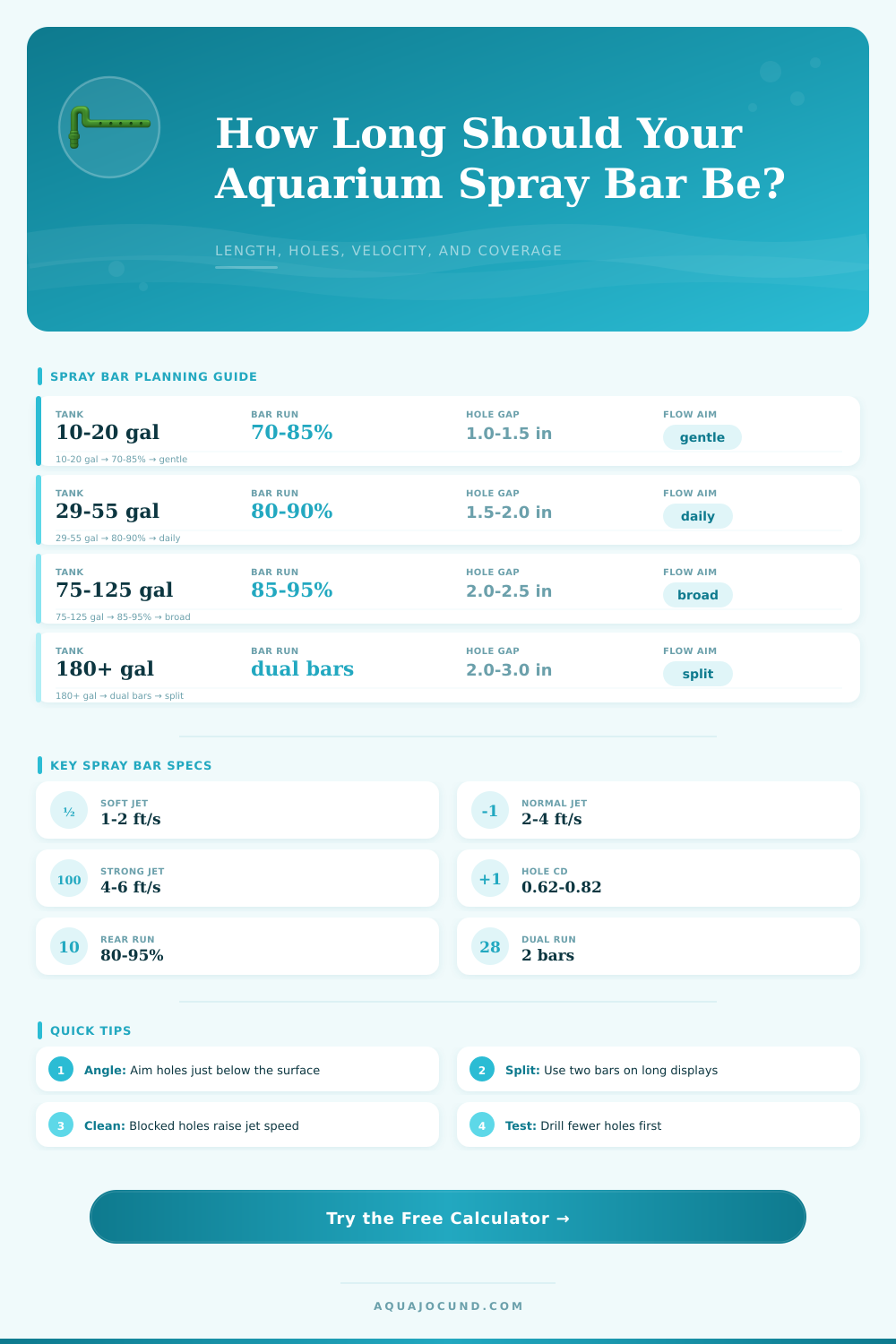
| 10 gallon | 20 × 10 × 12 in / 51 × 25 × 30 cm | 60-120 gph / 230-450 L/h | 14-17 in / 36-43 cm |
| 20 long | 30 × 12 × 12 in / 76 × 30 × 30 cm | 120-220 gph / 450-830 L/h | 22-26 in / 56-66 cm |
| 40 breeder | 36 × 18 × 16 in / 91 × 46 × 41 cm | 220-420 gph / 830-1590 L/h | 28-32 in / 71-81 cm |
| 55 gallon | 48 × 13 × 21 in / 122 × 33 × 53 cm | 300-550 gph / 1140-2080 L/h | 38-43 in / 97-109 cm |
| 75 gallon | 48 × 18 × 21 in / 122 × 46 × 53 cm | 400-750 gph / 1510-2840 L/h | 39-44 in / 99-112 cm |
| 125 gallon | 72 × 18 × 21 in / 183 × 46 × 53 cm | 650-1200 gph / 2460-4540 L/h | dual 28-33 in / 71-84 cm |
| 180 gallon | 72 × 24 × 24 in / 183 × 61 × 61 cm | 900-1800 gph / 3410-6810 L/h | dual 30-34 in / 76-86 cm |
| Hole Diameter | Area Per Hole | Good Spacing | Typical Use |
|---|---|---|---|
| 3/32 in / 2.4 mm | 0.0069 sq in / 4.45 sq mm | 1.0-1.5 in / 2.5-3.8 cm | Small tanks and low flow |
| 1/8 in / 3.2 mm | 0.0123 sq in / 7.92 sq mm | 1.5-2.0 in / 3.8-5.1 cm | Most freshwater returns |
| 5/32 in / 4.0 mm | 0.0192 sq in / 12.4 sq mm | 1.75-2.5 in / 4.4-6.4 cm | Medium flow bars |
| 3/16 in / 4.8 mm | 0.0276 sq in / 17.8 sq mm | 2.0-3.0 in / 5.1-7.6 cm | Large returns or dual rows |
| 1/4 in / 6.4 mm | 0.0491 sq in / 31.7 sq mm | 2.5-4.0 in / 6.4-10.2 cm | Manifolds and rack bars |
A spray bar are used to distribute the return flow from the filter throughout an aquarium. The spray bar is important because the spray bar will determines how the water will move throughout the aquarium. With the proper use of a spray bar, the fishes will stay active, the plants will remains vertical, and the detritus will move towards the filter.
A spray bar is simply a tube with hole drilled into the tube. The length of the tube is important in that it will determine if the water features in the aquarium is a steady movement of water or if there are strong jet of water in certain areas but dead spots in others. You must decide how long the spray bar should be in relation to the length of the aquarium.
How to choose a spray bar for your aquarium
If the return flow does not reach the far end of the aquarium, then the fish on the opposite side of the tank will not recieve any movement in the water. However, if the spray bar is too long, the water pressure may drop through the last few holes in the spray bar, meaning there will be no water movement in those last few area of the tank. A calculator can help you decide how much holes the spray bar should have and how fast the water should emerge from the holes.
These three numbers are the most important in determining the type of water movements that will be established within the aquarium. The size of the holes in the spray bar and the distance between the holes also controls the velocity of the water movement in the tank. If the aquarium contain planted tanks or shrimp, then you want to use small holes that are placed close to one another.
For tanks that require more water movement, such as those containing fish that requires a current, use larger holes that are further from one another. The calculator can estimate the outlet velocity to help you determine whether the velocity is gentle or strongly in relation to the inhabitants of the tank. This will help prevent the possibility of drilling a multitude of holes in the spray bar only to find later on that the water movement is too strong in the tank.
Another factor to consider is the diameter of the pipe within the spray bar. The diameter of the pipe should be wide enough such that even the water at the last end of the pipe has the same pressure throughout the entire length of the pipe. An open-area check can help to determine whether the total area of the holes equal the area of the pipe.
Many people tend to ignore the diameter of the pipe within the spray bar, but it is a critical component of the system. The placement of the spray bar also has an impact on the way the water move within the tank. By mounting the spray bar one inch from the water’s surface, the return flow will create gentle ripples at the surface of the water.
By placing the spray bar further from the surface of the water, the return flow will help to water the substrate in the tank. Decoration and tall plants will likely block some of the water from the spray bar, so you should make adjustments to the spray bar to account for this after the aquascape is created. Start with fewer holes in the spray bar and add more as necessary.
For aquariums that is sixty feet in length or longer, it is useful to incorporate dual spray bars. Two shorter spray bars will allow the water to move in a manner that is not too strong yet ensures coverage of the entire length of the aquarium. The calculator allows the designer to choose multiple spray bars, and it will divide the flow of water from each spray bar such that it is easy to determine if two spray bars is sufficient for the length of the aquarium or if three spray bars are a better choice.
The goal is to create a spray bar that meet the needs of the aquarium. Planted tanks require a soft water movement with broad coverage, while reef tanks or tanks with fish that require alot of dissolved oxygen will need a water movement that is stronger. When all the parameters of the length of the aquarium, the number of holes in the spray bar, and the velocity of the return flow is set to meet the needs of the tank, the spray bar will become a functional part of the biological system that maintain the aquarium.