Airline Length Flow Calculator
Estimate how tubing length, water depth, valves, fittings, and pump pressure reduce aquarium air flow.
Air Flow Estimate
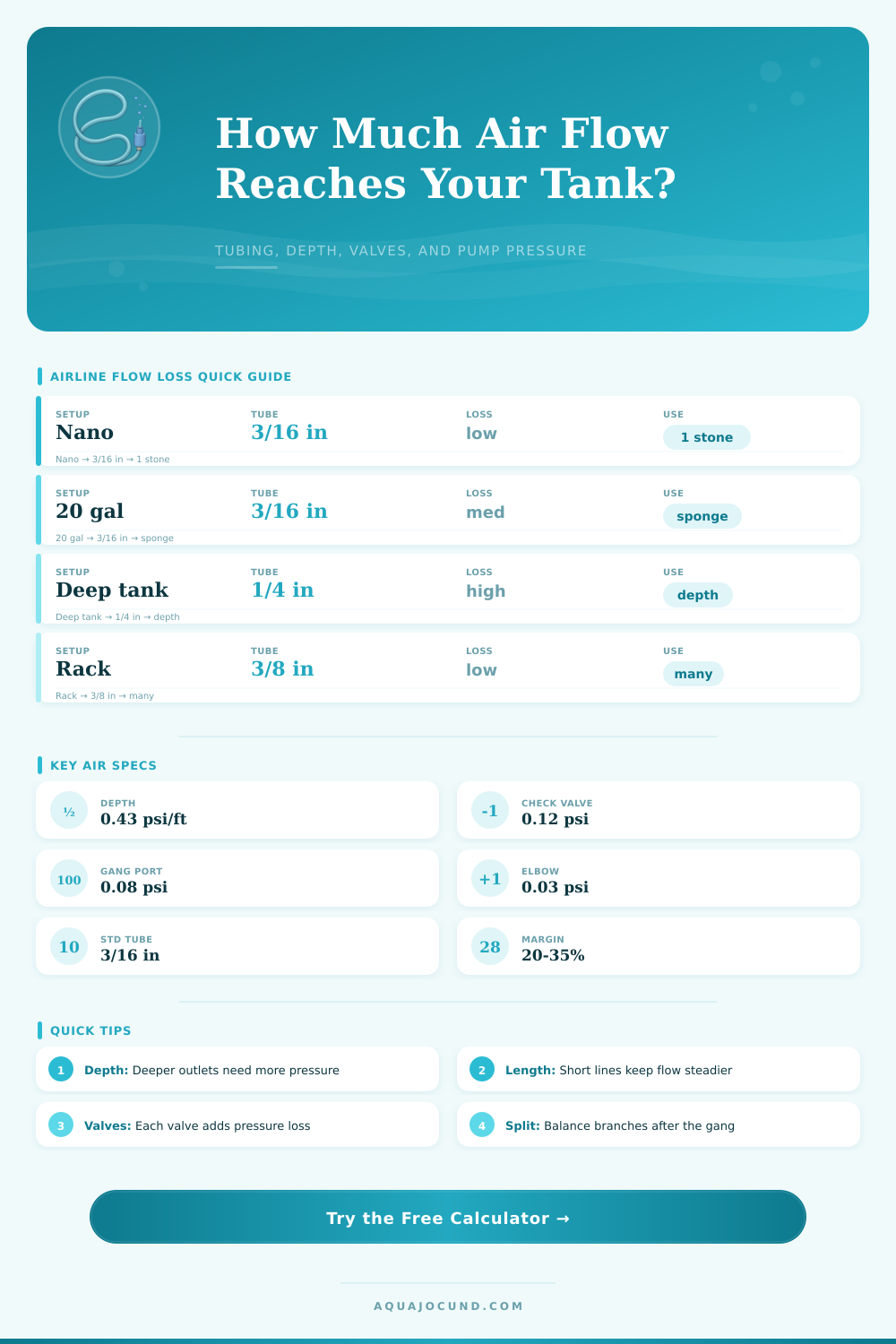
| Tubing Type | Inside Diameter | Best Use | Flow Loss Pattern |
|---|---|---|---|
| Micro airline | 1/8 in / 3.2 mm | Very short nano tank lines | High loss above about 0.5 L/min |
| Standard silicone or PVC airline | 3/16 in / 4.8 mm | Most stones and sponge filters | Moderate loss on common 3-12 ft runs |
| Wide airline | 1/4 in / 6.4 mm | Deep tanks and larger bubble bars | Lower loss for higher flow branches |
| Manifold feed tube | 3/8 in / 9.5 mm | Rack feed before individual valves | Low trunk loss before branch splitting |
| Tank Setup | Typical Depth | Common Airline Run | Practical Pump Range |
|---|---|---|---|
| 5-10 gal betta or shrimp | 8-12 in / 20-30 cm | 3-6 ft / 0.9-1.8 m | 0.8-1.8 L/min |
| 20 long sponge filter | 10-12 in / 25-30 cm | 5-10 ft / 1.5-3 m | 1.5-3.0 L/min |
| 40 breeder bubble bar | 13-15 in / 33-38 cm | 8-14 ft / 2.4-4.3 m | 3.0-5.0 L/min |
| 55-75 gal dual sponge | 16-20 in / 41-51 cm | 10-18 ft / 3-5.5 m | 4.0-8.0 L/min |
| Multi-tank rack | 10-18 in / 25-46 cm | 20-60 ft / 6-18 m | 12-40 L/min |
| Component | Typical Allowance | What It Represents | When to Add More Margin |
|---|---|---|---|
| Water depth | 0.433 psi/ft or 9.81 kPa/m | Static back pressure at the air outlet | Deep tanks, pond tubs, or low pump ratings |
| Check valve | 0.08-0.18 psi each | Cracking pressure and small restriction | Stiff new valves or mineral buildup |
| Gang valve port | 0.05-0.14 psi per used port | Needle opening and small passage loss | Ports nearly closed to balance flow |
| Small fitting or elbow | 0.02-0.05 psi each | Local turbulence at direction changes | Many connectors or hard plastic manifolds |
| Device | Normal Flow | Added Device Loss | Useful Note |
|---|---|---|---|
| Fine pore stone | 0.3-1.2 L/min | 0.18 psi | Small bubbles, clogs faster |
| Coarse air stone | 0.5-2.0 L/min | 0.10 psi | Lower restriction, larger bubbles |
| Sponge filter | 0.7-2.5 L/min | 0.12 psi | Needs steady lift, not extreme flow |
| Bubble bar | 1.2-4.5 L/min | 0.16 psi | Long bars benefit from wider tubing |
| Disc diffuser | 1.5-8.0 L/min | 0.22 psi | High flow and higher pressure demand |
Getting the correct amount of air into an aquarium is necessary for the air to be able to move through the system to reach the water. While many people think of the air pump as the only important component for providing air for there aquarium, there are other factors that have an impact on the amount of air that reaches the aquarium. Factors to consider include tubing, depth of the water, and the various fittings that is attached to the air pump.
The air has to work against the water pressure and the friction that occurs in the tubing in order for the air to reach the aquarium. Thus, the air pump has to be strong enough to overcome these factor. Should the resistance created by the water, tubing, and other fittings be too high for the air pump’s rating, the air flow that reaches the aquarium will be less than expected.
Getting Air to Your Aquarium
The calculator that is provided on this page allow you and your aquarium system to enter specific numbers that describe your system. Based off the information that you enter, the calculator will tell you if your air pump can handle the system’s resistance. Factors that the calculator considers include the distance that the air travels, the depth of the water, and the number of check valve and gang ports that are present in your system.
Each check valve and gang port reduces the air pressure in the aquarium system. For example, a single check valve can reduce the air pressure that the air pump creates to the point where the sponge filter cannot provide the proper amount of filtration for the aquarium. Another important factor is the depth of the water in the aquarium.
Many people do not consider the back pressure that the water can create against the air. A shallow aquarium and a deep aquarium will both require the same air pump and tubing to move the air from the air pump to the aquarium. However, because of the back pressure of the deep water, the deep aquarium may not be able to recieve the same amount of air as the shallow aquarium.
The calculator accounts for the possibility of this type of difference so that you can see if the air pump has enough power to push the air to the bottom of your aquarium. If your air pump does not have enough power, you can adjust your system to use shorter tubing, wider tubing, or you can use an air pump with higher pressure ratings. The diameter of the tubing that is used in the aquarium system is another factor that must be considered.
The wider the tubing, the less friction that is created for the air to travel through the system. However, wider tubing may become bulky if incorporated into a small aquarium, and wider tubing may also cost more money than narrow tubing. By consulting the reference material that is provided on this page, you can determine the airflow that will result from each type of tubing.
This will help you to avoid guesswork in the construction or renovation of your aquarium. Other factors to consider include the valves and the number of fittings in the system. Each elbow fitting or gang valve port will reduce the amount of air that is deliver to the aquarium system.
In the calculator, you can account for each of these ports and each of the elbows in your system. In determining how many air pump ratings are necessary to supply the aquarium, you must take into account these variables. In some cases, it may be more cost effective for your aquarium system to use a single air pump that has higher ratings than you calculates for your system.
In other instances, however, it may be more cost effective and easier to manage your system if you purchase additional air pumps than it is to buy one that has higher ratings. It is often a mistake to assume that the air pump’s rating for air flow is the amount of air that will flow through the system. That specific amount of air flow is only measured for the air pump when there is no back pressure against the air.
The back pressure of the water, other valves, and other system components will reduce the air flow. Furthermore, as the air pump ages, the air flow will decrease. Thus, the calculator includes a safety margin in case the actual air flow is less than what is calculated.
When you push your air pump to near its limit, there is no remaining headroom for other components that might reduce the air flow. When you run air pumps into different parts of the aquarium that are not all of the same depth, you have to consider which branch will be the deepest or longest. The deepest or longest branch of air will set the minimum amount of air pressure that the other air branches receive from the air pump.
Air can be throttled down on the shorter branches to account for the difference in air pressure between the longest branch. However, the air pressure for the longest branch of air cannot be increased without also changing the layout of the aquarium and the air pump system. Thus, when you design the system, calculate for the longest branch of air first.
This will ensure that each part of the aquarium receives the same amount of air. Often, the best solutions to air-related problems in the aquarium are small changes to the current system rather than buying a new air pump. For instance, shortening the tubing, widening the tubing that is used to deliver the air to the aquarium, or removing valves from the system can all help to ensure that the air can reach the aquarium with minimal resistance.
Use the calculator to determine these changes prior to purchasing new aquarium equipment. If the calculator shows that there is enough headroom in the system for the air to travel to each part of the aquarium, the air bubbles will be consistent throughout the aquarium and the filters will function properly without requiring constant adjustments to the system. By providing the correct amount of air to the aquarium, the aquarium inhabitants will remain healthy over long periods of time.