🫧 Air Stone Size Calculator
Estimate aquarium air flow, stone count, bubble coverage, depth pressure loss, and pump headroom from tank size and aeration goal.
| Air Stone Type | Usable Flow | Pressure Add | Best Placement |
|---|---|---|---|
| Micro cylinder 0.75 in | 0.2-0.6 L/min | 0.18 psi | Nano tank, low-current corner. |
| Small cylinder 1 in | 0.4-1.0 L/min | 0.20 psi | Small tanks or one side of a 20 gallon. |
| Medium cylinder 2 in | 0.8-1.8 L/min | 0.23 psi | General tanks with moderate bubbles. |
| Bar stone 4 in | 1.2-3.0 L/min | 0.28 psi | Back wall or under a sponge lift. |
| Bar stone 6 in | 2.0-4.5 L/min | 0.32 psi | Long aquariums needing even coverage. |
| Disc stone 2 in | 1.5-3.0 L/min | 0.35 psi | Deep center plume or sump chamber. |
| Disc stone 4 in | 4.0-8.0 L/min | 0.45 psi | Large tanks, vats, and strong lift columns. |
| Limewood diffuser | 0.3-1.2 L/min | 0.40 psi | Fine bubble use with frequent replacement. |
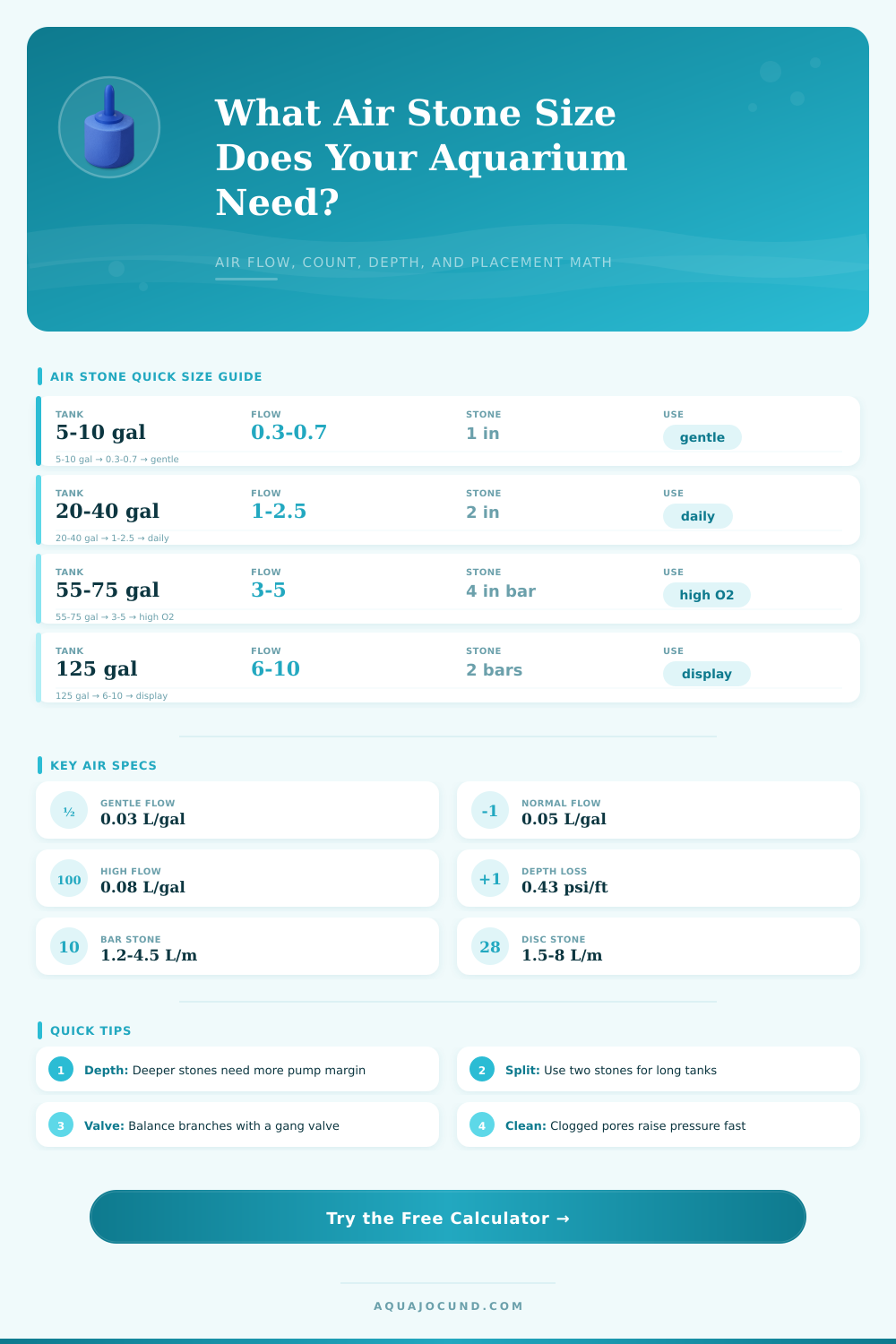
| Tank | Dimensions | Typical Flow | Common Stone Layout |
|---|---|---|---|
| 5 gal | 16 x 8 x 10 in / 41 x 20 x 25 cm | 0.2-0.4 L/min | One micro cylinder turned down. |
| 10 gal | 20 x 10 x 12 in / 51 x 25 x 30 cm | 0.4-0.8 L/min | One 1 in cylinder or limewood stone. |
| 20 long | 30 x 12 x 12 in / 76 x 30 x 30 cm | 0.8-1.6 L/min | One 2 in cylinder or 4 in bar. |
| 40 breeder | 36 x 18 x 16 in / 91 x 46 x 41 cm | 1.8-3.2 L/min | Two small stones or one 4 in bar. |
| 55 gal | 48 x 13 x 21 in / 122 x 33 x 53 cm | 2.5-4.5 L/min | Two 2 in stones or one 6 in bar. |
| 75 gal | 48 x 18 x 21 in / 122 x 46 x 53 cm | 3.4-6.0 L/min | Two bars or one larger disc in sump. |
| 125 gal | 72 x 18 x 21 in / 183 x 46 x 53 cm | 5.5-10 L/min | Two 6 in bars or two large discs. |
| Stone Depth | Water Pressure | Recommended Pump Margin | What It Means |
|---|---|---|---|
| 6 in / 15 cm | 0.22 psi | 15-25% | Most small pumps hold flow easily. |
| 12 in / 30 cm | 0.43 psi | 25-35% | Normal aquarium depth. |
| 18 in / 46 cm | 0.65 psi | 35-45% | Use a stronger pump or fewer restrictions. |
| 24 in / 61 cm | 0.87 psi | 45-60% | Deep tanks need pumps with pressure capacity. |
| Goal | Base Flow Rate | Bubble Pattern | Use Case |
|---|---|---|---|
| Gentle movement | 0.025 L/min per gal | Soft corner plume | Betta, shrimp, or low-current fish. |
| Standard aeration | 0.045 L/min per gal | Steady visible bubbles | Most daily freshwater aquariums. |
| Planted night air | 0.035 L/min per gal | Moderate timed output | Nighttime gas exchange with less CO2 loss. |
| High oxygen | 0.075 L/min per gal | Strong lift column | Warm water, heavy stock, or low oxygen risk. |
| Treatment tank | 0.10 L/min per gal | Strong surface agitation | Medication, salt bath support, or quarantine. |
| Sponge filter drive | 0.12 L/min per gal | Lift plus filtration | Air-driven sponge or box filter flow. |
When choosing the best air stone for your aquarium, you need to consider a few different factor. The air stone will create the bubbles in your tank, which will allow the water to circulate and provide oxygen to the fish at the bottom of your aquarium. However, if there are too many bubbles or too few, this can pose a problem for your fish.
Too few bubble will make the fish gasp for air, while too many will remove the carbon dioxide that the plant need or cause the fish to feel the water current too much. The first few factor to consider are the size and the shape of your aquarium and the height of the water in the aquarium. The shape of your aquarium can play a big part in how your bubbles will move throughout the tank, regardless of the size of the aquarium.
How to Choose the Right Air Stone for Your Fish Tank
If you have a long aquarium, it may be better to place your air stone in one end of the tank so that the water dont have to move as much to circulate throughout the tank. The depth of the water is also another factor; every foot of water represent more resistance on the air pump. This is also multiplied by the amount of airline tubing and the air stone.
Online calculator can help you determine these measurements. Another factor to consider when choosing the appropriate air stone is the type of air stone. Depending on the size of your aquarium, a small air stone may work for a ten-gallon tank but not for a fifty-five gallon tank.
Instead, you would likely need to use more air stone or an air stone with a more big diameter, such as a bar or disc air stone. Air stones has specific ranges in which they need to work. Using the air stone outside of these parameter may cause it to fail or waste the air pumps strength.
Air stone placement is another factor to consider. Using just one air stone in a long aquarium may not provide enough circulation to the other end of the tank. In this case, you may want to use two air stones to ensure the water move throughout the aquarium in an even manner.
Your aeration goals may influence the performance of your air stone. For instance, if you have a planted aquarium, you may want to reduce the number of bubbles created by the air stone so that the fish are not disturbed during the night. On the other hand, a hospital tank may require more aeration to help the ill fish.
The air stone may also have to work harder in a warm tank than in a cool one; the warmer the water, the less dissolved oxygen it can hold. A tank with many fish will also require more aeration than a shrimp tank with fewer fish. There are calculators that can help you determine these parameter to suit your aquarium.
Finally, the air pump’s rating is another consideration. Most people will buy an air pump based off the size of their aquarium. However, the air pump must overcome the resistance created by the depth of the water, the airline tubing, and the air stone pores.
Calculators can help you determine the margin percentage of the air pump. This percentage will show how much extra capacity the air pump has beyond the aquariums requirement. A lower percentage means that the air pump will work but will struggle to overcome the resistance caused by the air stone becoming clogged.
Aquariums and air stones change over time. Plants grow, fish grow, and air stones develop debris that create resistance for the air pumps. By calculating the margin percentage of the air pump, you can ensure that you have a buffer for these change.
If the water begins to make the fish gasp at the surface, it is a sure sign that the air pump is struggling to supply the water with the oxygen the fish require. You can use this buffer to determine whether or not you need a gang valve to even cover your aquarium. The goal with any air stone is to create a steady and visible number of bubble that will reach the majority of your aquarium without creating a whirlpool of water on the surface of the aquarium.
Following these parameter will allow the air stone to perform as it should and allow the fish to comfortabley live in their tanks.