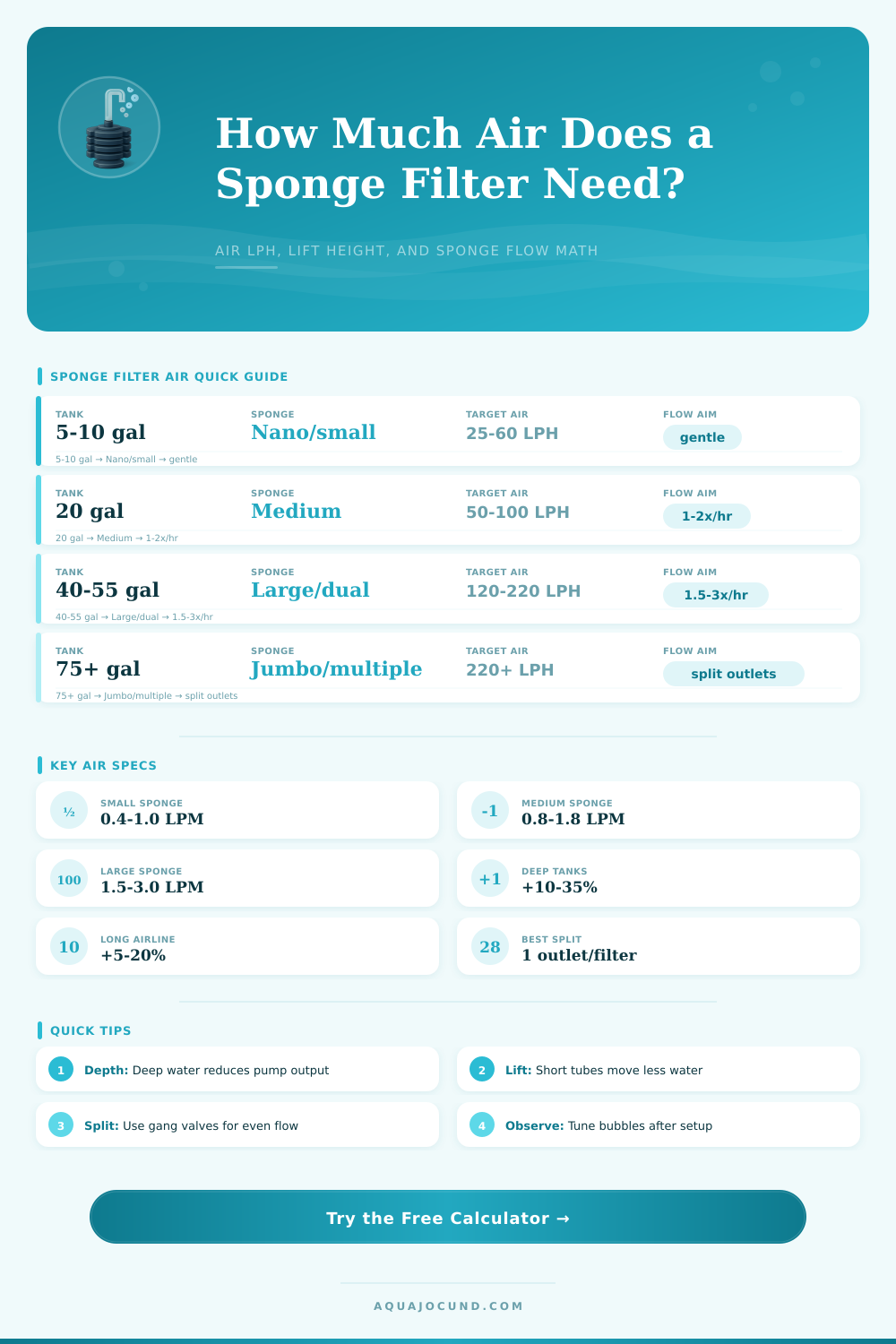
Sponge Filter Air Requirement Calculator
Estimate air pump LPH, per-outlet LPM, water movement, and lift allowance for sponge filters.
| Sponge type | Typical air | Water per air | Best use |
|---|---|---|---|
| Nano single sponge | 20-45 LPH | 1.4 L water per 1 L air | Betta, shrimp, fry boxes |
| Small weighted sponge | 30-70 LPH | 1.7 L water per 1 L air | 5-15 gal gentle tanks |
| Medium single sponge | 50-110 LPH | 2.1 L water per 1 L air | 10-30 gal general use |
| Large single sponge | 90-180 LPH | 2.4 L water per 1 L air | 29-55 gal or messy stock |
| Dual medium sponge | 100-220 LPH | 2.5 L water per 1 L air | Broader intake area |
| Jumbo sponge | 150-320 LPH | 2.7 L water per 1 L air | Large tanks and tubs |
| Corner block sponge | 100-240 LPH | 2.3 L water per 1 L air | Corner biofiltration |
| Matten wall/filter block | 120-360 LPH | 3.0 L water per 1 L air | Low velocity broad sponge wall |
| Condition | Adjustment | Why it matters | Typical fix |
|---|---|---|---|
| Short uplift, under 6 in / 15 cm | About +25% | Weak lift column moves less water for the same air | Extend tube or accept gentler flow |
| Moderate uplift, 10-18 in / 25-45 cm | Baseline | Most sponge filters lift efficiently in this range | Use normal sizing |
| Deep stone, over 18 in / 46 cm | +10-35% | Water pressure reduces many small pump outputs | Use deeper-rated pump |
| Long airline, over 8 ft / 2.4 m | +6-20% | Tubing and fittings add restriction | Shorten run or use larger manifold |
| Tank | Dimensions | Volume | Typical sponge air |
|---|---|---|---|
| 5.5 gal nano | 16 x 8 x 10 in / 41 x 20 x 25 cm | 21 L | 25-45 LPH |
| 10 gal standard | 20 x 10 x 12 in / 51 x 25 x 30 cm | 38 L | 35-75 LPH |
| 20 gal long | 30 x 12 x 12 in / 76 x 30 x 30 cm | 76 L | 55-120 LPH |
| 29 gal | 30 x 12 x 18 in / 76 x 30 x 46 cm | 110 L | 80-160 LPH |
| 40 breeder | 36 x 18 x 16 in / 91 x 46 x 41 cm | 151 L | 120-240 LPH |
| 55 gal | 48 x 13 x 21 in / 122 x 33 x 53 cm | 208 L | 160-320 LPH |
| 75 gal | 48 x 18 x 21 in / 122 x 46 x 53 cm | 284 L | 220-420 LPH |
| Setup | Loss range | Balanced output cue | Calculator treatment |
|---|---|---|---|
| Single short line | 0-5% | Steady fine bubbles | Small tubing allowance |
| Check valve plus control valve | 3-10% | Valve partly open, no pulsing | Fitting count increases reserve |
| Gang valve with 2-4 outlets | 8-18% | Each sponge bubbles evenly | Per-outlet result guides splitting |
| Long rack manifold | 15-35% | End outlets still adjustable | Long airline and pump factor increase LPH |
Sponge filters are pieces of aquarium equipment that require air in order to perform there function of moving water through the sponge filter. The amount of air provided to a sponge filter will determine the amount of water that pass through the sponge filter. If the air provided to a sponge filter is too little, the water wont effectively move through the filter.
If, however, the air provided to the sponge filter is too much, the current that the filter create may be too strong for the fish that live in the tank. The amount of air that is required to operate a sponge filter efficient is dependent upon a variety of different factors. Some of those factors are the volume of the tank in which the sponge filter will operate, the style of the sponge filter itself, the height of the lift tube that is associated with the filter, and the depth at which the air stone that provide the air to the sponge filter sits within the tanks water.
How Much Air Does a Sponge Filter Need?
One of the factors that is especially critical in determining the amount of air that is provided to a sponge filter is the height of the lift tube. If the lift tube is too short, the water that is moving through the filter may not move as much water as the owner had expected from the sponge filter. If the lift tube is too deep, however, the water pressure that is created will reduce the output of the air pump that provides air to the sponge filter.
Thus, the depth of the air stone impact the output of the air pump, and the depth of the air stone will also impact the amount of water that passes through the sponge filter. The calculator that is provided accounts for the height of the lift tube, the depth of the air stone, the length of the airline that connect the air stone to the sponge filter, and the resistance that is created by the fittings in the airline. The style of sponge that is used within the sponge filter will also impact the amount of air that the filter requires.
For instance, an thin nano sponge will have a different surface area and a different water-to-air ratio then a jumbo block sponge. Because these variables are different between the two types of sponge filters, the thin nano sponge will require less air than the jumbo block sponge. The calculator takes into account both the surface area and the water-to-air ratio for the type of sponge filter that is to be utilized.
Furthermore, the calculator builds a safety margin into the air volume that is calculated. The reason for including a safety margin is due to the fact that the output of an air pump may reduce if the tank experience temperature swings, if the filter becomes slightly clogged, or if the diaphragms within the air pump begin to age. Another factor that can influence the amount of air that is required for a sponge filter is the stocking level for the tank in which that filter will be used.
For instance, a tank that contain planted tanks and few fish will have a different waste load than a grow-out tank that contains many fish. The waste load that the tanks fish creates will influence the amount of water turnover that is required to keep the tanks water as clean as possible. Thus, the deeper the waste load of the tank, the more air that will be required to provide the necessary amount of water turnover.
This factor in the calculator allows for the user to adjust for the waste load of the tank. Due to the fact that many individuals attempt to size the air pump for their sponge filter by referencing the free-air rating of the pump, which is a different number from the actual output of the air pump when submerged in water, the calculator also utilizes the working depth of the water in which the sponge filter is located. The calculator also permits for the user to split the total amount of air that is calculated for the tanks sponge filter into the number of sponge filters that is to be utilized by the aquarium.
This allows for the user to determine if one air pump may be sufficient for providing air for two or three sponge filters. Additionally, if the air pump’s air is to be provided to more than one sponge filter, the air pump should not starve one sponge filter for air in order to supply air to another sponge filter. Reference tables are included that indicate the amount of air that is required by different types of sponge filters.
These tables may be helpful in the initial purchase of the air pump for the tank. It is also important for the owner of the aquarium to ensure that the outlets of the sponge filters are balanced after the sponge filters have been submerged into the tanks water. If the sponge filter outlets are not balanced after submerging the filters into the tank, the filter may not efficient move the necessary amount of water through the filter.
By ensuring that the air passes steadily and evenly through the sponge filter, the sponge filter will remain effective for longer periods, and will help to keep the water in the aquarium clear.