Bio Media Quantity Calculator
Size aquarium biological filter media from water volume, stocking pressure, food input, ammonia load, and media capacity.
Bio Media Quantity Results
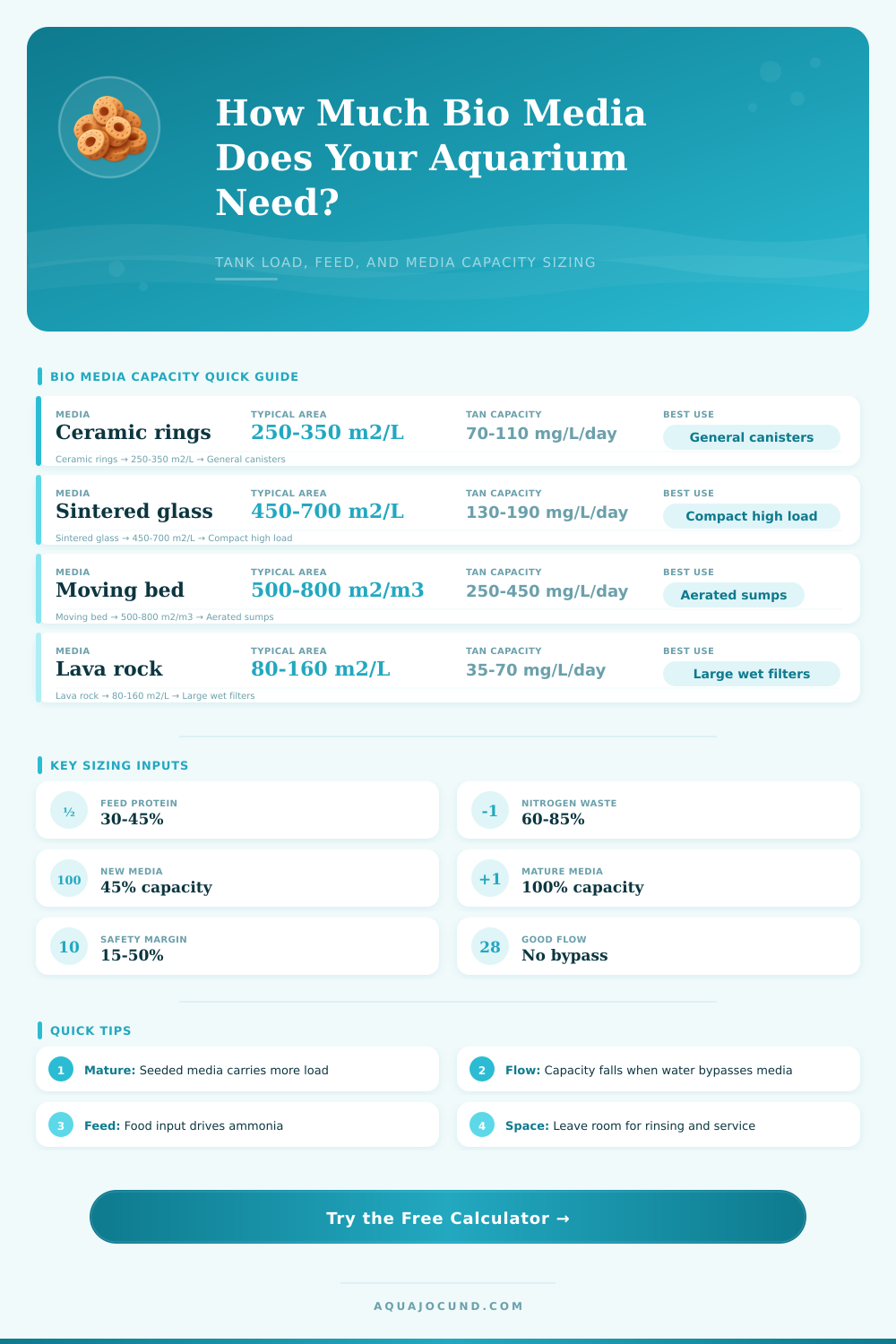
| Media type | Typical surface area | Effective capacity | Bulk density | Calculation note |
|---|---|---|---|---|
| Ceramic rings | 250-350 m²/L | 90 mg TAN/L/day | 0.45 kg/L | Reliable submerged media with moderate void space |
| Sintered glass | 450-700 m²/L | 160 mg TAN/L/day | 0.38 kg/L | High area media, protect from heavy debris |
| Porous pumice | 200-450 m²/L | 100 mg TAN/L/day | 0.55 kg/L | Variable pores, rinse grit before use |
| Lava rock | 80-160 m²/L | 55 mg TAN/L/day | 0.65 kg/L | Best when used in larger wet filters |
| Plastic bio balls | 100-180 m²/m³ | 120 mg TAN/L/day | 0.12 kg/L | Works well in wet/dry trickle filters |
| Reticulated sponge | 250-500 m²/m³ | 80 mg TAN/L/day | 0.08 kg/L | Good bio plus mechanical capture |
| K1-style moving bed | 500-800 m²/m³ | 340 mg TAN/L/day | 0.15 kg/L | Needs strong aeration and free motion |
| Shower tower media | 200-450 m²/m³ | 260 mg TAN/L/day | 0.18 kg/L | High oxygen wet/dry configuration |
| Daily food | Protein | Estimated TAN | Use case |
|---|---|---|---|
| 0.5 g/day | 38% | 22-32 mg/day | Nano or single centerpiece fish |
| 2 g/day | 40% | 95-135 mg/day | Small community aquarium |
| 5 g/day | 42% | 250-360 mg/day | Medium stocked display |
| 12 g/day | 44% | 640-920 mg/day | Heavy cichlid, goldfish, or predator tank |
| 30 g/day | 36% | 1,300-1,850 mg/day | Growout system or pond filter |
| Tank | Typical dimensions | Moderate feed | Ceramic rings | Sintered glass |
|---|---|---|---|---|
| 10 gal / 38 L | 20 × 10 × 12 in / 51 × 25 × 30 cm | 0.5 g/day | 0.5-0.8 L | 0.3-0.5 L |
| 20 gal / 76 L | 24 × 12 × 16 in / 61 × 30 × 41 cm | 1.5 g/day | 1.0-1.6 L | 0.6-1.0 L |
| 40 gal / 151 L | 36 × 18 × 16 in / 91 × 46 × 41 cm | 3.5 g/day | 2.0-3.4 L | 1.2-2.0 L |
| 75 gal / 284 L | 48 × 18 × 21 in / 122 × 46 × 53 cm | 7 g/day | 4.0-6.8 L | 2.3-3.9 L |
| 125 gal / 473 L | 72 × 18 × 21 in / 183 × 46 × 53 cm | 14 g/day | 8.0-13.5 L | 4.5-7.6 L |
| Factor | Low value | Normal value | High value | Why it matters |
|---|---|---|---|---|
| Media maturity | New 45% | Seeded 75% | Mature 100% | Biofilm density determines real nitrification rate |
| Flow and oxygen | Poor 65% | Good 100% | Aerated 115% | Nitrifiers need oxygen and repeated contact |
| Debris loading | Dirty 75% | Normal 90% | Clean 100% | Mulm blocks pore space and reduces contact area |
| Temperature | Below 64°F lower | 72-82°F stable | Above 86°F caution | Cold slows bacteria; heat lowers oxygen margin |
| pH | Below 6.5 lower | 6.8-8.2 stable | Above 8.5 higher TAN risk | Low pH slows nitrification; high pH raises unionized ammonia risk |
Biological filter media are another essential component of the aquarium. The amount of biological filter media that is place into the aquarium will determine the stability of the aquarium. Using too little biological filter media will result in the ammonia levels of the aquarium building up in the tank.
Conversely, using too much biological filter media will take up the space for the water and the plants in the aquarium. The amount of biological filter media that is needed are dependent upon the amount of waste that the tank creates. The amount of waste that the aquarium produces is dependent upon the amount that the biological filter media can process.
How Much Biological Filter Media Do You Need?
Many peoples must consider a few different inputs to determine the correct amount of biological filter media. The volume of the tank is one of the main inputs that will be used to determine the amount of biological filter media that will be needed. The stocking pressure and the feeding amounts for the fish in the aquarium is also two of the main considerations for determining the amount of biological filter media that is needed.
The protein percentage in the fish food is another of the inputs that will help people to determine the amount of biological filter media that is needed. Additionally, the type of biological filter media that will be used, the age of the biological filter media, the flow of the water in the aquarium, and the temperature of the aquarium will also impact the amount of waste that the biological filter media can handle. Many people will begin with guess at the amount of biological filter media that is needed.
However, you’ll have to make adjustments to the amount of biological filter media that is place into the aquarium if problems begin to appear in the tank. While the guessing method will work for some people, the guessing method may also fail. A calculator that is used to calculate the amount of biological filter media that is needed can take the place of guessing at the amount of biological filter media that will be needed for the aquarium.
Such a calculator will ask for the amount of feed and the protein percentage of that feed. It will also calculate for the maturity of the biological film, the water movement in the tank, and the temperature and pH of the tank. Based off these parameters, the calculator will recommend the amount of biological filter media that is needed, as well as how much chamber space is needed to hold that amount of biological filter media.
The biological filter media calculator is useful in that it can separate the design load from the safety margin. The load that is built into the aquarium is for the growth of the fish, as well as for the days when there will be increased feeding. The aquarium will not waste the safety margin.
A safety margin ensures that the biological filter media will remain stable if one of the fish in the aquarium die, or if the heater within the aquarium should fail. Real tanks have many variables that cannot be accounted for in a calculator, such as the need to monitor the tank after the installation of the biological filter media. The mechanical prefilters for the tank protect the biological filter media.
By using mechanical prefilters that are clean according to a schedule, you can keep the surface area of the biological filter media clean. If the prefilter becomes clogged with the waste from the aquarium, the effectiveness of the biological filter media will be reduced. Bypassing the biological filter media is also something that will happen in many aquariums, and the biological filter media may get around the biological filter media instead of move through it.
Swings in the temperature within the tank can also impact the activity of the bacteria within the biological filter media. Thus, although the biological filter media calculator is useful and helpful for determining how much biological filter media should be placed into the aquarium, the balance and condition of that aquarium must also be monitored after it is established. Another consideration in placing biological filter media into the aquarium is the type of biological filter media that will be used.
Sintered glass is one of the types that can be used; it has a high degree of surface area. However, sintered glass can become clogged if the prefilter is not effective at removing fine debris from the aquarium water before it reach the biological filter media. Additionally, lava rock is another type of biological filter media that can be used, though it does not have the same degree of surface area as sintered glass.
However, lava rock is less expensive than sintered glass, and it is easier to rinse the lava rock when using large wet filter systems. Finally, moving bed media is another type that can be used, but it requires the addition of aeration to the system to ensure the media does not become compacted, as well as providing space for the media to tumble within the biological filter. No type of biological filter media is the best for all aquariums, and each aquarium will have a different requirement for the type of biological filter media.
The major goal is not to use an exact liter count for the amount of biological filter media that will be needed for the aquarium. Instead, the goal is simply to ensure that there is enough established biological filter media and surface area for the aquarium to absorb the normal fluctuations in the waste that the aquarium produces. Once the biological filter media has had time to mature, and the water movement within the aquarium is even, the aquarium will become stable.
Once the aquarium is stable, fish can be added to the aquarium. Additionally, feeding can be increased for the fish in the aquarium, as well as a variety of other changes can be made to the aquarium without concern for the biological filter media. You should of checked the filter media more often too.