Aquarium Ich Treatment Temperature Calculator
Estimate a gradual heat ramp, treatment hold time, clean-day clock, and temperature tolerance risk for freshwater ich planning.
| Livestock profile | Usual temp | Planning cap | Stress line | Clean clock |
|---|---|---|---|---|
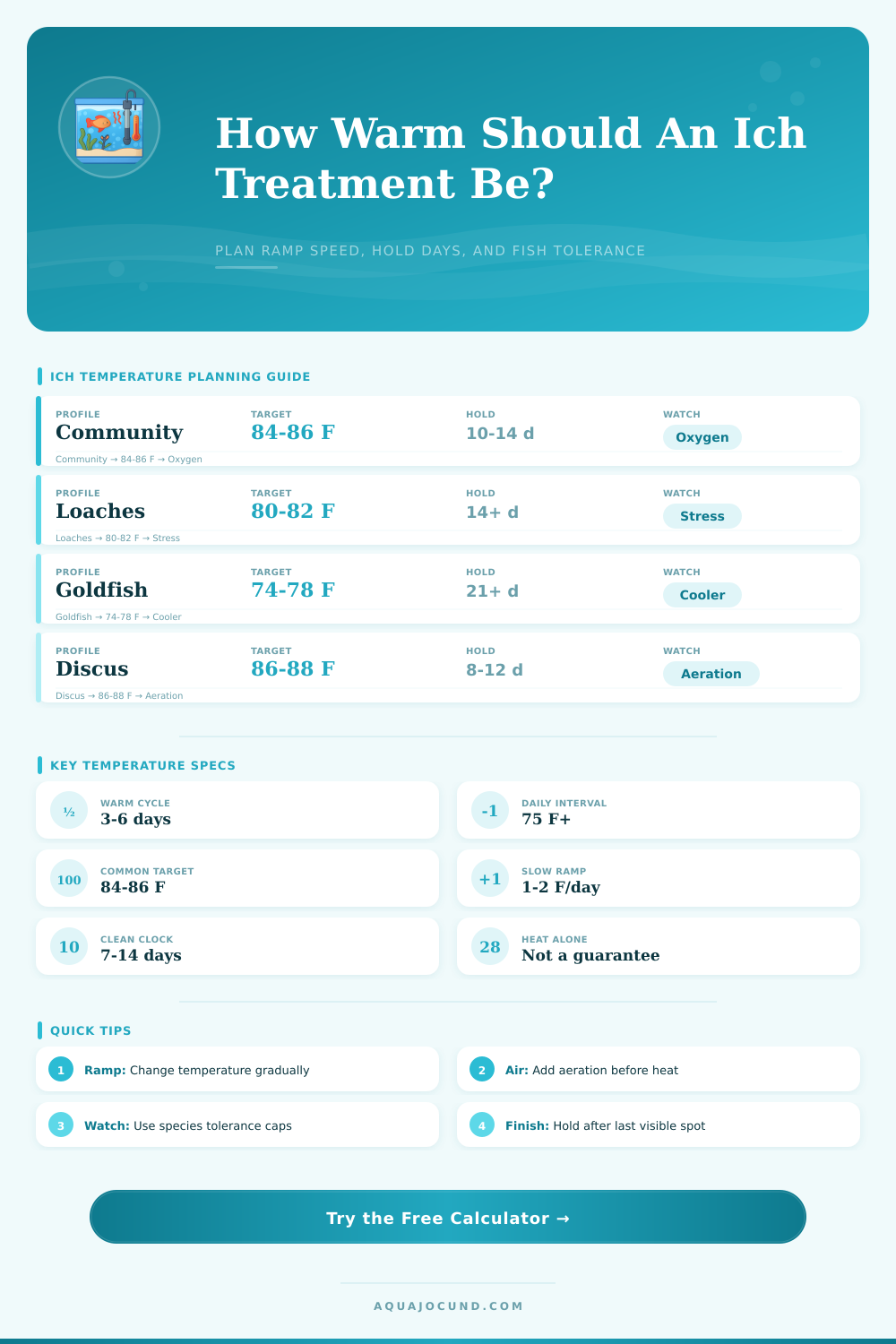
| Tropical community fish | 74-80 F / 23-27 C | 86 F / 30 C | 88 F / 31 C | 7 days |
| Heat-tolerant livebearers | 76-82 F / 24-28 C | 88 F / 31 C | 90 F / 32 C | 6 days |
| Loaches, corydoras, catfish | 72-78 F / 22-26 C | 82 F / 28 C | 84 F / 29 C | 10 days |
| Goldfish and coolwater fish | 64-74 F / 18-23 C | 78 F / 26 C | 80 F / 27 C | 10 days |
| Koi or pond holding tub | 60-74 F / 16-23 C | 75 F / 24 C | 78 F / 26 C | 14 days |
| Discus or very warm tropicals | 82-86 F / 28-30 C | 88 F / 31 C | 90 F / 32 C | 7 days |
| Shrimp, snails, delicate inverts | 68-76 F / 20-24 C | 80 F / 27 C | 82 F / 28 C | 10 days |
| Fry, weak fish, recent shipment | 74-80 F / 23-27 C | 82 F / 28 C | 84 F / 29 C | 10 days |
| Water temperature | Estimated cycle speed | Treatment rhythm | Planning note |
|---|---|---|---|
| 55-64 F / 13-18 C | About 21 days | Long interval | Cool water greatly stretches the cycle. |
| 65-74 F / 18-23 C | About 9-14 days | Every other day range | Expect a longer plan than tropical tanks. |
| 75-79 F / 24-26 C | About 3-6 days | Daily range | Warm enough for faster visible cycling. |
| 80-84 F / 27-29 C | About 4 days | Daily range | Often used as moderate heat support. |
| 85-86 F / 29-30 C | About 3-4 days | Daily range | Common heat-support target for tolerant fish. |
| 87-89 F / 31-32 C | About 3 days | Daily range | Only for heat-tolerant livestock with strong aeration. |
| Approach | Cycle multiplier | Extra days | Best use | Temperature role |
|---|---|---|---|---|
| Medication plus heat support | 2.0 cycles | 2 days | Most freshwater community outbreaks | Speeds exposed stages for label treatment timing. |
| Heat support only | 2.8 cycles | 5 days | Only when medication is not being used | Longer margin because heat alone can fail. |
| Salt plus heat support | 2.5 cycles | 3 days | Salt-tolerant freshwater fish | Ramp gently and account for oxygen demand. |
| Sensitive fish conservative heat | 3.5 cycles | 5 days | Loaches, scaleless fish, weak fish | Lower target means longer observation. |
| Quarantine observation plan | 3.0 cycles | 7 days | New arrivals after visible signs clear | Temperature mostly estimates the clean-clock length. |
| Tank | Dimensions | Net volume at 90% | 2 F/day ramp 78 to 86 F | Aeration priority |
|---|---|---|---|---|
| 10 gallon | 20 x 10 x 12 in / 51 x 25 x 30 cm | 9.4 gal / 36 L | 4 days | High, small water volume shifts fast. |
| 20 long | 30 x 12 x 12 in / 76 x 30 x 30 cm | 16.8 gal / 64 L | 4 days | High if heavily stocked. |
| 40 breeder | 36 x 18 x 16 in / 91 x 46 x 41 cm | 40.4 gal / 153 L | 4 days | Moderate with broad surface area. |
| 55 gallon | 48 x 13 x 21 in / 122 x 33 x 53 cm | 51.1 gal / 193 L | 4 days | Moderate, verify circulation at ends. |
| 75 gallon | 48 x 18 x 21 in / 122 x 46 x 53 cm | 66.8 gal / 253 L | 4 days | Moderate, add surface movement. |
| 300 gallon tub | Custom pond hold / quarantine | 270 gal / 1022 L | 4 days if heated evenly | Very high, warm water holds less oxygen. |
| Signal | Calculator effect | Why it matters | Planning action |
|---|---|---|---|
| Target above profile cap | Higher risk index and warning | Fish tolerance is usually the limiting factor. | Lower target or choose conservative profile. |
| Poor aeration | Adds 28 risk points | Warmer water carries less dissolved oxygen. | Add air before ramping heat. |
| Heavy visible spots | Adds treatment days | More parasites can extend the practical clean clock. | Do not count clean days until spots stop appearing. |
| Basic heater dial | Adds overshoot risk | Small overshoots matter near tolerance caps. | Use an external thermometer or controller. |
| Medication oxygen concern | Adds risk points | Some treatments and heat both stress respiration. | Follow label limits and increase surface agitation. |
When ich appears in a fresh water tank, you must find a way to increase the temperature of the water to treat an ich parasite that has established itself in the tank. Increasing the temperature of the water shorten the life cycle of the parasite, which allows the medication to reach the free-swimming stage of the parasite. However, increasing the temperature of the water also decrease the amount of dissolved oxygen that is present in the water, which may lead to stress for the fishes.
Thus, it is important to find a balance between increasing the temperature to kill the ich parasite and maintain sufficient levels of dissolved oxygen for the survival of the fish in the tank. The temperature calculator allow you to calculate the necessary parameter to develop a plan for increasing the temperature of the water in your freshwater tank. The parameters that you must enter into the calculator are the volume of your tank, the current temperature of the water in the tank, the desired target temperature, the ramp rate at which you would like to increase the temperature, the quality of the aeration in the tank, the stocking pressure in the tank, and the reliability of the heater that heats the tank.
Use the Temperature Calculator to Treat Ich
The ramp rate is the slowest if your fish are known to be sensitive to temperature change. The stocking pressure of your tank determine how many fish are living within that tank; the more fish that live in the tank, the more oxygen that they requires to survive. Finally, the reliability of the heater determine how closely the water in the tank will reach the target temperature; if the heater isnt reliable, the temperature may drift from the target.
The different fish species has different temperature tolerances. For instance, tropical community fish can typically tolerate temperatures up to 86 degrees; however, species like loaches and catfish may experience stress at these temperature. Additionally, fish species like goldfish and koi require even more conservative target temperature than tropical community fish.
The temperature calculator incorporates these parameters to alert you if the target temperature is too high for the fish in your tank. Additionally, the higher the temperature of the tank, the more oxygen that the fish will require to survive. A temperature may be safe for fish when maintained at 78 degrees; however, that same temperature may pose a threat to the fish at 84 degrees, as the fish will require more oxygen at 84 degrees than they required at 78 degrees.
The calculator also allow you to calculate the length of time (the hold duration) that the water in the tank must be maintained at the target temperature to continue the treatment of the ich parasite. The temperature must be maintained even after the spot of ich have disappeared from the fish; the life cycle of the ich parasite continues even if it is not visible on the fish. The calculator factors the parameter of the initial stage of the ich infection and the number of days that have already passed into the calculation; the calculator will also add a safety margin to the hold duration.
A safety margin is built into the calculation in case factor like high stocking rates or unreliable heaters affect the ich parasite’s reaction to the heat. You must provide sufficient aeration within the aquarium to ensure that the fish are receiving the necessary amount of dissolved oxygen in their water. Warmer water contains less dissolved oxygen than cooler water, and the medication for treating ich may also affect the ability of the fish to breathe.
Risk point are assigned to your tank based off the aeration and stocking rates; these risk points allow the calculator to provide an overall index of the dissolved oxygen in the tank. An airstone should be added to the tank prior to starting the treatment process to ensure that there is enough dissolved oxygen for the fish. Heat is not the only method of treating ich; the target temperature for the tank is not the only method for eliminating the ich parasite from the tank.
Heat shortens the life cycle of the ich parasite; thus, medication can more effectively target the free-swimming ich parasite. However, heat does not kill every life cycle stage of the ich parasite. Thus, the time period during which you must maintain the target temperature is not a guarantee of the elimination of the ich parasite.
If the symptom of ich continue after the planned period for maintaining the target temperature, another reassessment of the medication or water quality is needed. When the treatment period is over, you must establish a return ramp to lower the temperature of the tank. Bringing the temperature of the tank too quick will shock the fish.
The temperature calculator establishes a cool-down rate that indicates at what rate the tank should be returned to the original water temperature. Ensuring that the cool-down rate is the same as the rate at which the tank was heated will minimize the stress placed upon the fish; it will also allow for sufficient time to observe if the ich parasite has reappeared in the fish. This calculator will provide you with a plan for treating ich in your freshwater tank based upon the volume of the tank, the different temperature limitations of the fish species in the tank, the aeration in the tank, and the initial stage of the ich infection.
However, the calculator does not eliminate the need for you to continue to observe the fish in your tank. Regardless of the plan that emerge from this calculator, you must continue to observe the fish every day; you must also be prepared to adjust the parameters of the plan should the symptoms of ich not dissapear by the end of a treatment period.