Fish Anesthesia Clove Oil Calculator
Estimate clove oil or eugenol bath concentration, premixed stock volume, staging target, induction watch window, and clean-water recovery volume.
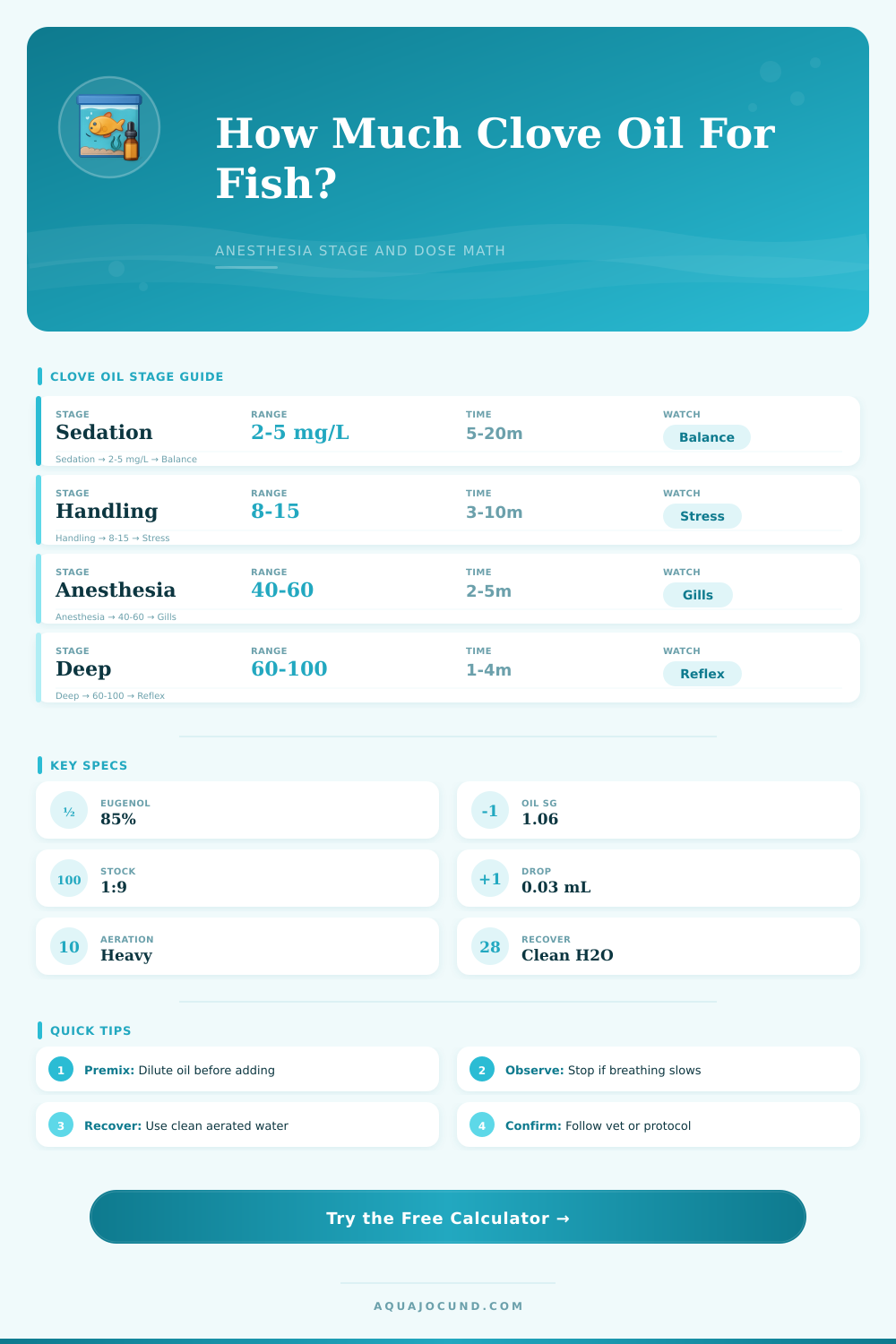
| Stage | Target Range | Expected Signs | Typical Use | Calculator Target |
|---|---|---|---|---|
| Stage 1 calm sedation | 2-5 mg/L | Less startle response, normal balance | Short observation or low-stress transfer | 3 mg/L |
| Stage 2 handling sedation | 8-15 mg/L | Slow swimming, reduced escape response | Brief netting, inspection, photography | 10 mg/L |
| Stage 3 light anesthesia | 20-30 mg/L | Partial balance loss, reacts to touch | Quick measurement or minor handling | 25 mg/L |
| Stage 4 surgical anesthesia | 40-60 mg/L | Loss of equilibrium, slower opercula | Approved procedure with gill monitoring | 50 mg/L |
| Stage 5 deep anesthesia | 60-100 mg/L | Minimal reflex, ventilation closely watched | Only under experienced protocol control | 70 mg/L |
| Fish Group | Starting Factor | Size Effect | Watch Point | Use Note |
|---|---|---|---|---|
| Hardy community fish | 1.00x | Medium fish baseline | Respiration rate | Use staged observation before handling |
| Tetras, discus, rasboras | 0.70x | Small fish may respond faster | Balance and gill effort | Start reduced and move slowly |
| Scaleless fish or loaches | 0.60x | Tiny fish need extra caution | Sudden rolling | Use only with expert guidance |
| Goldfish or koi | 0.90x | Large fish need more recovery water | Oxygen demand | Use heavy aeration in bowls |
| Salmonids or trout | 1.00x | Cool water slows recovery | Fast induction | Common research targets are 40-60 mg/L |
| Fry, weak, or injured fish | 0.50x | Very small mass responds quickly | Respiration stop | Reduce or avoid unless directed |
| Preparation | Input | Calculator Formula | Why It Matters |
|---|---|---|---|
| Pure clove oil | Eugenol percent and specific gravity | mg needed / (SG x 1000 x eugenol fraction) | Turns active target into measurable oil volume |
| 1:9 premix | 10% oil in ethanol or high-proof alcohol | oil mL / 0.10 | Helps disperse oil before it enters the bath |
| Drops shortcut | 0.03 mL per drop default | oil mL / drop size | Useful only after calibrating the dropper |
| Carrier check | Premix minus oil volume | carrier mL / bath L | Keeps solvent addition visible |
| Recovery bath | 1x to 4x treatment volume | bath volume x multiplier | Provides clean, aerated water after induction |
| Container | Approx Volume | Best Use | Water Depth Note | Recovery Plan |
|---|---|---|---|---|
| 1 gal specimen tub | 3.8 L | Very small fish sedation | Keep shallow enough to observe | Prepare 2-4 gal clean water |
| 2.5 gal hospital tub | 9.5 L | Betta or small community fish | Measure actual fill line | Use matching temperature |
| 5 gal bucket | 18.9 L | Goldfish or medium fish | Round volume changes with depth | Add air stone before dosing |
| 10 gal tank | 37.9 L | Procedure or larger holding bath | Substrate should be absent | Use separate recovery tank |
| 20 gal vat | 75.7 L | Koi, cichlid, or research bath | Confirm partial-fill water height | Have large clean reserve ready |
| Formula | Imperial | Metric | Purpose |
|---|---|---|---|
| Rectangle volume | L x W x H / 231 | L x W x H / 1000 | Find bath water volume |
| Cylinder volume | pi x r2 x H / 231 | pi x r2 x H / 1000 | Round bowls and buckets |
| Active eugenol mass | L x mg/L target | L x mg/L target | Total active ingredient needed |
| Oil volume | mg / (SG x 1000 x eugenol fraction) | same | Convert active mass to clove oil mL |
| Premix volume | oil mL / oil fraction in stock | same | Amount of diluted stock to add |
Clove oils is a tool that many peoples use to handle fish. Clove oil is useful because clove oil are inexpensive and readily available. Clove oil can be used if you need to move the fish, if you need to take a photograph of the fish, or if you need to perform some procedure on the fish.
Like all tool, though, you must use clove oil with care to ensure that the fish is not sedated beyond the necessary amount. The concentration of clove oil will determine both how quick the fish loses its equilibrium and how stressful the process is for the fish. Too little clove oil will leave the fish agitated, while too much clove oil may cause the fish to slow it’s breathing before you are ready to perform any task with the fish.
How to Use Clove Oil to Sedate Fish Safely
A calculator can determine the amount of clove oil that you need by entering the volume of the bath, the target stage for the fish, the species of the fish, and the strength of the clove oil product. A 1:9 premix of clove oil is the most common concentration of clove oil used to sedate fish. This ratio of clove oil to water is necessary because pure clove oil dont readily disseminate in water on its own.
The mixture spread throughout the water, but clove oil may form a slick on the waters surface. Aeration should be used after adding the clove oil to the water to ensure that both the clove oil and the water are even distributed throughout the water, and to provide the necessary oxygen for the fish during this process. The recovery multiplier will inform you of the amount of clean water that you need to prepare prior to use clove oil.
You must prepare clean water for the fish to be able to clear the clove oil from it’s body. The effect of the clove oil will differ based off the size of the fish and the temperature of the water in which the fish is sedated. Warm water will cause the fish to enter the stages of clove oil sedation more quick than cold water, and larger fish will require more time to sedate than small fish.
Both of these factor is accounted for in the clove oil calculator to ensure that the dose of clove oil is the correct amount for the size of the fish species that you intend to sedate, such as tetras or koi. The stage reference table will illustrate what each stage of clove oil sedation looks like. Stage one is used when you simply need to reduce the startle response of the fish for short term transport.
Stage two is used for netting the fish. Stage three indicates that the fish begin to lose its equilibrium. Stages four and five are used for procedures that require the fish to remain sedated.
If you use stages four or five, you must continuously observe the gills of the fish. Clove oil act upon the central nervous system of the fish, and you must keep an eye on the fish at all times to ensure that it does not become too deep sedated. The calculator will provide a numeric target for each stage, and will calculate the safety adjustment to the target.
Because clove oil act upon the central nervous system of the fish, it is not a procedure that requires no monitoring of the fish once you have added the clove oil to the water. While the clove oil will induce sedation in the fish, there is no warning of how deeply sedated the fish will become. The clove oil calculator will provide an estimated induction window, as well as alert you to any risk factor for the fish during the sedation process.
You should of had the recovery water ready prior to beginning to use clove oil to sedate your fish. The temperature of the recovery water should be the same than the treatment water, and the recovery bath should be aerated to provide the necessary oxygen to the fish as it begins to right itself. Most people will prepare at least twice the volume of recovery water as the volume of the treatment water.
The clove oil calculator will indicate this requirement in the recovery water field within the tool. To use clove oil effectively to sedate your fish you must measure the bath you will use, decide upon the stage of sedation you wish to achieve, premix the clove oil with the water, and move the fish into the clean water as soon as you have completed your task.