Freshwater Dip Duration Calculator
Estimate a timed dip window from species tolerance, fish condition, water match, dip goal, and container volume.
Formula Breakdown
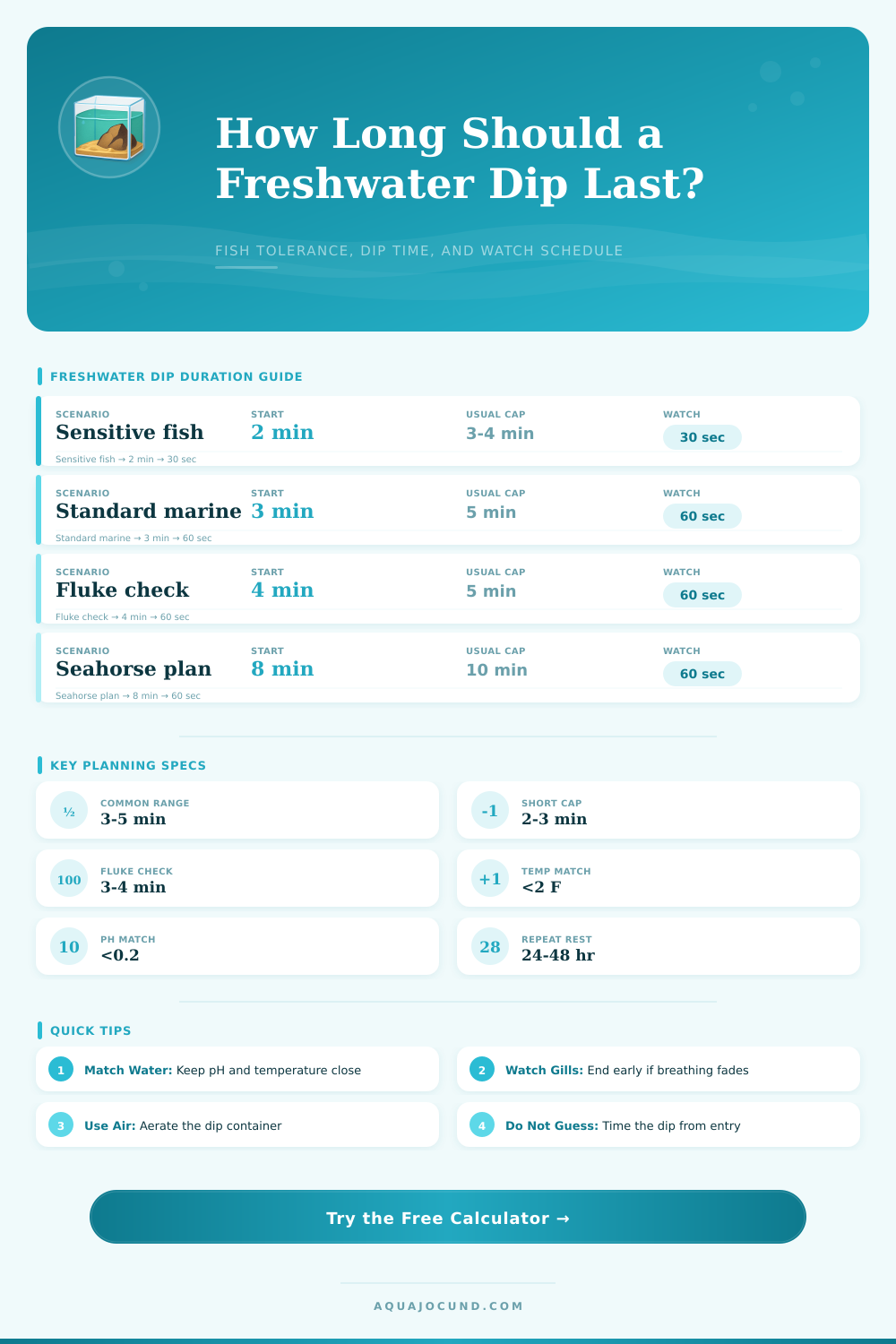
| Group | Planner Range | Duration Modifier | Best Use |
|---|---|---|---|
| Clownfish, damsels, hardy chromis | 4-6 min | +0.4 min | Standard timed dip when behavior is steady |
| Tangs, rabbitfish, many robust marine fish | 4-5 min | +0.1 min | Fluke screening and short parasite relief dips |
| Angelfish, butterflyfish | 3-5 min | 0 min | Moderate plan with close breathing checks |
| Gobies, blennies, small fish | 3-4 min | -0.2 min | Short dip with low handling stress |
| Wrasses, jawfish, skittish species | 2-4 min | -0.6 min | Cautious screen when jumping or panic risk is high |
| Lionfish, scorpionfish, venomous fish | 2-4 min | -0.4 min | Special handling with no crowding |
| Seahorse or pipefish specialist plan | 8-10 min | special range | Only when the keeper intends a syngnathid-style dip |
| Unknown tolerance | 2-4 min | -0.5 min | Conservative first dip or mixed-risk fish |
| Objective | Base Timer | Cap | Calculation Note |
|---|---|---|---|
| Emergency quick rinse | 2.0 min | 3.0 min | Prioritizes low exposure for weak or urgent cases |
| Sensitive short dip | 3.0 min | 4.0 min | Uses stricter exit cues and smaller adjustments |
| Standard parasite relief | 4.0 min | 5.0 min | Default for most marine fish in matched freshwater |
| Fluke check / dark bucket | 4.5 min | 5.0 min | Targets the common 3-4 minute inspection window |
| Hardy extended observation | 5.0 min | 6.0 min | Only for vigorous hardy fish and excellent water match |
| Seahorse specialist dip | 8.0 min | 10.0 min | Separate specialist range, not a general fish default |
| Parameter | Good Match | Caution Zone | Calculator Effect |
|---|---|---|---|
| Temperature | 0-2°F / 0-1.1°C | 2-4°F / 1.1-2.2°C | Larger mismatch subtracts time |
| pH | 0.0-0.2 difference | 0.2-0.4 difference | Large pH gaps reduce the timer |
| Dechlorination | Confirmed before fish entry | Uncertain source water | Rough preparation applies a penalty |
| Aeration | Gentle to strong air | No active aeration | No air shortens the plan |
| Crowding | One fish or ample water | Several fish in a small cup | Low water per fish lowers confidence |
| Container | Imperial Volume | Metric Volume | Typical Dip Fit |
|---|---|---|---|
| Specimen cup | 0.5 gal | 1.9 L | Very small fish only, short watch window |
| Small dip bowl | 1.0 gal | 3.8 L | One small goby, blenny, or clownfish |
| Utility bucket half full | 2.5 gal | 9.5 L | One average marine fish with air stone |
| Standard 5 gal bucket | 5.0 gal | 18.9 L | Large fish or easier observation room |
| Small hospital tub | 10.0 gal | 37.9 L | Large robust fish, low crowding, strong aeration |
| Observation | Timer Action | What It Means | Calculator Cue |
|---|---|---|---|
| Brief darting, then upright | Continue watching | Common entry reaction | Normal |
| Heavy breathing but responsive | Keep checks close | Stress is present but gills are moving | Heavy breathing |
| Lying down with fast breathing | Prepare to exit early | Some species do this, but margin is lower | Bottom posture |
| Rolling, fading response, slowed gills | Exit immediately | Severe distress signal | Bad cue |
Freshwater dip can be used to treat fish for external parasites. In some instances, freshwater dips is used to reset fish that are stressed out from the shipping process. To perform a freshwater dip, move the fish to freshwater for a specific period of time.
The specific period of time will cause an osmotic shock that will kill the majority of the parasites that is living on or within the fish. Because most parasites cannot survive osmotic shock, freshwater dips can help to removing those parasites from the fish. However, it is important to find the correct amount of time for the freshwater dip; if the freshwater dip goes on for too long, the fish may be harmed.
How to Do a Safe Freshwater Dip for Fish
The duration of the freshwater dip can depend on several factors. One factor is the species of the fish. For instance, robust clownfish can better take the duration of a freshwater dip than small fish like gobies or wrasses.
Additionally, the condition of the fish can also play a role in the length of a freshwater dip. For instance, if the fish is stressed and breathing heavy, it can be less tolerant of a longer freshwater dip. To calculate the amount of time that the freshwater dip should go on, there are calculators available online.
These calculators asks for the species of the fish, the condition of the fish, and the water parameters to be entered into the calculation. The water parameters will have an impact on the length of the freshwater dip because if the temperature or the pH of the freshwater does not match the fishs parameters, the calculator will show a shorter amount of time for which to perform the freshwater dip to ensure that the fish is not harm. In addition to the variables that can be accounted for in the calculator, the volume of the water in which the fish is performing the freshwater dip and the amount of aeration in that water can also impact the length of the freshwater dip.
For instance, if the fish is within a large bucket with plenty of aeration in the water, there will be more oxygen in the water than if the fish is within a small cup without any aeration. Because more oxygen is beneficial for the fish during the freshwater dip, if the amount of water to fish ratio is small, the calculation of the length of the freshwater dip will be shorter. Finally, the behavior of the fish during the freshwater dip should also be accounted for.
For instance, if the fish is breathing heavy, it may be worth continuing the freshwater dip. However, if the fish is lying on the bottom of the container or if it has slow movement of its gills, the fish should be remove from the freshwater immediatly. Many freshwater dip procedures may include adding three or five minutes as the length of the freshwater dip.
However, it is not necessary to use a set amount of time for the freshwater dip to be effective. For instance, a hardy fish may be able to stand the five-minute freshwater dip while another fish that is stressed or in water that is not correctly matched to its species may only be able to stand a three minute freshwater dip. Additionally, if you are to perform another freshwater dip in the near future (within twenty-four or forty-eight hours), the freshwater dip should be shorter to allow the fish to recover from the first freshwater dip.
It is also important to make sure that the temperature of the freshwater that is being used matches with the tanks water temperature. The freshwater dip causes osmotic stress to the fish; adding thermal shock to the fishs body will make it even more stressful out. The same is true for the pH of the freshwater.
Additionally, the freshwater must be dechlorinated before adding the fish to it, as the chlorine in freshwater is harmful to the fish. Aeration of the freshwater is also required before and during the freshwater dip procedure; aeration will increase the amount of dissolved oxygen in the water, which is beneficial to the fish while it is performing the freshwater dip. Some may believe that a longer freshwater dip is better for the removal of the parasites.
However, the longer a freshwater dip is performed, the more the fish may lose it’s equilibrium or may be damaged by the freshwater dip. Shorter freshwater dips performed over time are often the best alternative to a long freshwater dip. Though the calculators will provide the length of time for the freshwater dip, those who wish to perform such a treatment should use the calculator as an starting point only.
By using the calculator and also watching the fishs gills and behavior, the freshwater dip can be performed more precise and with the fish more likely to remain healthy.