Aquarium Salt Bath Duration Calculator
Estimate salt amount, exposure time, and observation intervals for separate-container freshwater salt baths.
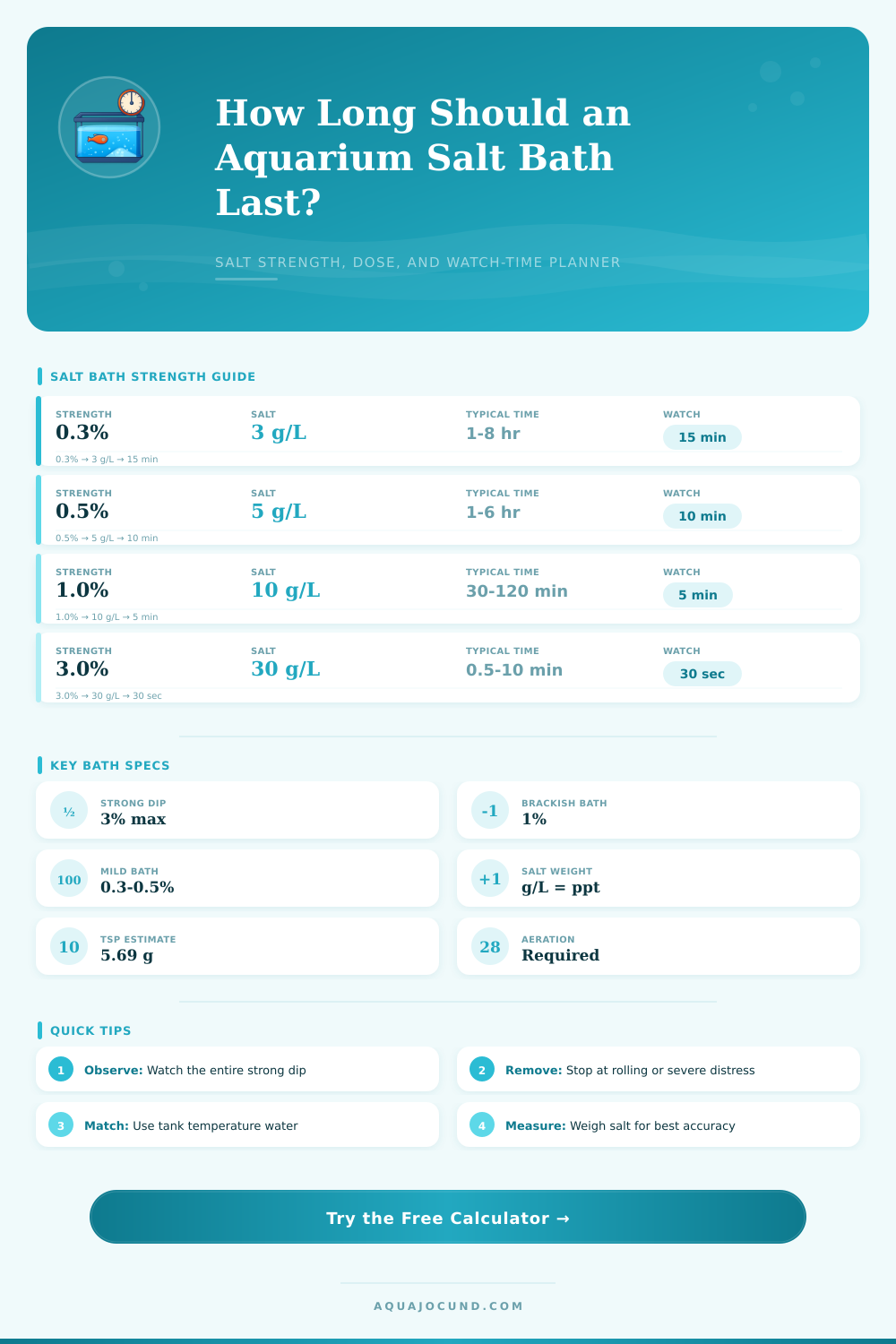
| Strength | Salt per Liter | Salt per Gallon | Typical Duration | Use Case |
|---|---|---|---|---|
| 0.3% | 3 g/L | 11.4 g/gal | 1-8 hours | Gentle osmotic support |
| 0.5% | 5 g/L | 18.9 g/gal | 1-6 hours | Mild separate bath |
| 1.0% | 10 g/L | 37.9 g/gal | 30-120 minutes | Brackish-style short bath |
| 2.0% | 20 g/L | 75.7 g/gal | 5-30 minutes | Strong monitored bath |
| 3.0% | 30 g/L | 113.6 g/gal | 0.5-10 minutes | Intensive dip only |
| Group | Tolerance | Strong Dip Cap | Duration Factor | Calculator Note |
|---|---|---|---|---|
| Goldfish or koi | High | 10 min | 1.10 | Usually robust with aeration |
| Hardy community | Medium-high | 8 min | 1.00 | Use normal observation |
| Betta or labyrinth | Medium | 6 min | 0.80 | Shorter if breathing hard |
| Livebearer or rainbowfish | High | 8 min | 1.05 | Often salt tolerant |
| Cichlid or larger barb | Medium-high | 8 min | 1.00 | Watch aggression and panic |
| Cory, loach, scaleless | Low | 3 min | 0.45 | Avoid high strength when possible |
| Sensitive tetra or wild fish | Low | 3 min | 0.40 | Bioassay and conservative cap |
| Fry or very small fish | Very low | 2 min | 0.35 | Prefer low strength and close watch |
| Container | Volume | 0.5% Salt | 1.0% Salt | 3.0% Salt |
|---|---|---|---|---|
| Small bowl | 0.5 gal / 1.9 L | 9.5 g | 18.9 g | 56.8 g |
| One-gallon bath | 1 gal / 3.8 L | 18.9 g | 37.9 g | 113.6 g |
| Utility bucket | 2 gal / 7.6 L | 37.9 g | 75.7 g | 227.1 g |
| Five-gallon bucket | 5 gal / 18.9 L | 94.6 g | 189.3 g | 567.8 g |
| Metric tub | 10 L / 2.6 gal | 50 g | 100 g | 300 g |
| Bath Strength | First Check | Repeat Check | Hard Stop Signal | Timer Rule |
|---|---|---|---|---|
| 0.3% | 15 min | Every 15 min | Persistent listing | Use hour-scale cap |
| 0.5% | 10 min | Every 10 min | Rapid gill pumping | Do not extend casually |
| 1.0% | 5 min | Every 5 min | Loss of balance | Shorten for sensitive fish |
| 2.0% | 1 min | Every 1 min | Rolling or limp posture | Stay beside container |
| 3.0% | 30 sec | Every 30 sec | Any roll or severe distress | Dip only, no multitasking |
Aquarium salt bath are a method of treatment that lies somewhere in between the idea of treating the fish in the main tank and doing nothing at all for the affects fish. An aquarium salt bath involves removing the fish from its main tank, exposing it to salt water for a period of time, and then the owner returns the fish to the main tank with clean water after the salt bath. Aquarium salt baths work because the salt water change the osmotic pressure around the fish, which lead to increased mucus production by the fish, and because the increased osmotic pressure can help to slow the reproduction of external parasite that infect the fish.
However, if the salt exposure take too long, the benefits of the salt bath will end, and the salt exposure will begin to stress the fish. Fish have different sensitivity to salt exposure than other fish species. For instance, goldfish and koi can take stronger salt baths for longer periods of time than tetras and other species that is wild-caught.
How to Do a Safe Aquarium Salt Bath
Furthermore, fish that do not have scales, like corydoras catfish, are also more sensitive to salt exposure than other fish species. Therefore, it is important to recognize which group of fish the affected fish belongs to. By determining to which group of fish the affected fish belong, the aquarium salt bath calculator can make adjustment to ensure that the suggested time for the salt bath is realistic for that certain type of fish.
The strength of the salt bath is just as important than the tolerance of the fish to salt. For example, a 0.3 percent salt solution can be used for several hour, and is suitable for fish species that require only a small osmotic adjustment to its systems. However, a 3 percent salt solution is more powerful and can be used for only a brief period; using the 3 percent salt solution for even an extra minute may harm the fish.
The salt strength that is chosen will impact the time that is permitted for the salt bath; the calculator will incorporate the group of fish being used to calculate the maximum length of the salt bath. Furthermore, the calculator will also adjust the time for the salt exposure according to the current condition of the fish, the aeration of the water, the temperature of the water, and whether or not the fish have use salt water recently. Each of these factor will impact the amount of stress that can be placed upon the fish.
The current condition of the fish is one factor to consider. Fish that have abnormal symptoms, such as clamped fin or rapid gill movement, can take less time in the salt bath than fish that are swimming normal. Additionally, the water temperature impacts the amount of dissolved oxygen that is present in the water.
Very warm or cold water holds less dissolved oxygen than water that is closer to the ideal temperature range for the species of fish that live in the aquarium. Thus, few minutes should be allowed for fish in water with an abnormal temperature. Aeration of the water has the opposite effect to temperature; the more oxygen that is present in the water (due to increased aeration), the more room that the fish will have for the salt bath.
The most important factor in a salt bath is not the timer, but the behavior of the fish during the salt bath. If the fish begins to roll in the water, lose their balance, or exhibit frantic swimming, it mean that the fish has reached the limit of their tolerance for salt water. Therefore, the salt bath calculator includes a check interval to allow owner to observe the fish, but the signal to end the salt bath must come from the fish’s behavior.
Because salt baths that use strong salt concentration are often risky treatments, the owner must be beside the fish tank during the salt bath; they should not walk away. In determining the amount of salt to add to the tank, it is first important to calculate the volume in liter of the tank that will be used for the salt bath. The salt bath calculator will multiply the volume of the tank by the number of gram of salt that should be used per liter of water at the chosen concentration of salt, and will report the amount of salt needed in both gram and teaspoon.
The number of gram is the most accurate measurement of salt to use, as the size of the salt crystals vary; however, the teaspoon measurement provides a quick estimation of the amount of salt to use if measuring tool in teaspoons are all that are available. Furthermore, the temperature of the salt bath should match the temperature of the original aquarium; adding salt water to the tank that has a different temperature may stress the fish. During the salt bath, owner have the opportunity to closely observe the fish.
The fish are away from the rest of the aquarium and do not need to worry about interaction with other fish or plants. Observing the fish during the salt bath allows owner to determine whether or not the salt bath was effective in treating the fish; if the fish are still acting normal after the salt bath, it may be necessary to use a different treatment method. Alternatively, if the fish act normal during the salt bath, it is likely that the salt bath was effective.
The goal in performing a salt bath is to provide the shortest length of time to perform the treatment while still meeting the reason for performing the salt bath. Thus, the aquarium salt bath calculator calculates the time that is merely a starting point for owner; they should adjust the length of the salt bath the moment the behavior of the fish change.