Formalin Dosing Calculator Aquarium
Calculate standard 37% formalin product doses for fish dips, short baths, prolonged tank baths, quarantine tanks, and flow-through charge math.
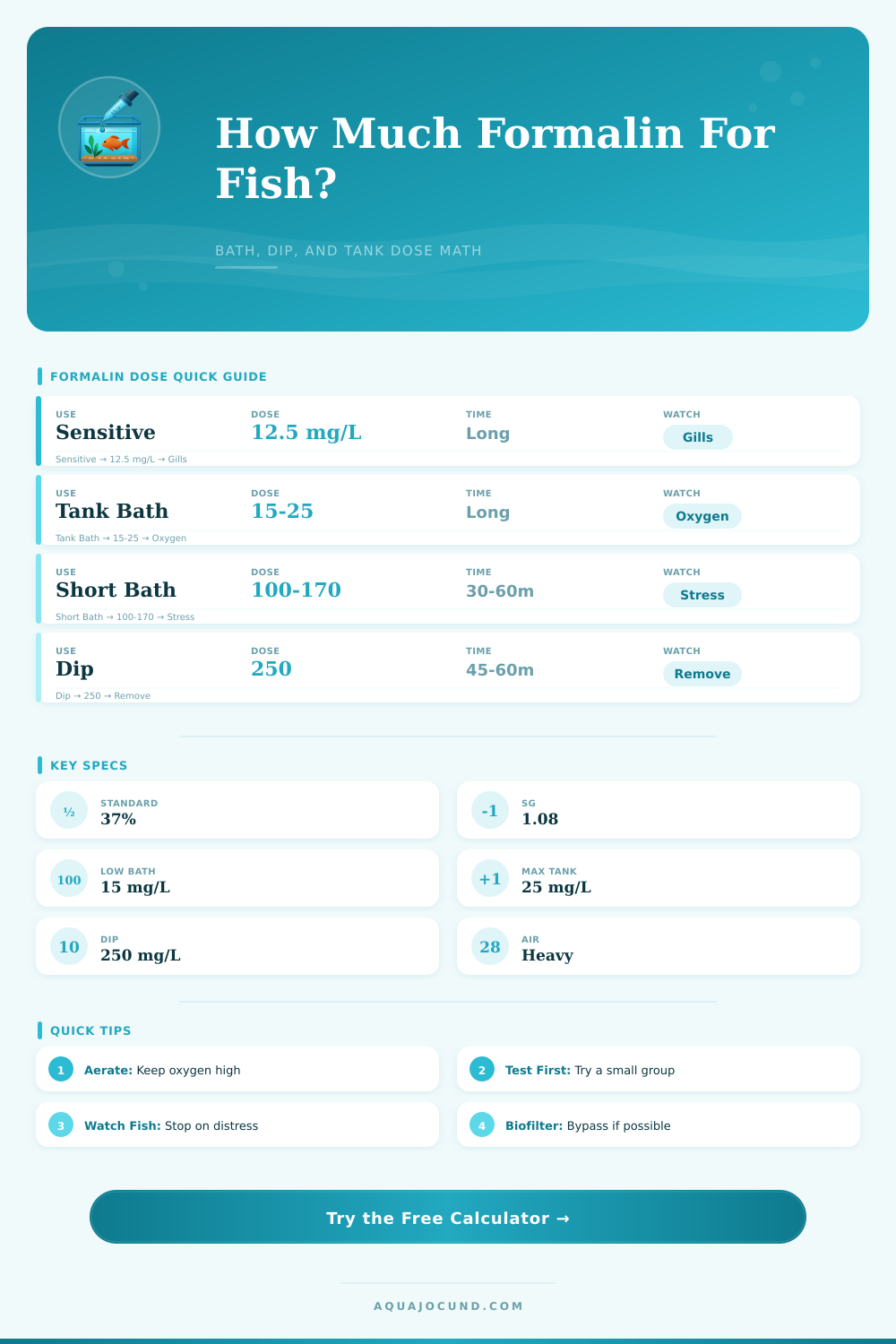
| Use Case | Standard Dose | Typical Time | Best Use | Extra Caution |
|---|---|---|---|---|
| Sensitive species bath | 10-12.5 mg/L | Prolonged, observe often | Tetras, discus, scaleless fish, stressed fish | Stop immediately if fish pipe, roll, or clamp hard |
| Prolonged tank bath | 15-25 mg/L | Label-directed tank exposure | Quarantine tanks with external protozoa or flukes | Use vigorous aeration and avoid heavy organics |
| Short bath | 100-170 mg/L | 30-60 minutes | Separate bath container for robust fish | Transfer fish early if breathing becomes labored |
| Intensive dip | 250 mg/L | 45-60 minutes maximum | Experienced keepers treating external parasites | Never leave fish unattended during the dip |
| Flow-through charge | Label value, often 167-250 mg/L | Usually 1 hour | Raceways and vats with known inflow | Requires charge dose plus metered inflow dose |
| Tank | Nominal Size | Approx Metric | 25 mg/L Dose | 250 mg/L Dip |
|---|---|---|---|---|
| 5 gallon hospital | 16 x 8 x 10 in | 19 L | 0.44 mL of 37% | 4.4 mL of 37% |
| 10 gallon quarantine | 20 x 10 x 12 in | 38 L | 0.88 mL of 37% | 8.8 mL of 37% |
| 20 gallon long | 30 x 12 x 12 in | 76 L | 1.75 mL of 37% | 17.5 mL of 37% |
| 29 gallon tank | 30 x 12 x 18 in | 110 L | 2.54 mL of 37% | 25.4 mL of 37% |
| 40 breeder | 36 x 18 x 16 in | 151 L | 3.5 mL of 37% | 35.0 mL of 37% |
| 75 gallon display | 48 x 18 x 21 in | 284 L | 6.57 mL of 37% | 65.7 mL of 37% |
| Product Type | Strength Input | Specific Gravity | Calculator Behavior | Use Note |
|---|---|---|---|---|
| Standard formalin | 37% | 1.08 | Matches aquaculture label-style formula | Use when the label states 37% formaldehyde |
| Weaker aquarium product | 3-10% | Use label or 1.00 | Raises mL to equal the same active amount | Confirm additives and label directions first |
| Concentrated stock | 30-40% | Use SDS value | Adjusts by actual active formaldehyde percent | Measure with a syringe or graduated cylinder |
| Unknown bottle | Do not guess | Do not guess | Calculator cannot make an unknown safe | Use a known fish-labeled product instead |
| Group | Suggested Ceiling | Oxygen Need | Biofilter Risk | Action During Treatment |
|---|---|---|---|---|
| Hardy quarantine fish | Use label range | High | Moderate | Observe breathing every few minutes at high dose |
| Tetras, discus, scaleless fish | About 12.5 mg/L for long bath | High | Moderate | Use lower dose and test a small group first |
| Fry, weak, or oxygen-stressed fish | Reduce or avoid | Very high | Moderate | Seek fish health advice before dosing |
| Marine fish dips | Short bath only | Very high | Low if outside display | Use matched salinity and temperature |
| Shrimp, snails, corals, plants | Do not expose | Not applicable | High system impact | Remove invertebrates or use separate hospital tank |
| Formula | Imperial | Metric | Purpose |
|---|---|---|---|
| Rectangle volume | L x W x H / 231 | L x W x H / 1000 | Find water volume before dose math |
| Cylinder volume | pi x r2 x H / 231 | pi x r2 x H / 1000 | Round vats and treatment buckets |
| Product mL | gal x mg/L x 0.003785 / SG | L x mg/L / SG / 1000 | Standard 37% formalin product basis |
| Strength adjusted mL | standard mL x 37 / product % | standard mL x 37 / product % | Equivalent active formaldehyde amount |
| Flow meter dose | gpm x min x mg/L x 0.003785 / SG | L/min x min x mg/L / SG / 1000 | Maintains concentration through inflow |
Formalin is used to treat external parasite on fish. Formalin is effective because formalin is inexpensive and formalin is stable in a solution. Formalin, however, is a dangerous chemical if the dose of formalin isnt correct because formalin can cause stress to the gills of fish.
The dose of formalin has to be exact. Therefore, the user have to calculate the volume of formalin that is necessary in a tank. Due to the complexity of the calculation, many people make mistake when using formalin because they do not calculate the exact amount of formalin that is required for there specific tank.
Calculate Formalin Dose for Your Fish Tank
The formalin dosage calculator that is available on this page will allow people to input specific data about there fish tank and the formalin that will be used to treat the parasites on their fish. The data that the user will need to enter into the formalin dosage calculator will include the dimension of the tank, the dose of formalin that is to be used, the strength of the formalin product that will be used, and an optional field for incorporating a safety adjustment. The calculator will perform the mathematical calculations so that people dont have to calculate the dosage of formalin themselves.
One of the data fields that the user will need to enter is the volume of the water in the tank. The volume of the water in the tank is critical because the actual volume of water in the tank may differ from that which is printed on the tanks label. The substrate that is present in the tank and the decorations that is placed within the tank can affect the actual volume of water that is contained within the tank.
The actual volume of water in the tank is a necessity to calculate the amount of formalin that should of been used. The strength of the formalin is another critical input for the formalin dosage calculator. Not all bottles of formalin contains the same amount of formaldehyde.
If the user use a lower strength of formalin, then a higher volume of formalin will be required. The safety factor field can be used to reduce the dose of formalin that is to be used in the tank. By using a safety factor, people may be able to avoid having to perform an emergency water change to protect there fragile fish.
Formalin is effective in treating fish parasites with warmer water. However, because formalin consumes the dissolved oxygen in the water while it is working to treat the fish for their parasites, the dissolved oxygen levels in the water can become problematic. Warm water holds less dissolved oxygen than cool water.
Therefore, formalin will work best in cooler water with a more stable water condition. Another factor that can contribute to the efficiency of formalin is the amount of organic matter in the water. Formalin can bind to organic matter in the water.
When formalin bind to organic matter in the water, the effective dose of formalin will be less than the amount of formalin that was added to the water. Formalin is often used to treat fish for external parasites in short baths or intensive dips. Short baths and intensive dips require higher concentrations of formalin than the level that is used for long baths.
Reference tables for formalin concentrations are included on this page. These tables include common formalin concentrations in the water, such as 250 mg/L for dips or 12.5 mg/L for baths. The formalin dosage calculator will turn these reference numbers into the specific number of milliliters of formalin that should be added to the container of formalin that will be used to treat the fish.
A common mistake is to use the printed size of the tank instead of the volume of water that is actualy in the tank. The printed size of the tank is often not the same as the actual volume of water that is in the tank. Another common mistake with formalin is to assume that all bottle of formalin contain the same amount of formaldehyde.
The strength of formalin bottles can differ. It is necessary to measure the actual volume of water in the tank and to determine the strength of formalin that will be used before treating the fish. In flow-through systems, the inflow rate of the water will determine how much formalin must be added to the system to maintain a specific concentration of formalin in the water.
The formalin dosage calculator will account for the continuous addition of formalin to the water. This will remove the need for the use of arithmetic to calculate how much formalin to add to the flow-through system. Instead, people can pay closer attention to the behavior of there fish and the dissolved oxygen levels in the tank.