Water Change Nitrate Reduction Calculator
Estimate how much nitrate a water change removes, how source-water nitrate affects the result, and how repeated changes compound over time.
Nitrate Reduction Estimate
| Aquarium Type | Preferred Range | Action Level | Notes |
|---|---|---|---|
| Dwarf shrimp tank | 0-10 ppm | 15-20 ppm | Use smaller repeated changes to avoid rapid parameter swings. |
| Freshwater community | 5-25 ppm | 40 ppm | Weekly changes usually hold nitrate steady when feeding is moderate. |
| High-tech planted | 10-30 ppm | 40 ppm | Do not chase zero nitrate if plants are intentionally fertilized. |
| Goldfish or large cichlid | 10-30 ppm | 40-60 ppm | Heavy feeding may require larger volume or more frequent changes. |
| Mixed reef | 1-10 ppm | 20 ppm | Match salinity, alkalinity and temperature before large changes. |
| Change Size | Immediate Removal | When Useful | Caution |
|---|---|---|---|
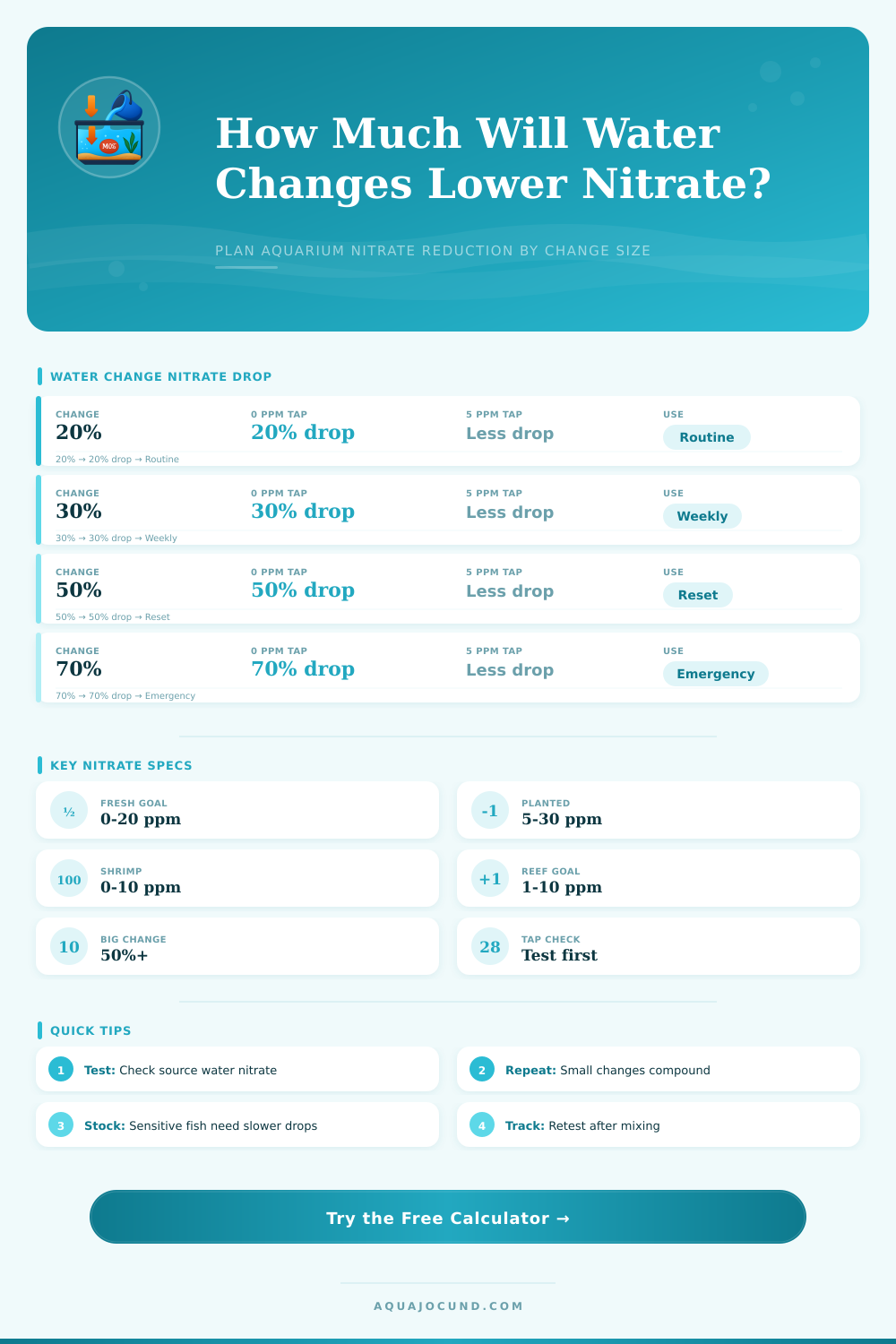
| 10% | About 10% of excess nitrate | Routine polishing, nano tanks, delicate livestock | Slow if nitrate is already high. |
| 25% | About 25% with zero-nitrate source water | Standard weekly maintenance | Tap nitrate reduces the final drop. |
| 50% | About half the gap to source water | Correcting neglected tanks or heavy bioload | Match temperature and hardness closely. |
| 75% | About three quarters of the gap | Emergency dilution in hardy systems | Use staged changes for sensitive fish. |
| Calculation | Formula | Example | Meaning |
|---|---|---|---|
| Single change | After = current × (1 - change) + source × change | 40 ppm, 50%, 0 tap = 20 ppm | Nitrate falls toward the nitrate level of new water. |
| Tap nitrate limit | Lowest practical nitrate = source water nitrate | 10 ppm tap cannot create 0 ppm | RO blending or plants may be needed if tap nitrate is high. |
| Repeated changes | Each session dilutes the remaining nitrate again | Two 50% changes remove 75%, not 100% | Compounding matters when planning a step-down. |
| Interval rise | Added nitrate = daily rise × days between changes | 1 ppm/day for 3 days adds 3 ppm | Bioload can erase progress between spaced changes. |
| Nominal Tank | Net Water Estimate | 25% Change | 50% Change |
|---|---|---|---|
| 10 gal betta | 8.5-9.5 gal | 2.1-2.4 gal | 4.3-4.8 gal |
| 20 long planted | 16-18 gal | 4-4.5 gal | 8-9 gal |
| 40 breeder | 32-36 gal | 8-9 gal | 16-18 gal |
| 75 gal display | 60-68 gal | 15-17 gal | 30-34 gal |
| 125 gal tank | 100-115 gal | 25-29 gal | 50-58 gal |
Nitrate management are a necessary task for anyone who keep an aquarium. Because nitrate management require you to understand how much nitrate leaves the aquarium during a water change, it is important for you to understand how much nitrate is contain in your source water as well as how much the fish tend to contribute to the aquarium between water changes. You may find that it is difficultly to manually calculate how much nitrate may be removed from the aquarium during water changes.
In this situation, it is helpful to use an calculator included in this article to calculate these number for you. The calculator will perform the dilution calculation for you if you enter the current reading of nitrate in your aquarium as well as the nitrate level in your source water. In addition to these parameters, you will be required to enter the net volume of your aquarium, the size of each water change, and the number of water changes that you would like to perform.
Aquarium Nitrate Calculator for Water Changes
Additionally, the calculator also includes a calculation of the amount of daily rise in nitrate levels in your water that will occurs between water changes. Therefore, the calculator will show you the impact that water changes have on your nitrate levels even though the number of changes are not linear; instead, the calculator will show you the impact of compounding water changes. While it may be easy to focus on the percentage of the water in your aquarium that you will change, it is important to also consider the level of nitrate in your source water.
For instance, if your source water contain 12 part per million of nitrate, your nitrates in the aquarium will shift towards that level with each water change; it doesnt matter how much water you change. Thus, your nitrate levels will have a ceiling; they will never go lower than the level of nitrate in your source water. The calculator allow you to test various size of water changes with your current source water levels to determine if the nitrate levels will reach the target that you wish to maintain with your fish.
The sensitivity of the livestock in your aquarium will have an impact upon your nitrate levels. Shrimp and fry is both sensitive to changes in nitrate as well as changes in temperature and hardness of the water; therefore, the calculator also includes a setting to adjust for the sensitivity of the fish in your tank. Reef tank also have issues with the sensitivity of the livestock to water changes; in this case, the tank owner must also consider the effect of salinity and alkalinity in addition to the nitrate levels; thus, a note on water preparation is include in the calculator.
The daily rise in nitrate levels can have an impact upon the nitrate levels within your aquarium. Daily rise in nitrate level comes from the feeding of the fish in the tank, the stocking density of the aquarium, and the efficiency of the aquarium filter to remove the waste of the fish. For example, an aquarium that contains planted tank with herbivorous fish will have a daily rise in nitrate levels of less than 1 part per million; however, a tank with a single goldfish could have a rise of 3 part per million daily.
Thus, the calculation of the daily rise allow you to see the impact of spacing the water changes too far apart; the rise will work against the benefit of the previous water change. The reference table include with the calculator shows different target level of nitrate for different types of fish. However, these levels are merely starting points for nitrate levels in your aquarium.
For instance, if you have a heavily planted tank, the nitrate levels may be higher than those targeting for livestock with sensitivity to nitrate levels. Additionally, a hospital tank with a sickly fish may have target nitrate level that are lower than the other examples in the table. However, because the calculator allow you to set your target nitrate levels, it will calculate the number of water changes that you will require to reach that target.
In addition to calculating the levels of nitrate that will be removed from your aquarium through water changes, the calculator may also show the number of gallons of water you will change; however, a large change in water with a change in temperature or dechlorination of the water could be detrimental to your fish. Thus, the calculator assume that you will perform water changes that are conditioned to the aquarium, and, therefore, calculates only the impact of nitrate levels. Ultimately, the most important number for the aquarium owner is not the percentage of water that you will change; rather, it is the reading of nitrate levels that will result from that water change.
By calculating these numbers before beginning your water change, you can ensure that the size of each water change will work for both your fish and your schedule. Thus, this calculator will help to prevent the process of nitrate management from becoming a guessing game.