Chaeto Growth Harvest Calculator
Estimate refugium chaeto growth, harvest timing, trim weight, and nutrient export from your light schedule, flow, nutrients, and biomass target.
| Factor | Low Range | Target Range | High Range | Calculator Effect |
|---|---|---|---|---|
| Nitrate | 0-2 ppm | 5-20 ppm | 30+ ppm | Limits growth when starved; high values raise demand |
| Phosphate | 0-0.02 ppm | 0.03-0.12 ppm | 0.25+ ppm | Low phosphate can stop a bright green ball from expanding |
| Photoperiod | 6-8 hr/day | 10-16 hr/day | 18-24 hr/day | Longer light helps until shading and stress reduce return |
| Flow | 1-4x/hour | 5-12x/hour | 20x+/hour | Moderate exchange feeds the outer strands without blasting pods |
| Density | Loose starter | Open ball | Packed clump | Dense centers shade, trap detritus, and trigger earlier harvests |
| Assumption | Working Value | Used For | Notes |
|---|---|---|---|
| Drained wet to dry mass | 10% | Dry tissue estimate | Actual moisture varies by how firmly the ball is drained |
| Nitrogen in dry algae | 4% | NO3 equivalent | Converted to nitrate with 4.43x nitrogen factor |
| Phosphorus in dry algae | 0.4% | PO4 equivalent | Converted to phosphate with 3.06x phosphorus factor |
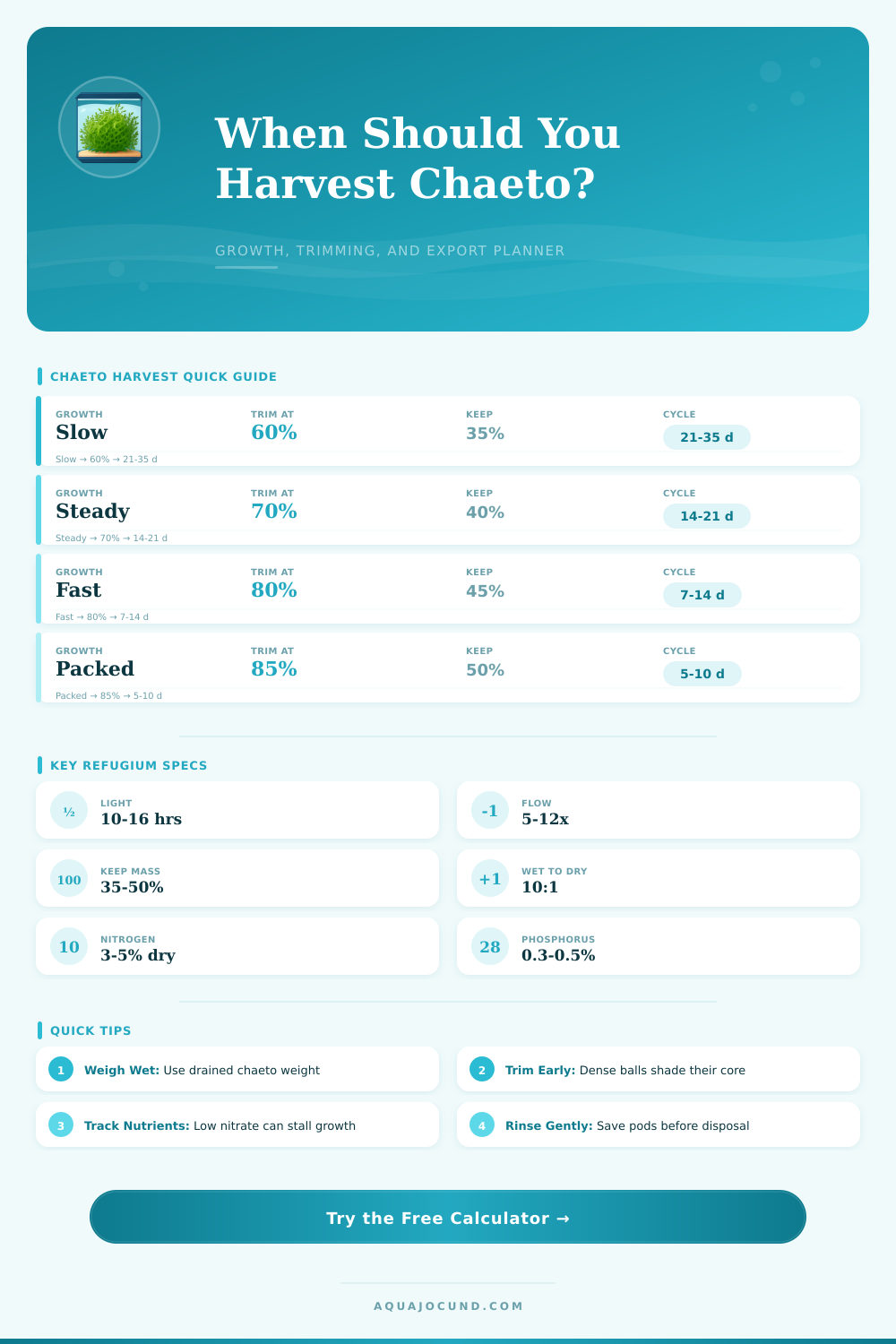
| Harvest trigger | 60-85% fill | Trim schedule | Earlier trimming keeps inner strands lit and growing |
| Style | Best Use | Keep Mass | Interval | Risk |
|---|---|---|---|---|
| Light pinch trim | Nano refugiums | 55-65% | Weekly | Small export, very stable pod habitat |
| Half-ball harvest | Most reef sumps | 40-50% | 1-3 weeks | Balanced export and quick regrowth |
| Hard reset trim | Overpacked clumps | 25-35% | As needed | Can slow regrowth if nutrients or iron are low |
| Rolling split | Large refugiums | 45-55% | Alternate sides | Requires even light and easy access |
| System Size | Starter Chaeto | Typical Light | First Harvest | Notes |
|---|---|---|---|---|
| 10-20 gal nano | 1-3 oz wet | 8-12 hr/day | 3-6 weeks | Avoid stripping nitrate to zero |
| 40 breeder reef | 4-8 oz wet | 10-14 hr/day | 2-4 weeks | Good match for moderate feeding |
| 75-120 gal reef | 8-16 oz wet | 12-16 hr/day | 1-3 weeks | Trim before a dense brick forms |
| 180+ gal reef | 1-3 lb wet | 14-18 hr/day | 1-2 weeks | Use rolling harvests for steadier export |
Calculator estimates use common refugium planning assumptions. Real export changes with chaeto strain, detritus load, lighting spectrum, trace elements, and how consistently the algae is drained before weighing.
To maintain a healthy refugium, you need to understand how algae function within a sump. A healthy refugium is not one that contains some algae within the sump, but instead is one where you are aware of both when the algae has completed it’s function of removing nutrients from the aquarium water, and when you must remove some of that algae so that the remaining algae can continue to perform its functions. Chaeto algae is one of the most popular forms of algae for refugiums because chaeto algae tend to grow at a steady rate, and because chaeto algae removes both nitrate and phosphate from the water.
The growth of chaeto can be managed with a calculator that requires the input of the current mass of chaeto, the volume of the refugium, the percentage of the refugium that is filled with chaeto, the growth rate of the chaeto, the photoperiod, and the water flow through the sump. Each of these factors is related to the growth of the chaeto; for example, if there is too much chaeto within the refugium, the outer layers of the chaeto will shade some of the chaeto’s center, slowing the growth of the center of the chaeto. Similarly, if the inner strands of the chaeto receive less light than the outer strands, the inner strands will stop removing nutrients from the water.
How to Keep Chaeto Healthy in Your Refugium
Therefore, it is necessary to trim some chaeto before the chaeto becomes too dense with the goal of ensuring that the entire mass of chaeto is growing at an even rate. Although many may feel that the chaeto is a filter that does not require maintenance, the chaeto will naturaly respond to changes in light or nutrient levels. For example, if the nitrate levels drop to below two parts per million, the chaeto will stall in its growth, even if the phosphate levels in the water are still within a proper range.
Additionally, if the phosphate levels drop to the point where they become the limiting factor for the growth of the chaeto, the chaeto will also stall in its growth. The calculator allows individuals to view the interaction between nitrate, phosphate, and the observed growth rate of the chaeto. By testing the chaeto water before and after harvesting the chaeto, an individual can adjust the photoperiod or the keep percentage to ensure that the chaeto is neither trimmed too much nor too little.
Water flow is another factor that may impact the growth of the chaeto. If the water flow is too low, the chaeto may pack down; however, if the water flow is too high, the small organisms that live within the chaeto balls will not be able to remain within the chaeto balls. The calculator includes a field for water flow because the turnover rate of the water within the refugium will impact whether the plumbing for the sump is assisting or limiting the growth of the chaeto.
In addition to the calculator, there are also reference tables that provide the common range for photoperiods, water flow, and the wet-to-dry ratio. Many that operate refugiums use these common ranges to estimate the export of nutrients from the tank. While these reference tables are not rules that should be followed, they do provide a starting point from which to compare the growth of the chaeto within an individual’s sump to the common range.
For example, if the chaeto grows faster than the calculator suggested, an individual can refer to the reference tables to determine if the light levels for the chaeto are too high, or if the trace elements are too high. Similarly, if the chaeto within the refugium grows too slow, the reference tables may help to reveal the reason for this slow growth. Another means of determining the health of the chaeto is to visually observe the chaeto balls.
Healthy balls of chaeto will appear bright green on the outside of the ball, but will be open and empty in the center of the ball. If the center of the ball is pale or stringy in appearance, the chaeto should be harvested earlier the following cycle, and an individual should fluff the chaeto that remains in the refugium. By fluffing the chaeto, an individual may be able to produce more biomass during the month than if the dense clump of chaeto is left alone in the refugium.
Water changes is another factor that can impact the growth of the chaeto. Any water change will dilute the amount of nutrients in the water. Because the chaeto consumes the nutrients in the water, removing those nutrients will also impact the growth of the chaeto.
While the calculator allows for the percentage of water changes to be entered, large changes of water each week may need to be accounted for in that an individual may need to use a larger refugium, or utilize longer periods of light for the chaeto to grow at the desired rate. The main goal in the use of this tool to calculate the parameters of the chaeto refugium is to harvest the chaeto when the chaeto is ready, rather than on a schedule. It is important to ensure that there is enough chaeto within the sump to enable the chaeto to regrow immediately after being harvested.
While the tool can provide an individual with a forecast of the growth of the chaeto, it is the testing of the chaeto water and the observations of the chaeto that will create a plan that works for that individual’s tank. Over time, an individual will begin to recognize the patterns of how the chaeto responds to iron levels, and how long it takes for the chaeto to rebound after being harvested. These patterns are important to understand about the system in which the chaeto lives.
Overall, using this tool will allow the owner of an established aquarium to maintain the refugium in balance, to avoid stripping the water of nutrients, and to avoid allowing the chaeto to choke itself out. Maintaining this balance will ensure the health of both the refugium and the remainder of the aquarium system.