📐 Aquarium Glass Overlap Calculator
Plan side and bottom assembly style, glass thickness, silicone gap, overlap allowance, panel dimensions, seam contact, and cut correction.
| Glass / Edge Type | Planning Tolerance | Suggested Gap | Cut Correction Note |
|---|---|---|---|
| Standard annealed float | +/- 1.0 mm | 1.0-1.5 mm | Good baseline for most DIY cut lists. |
| Low-iron aquarium glass | +/- 0.8 mm | 1.0-1.5 mm | Often used on display fronts; protect polished edges. |
| Machine-polished edges | +/- 0.5 mm | 1.0-2.0 mm | Add polish loss if the shop cuts before finishing. |
| Tempered ordered final-size | +/- 1.5 mm | 1.5-2.0 mm | Cannot be trimmed after tempering; confirm before order. |
| Laminated annealed glass | +/- 1.5 mm | 1.5-2.0 mm | Edge seal and laminate exposure need extra care. |
| Ultra-clear display glass | +/- 0.8 mm | 1.0-1.5 mm | Usually treated like low-iron with careful polishing. |
| Used / salvaged glass | +/- 2.0 mm | 1.5-2.5 mm | Measure every pane; chips and old cuts vary. |
| Assembly Style | Bottom Panel | Side / End Logic | Best Use |
|---|---|---|---|
| Walls sit on full bottom | Full outside footprint | Walls lose one thickness plus gap in height | Common small and medium builds |
| Bottom inset inside walls | Subtract two wall thicknesses and gaps | Walls keep full outside height | Clean side-wall look |
| Front/back outside, sides between | Usually full bottom | Side width subtracts front/back thickness and gaps | Clear full-length viewing panels |
| Sides outside, front/back between | Usually full bottom | Front/back length subtracts side thickness and gaps | Useful when end panels must cap the build |
| Raised floating bottom | Inset with clearance | All walls full height, bottom sits inside | Special builds with hidden bottom seam |
| Tank | Outside Dimensions | Typical Glass | Planning Gap | Contact Width |
|---|---|---|---|---|
| 10 gallon | 20 x 10 x 12 in / 508 x 254 x 305 mm | 3/16 in / 5 mm | 1 mm | 5-6 mm |
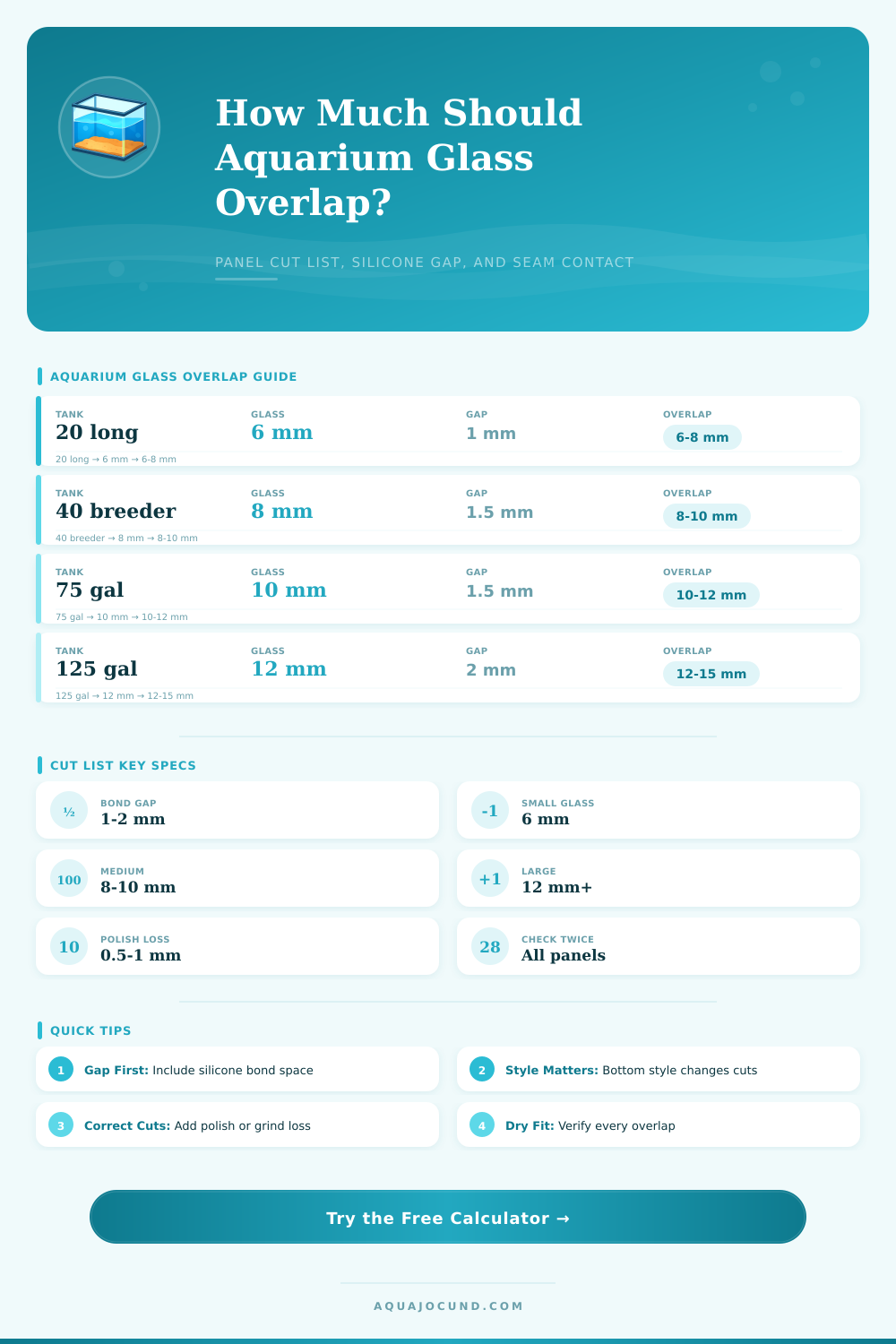
| 20 long | 30 x 12 x 12 in / 762 x 305 x 305 mm | 1/4 in / 6 mm | 1 mm | 6-8 mm |
| 40 breeder | 36 x 18 x 16 in / 914 x 457 x 406 mm | 5/16 in / 8 mm | 1.5 mm | 8-10 mm |
| 55 gallon | 48 x 13 x 21 in / 1219 x 330 x 533 mm | 3/8 in / 10 mm | 1.5 mm | 10-12 mm |
| 75 gallon | 48 x 18 x 21 in / 1219 x 457 x 533 mm | 3/8 to 1/2 in / 10-12 mm | 1.5-2 mm | 10-14 mm |
| 125 gallon | 72 x 18 x 22 in / 1829 x 457 x 559 mm | 1/2 in / 12 mm | 2 mm | 12-15 mm |
| 180 gallon | 72 x 24 x 24 in / 1829 x 610 x 610 mm | 5/8 in / 16 mm | 2 mm | 16-19 mm |
| Input | What It Changes | Typical Range | Calculator Treatment |
|---|---|---|---|
| Glass thickness | How much panels overlap at corners and bottom | 5-16 mm | Subtracted where panels fit between other panels |
| Silicone gap | Space left between mating glass faces | 1-2 mm | Subtracted with thickness from inset dimensions |
| Overlap allowance | Extra designed bearing/contact face | 0-3 mm | Added to effective contact width |
| Cut correction | Polish, grind, or shop sizing adjustment | -1 to +1 mm | Applied twice per panel dimension |
| Shop tolerance | Expected size variation from the cutter | 0.5-2 mm | Shown against gap margin in the breakdown |
| Bottom clearance | Relief around inset bottom panels | 0.5-2 mm | Subtracted from inset bottom dimensions |
- Choose assembly style first: A bottom-under build and an inset-bottom build can use the same outside tank size but very different bottom panel dimensions.
- Keep the silicone gap real: Zero-gap glass can starve the joint; include a small bond line in the cut list before ordering glass.
- Use correction consistently: If the shop wants final sizes after polishing, set cut correction to zero. If it cuts before polish, add the expected edge loss.
- Label every pane: Front, back, left, right, and bottom panels can look similar after cutting but assemble in a strict order.
- Overlap is not thickness design: This calculator sizes panel cuts and contact geometry; use a glass safety factor check for thickness and bracing decisions.
- Confirm with the glass shop: Tempered panels, laminated edges, and polished panes may need final-size ordering rather than after-cut correction.
- Dry fit before silicone: Check the actual gap, squareness, and edge contact while the panels are clean and still easy to adjust.
- Do not bridge bad edges: Chips, shelling, and out-of-square cuts reduce reliable contact even when the calculator shows enough overlap.
Building a glass aquarium require you to understand the differences between the dimension of the individual glass panels and the final dimensions of the aquarium itself. The dimensions of the individual glass panels must take into account the reduction of dimensions caused by the need to polish the edges of each panel, the loss of dimensions at the seams caused by the cutting of the glass, and the need for each panel to overlap with other to ensure that the aquarium can support the weight of the water. If the dimensions of the individual panels dont account for these factors, the panels will not fit together to form an aquarium that can hold water.
To assist in calculating the dimensions of each individual panel, there are glass aquarium calculator available. These calculators asks for the dimensions that you would like your finished aquarium to be, and they account for the silicone gap, the thickness of the glass, and the cut correction in determining the size of each panel. If you change the assembly style for the aquarium, such as changing from a bottom that sits under the walls to an inset bottom, the size of the bottom panel will change within the calculator.
How to Size Glass Panels for an Aquarium
If you do not change the size of that bottom panel, the side walls will not line up with the bottom panel when the aquarium are assembled. Another variable that you must account for in the dimensions of the individual panels is the thickness of the glass panels. The thickness of the glass will impact the amount of weight that can be placed on the corners and bottom seam of the aquarium.
However, thicker glass panels will reduce the internal dimension of the aquarium. To account for this reduction in dimensions, there is an overlap allowance field on the calculator. The overlap allowance allow the glass aquarium builder to add to the thickness of the glass panels to provide strength to the aquarium.
Because the strength of the aquarium is related to the size of the glass seams that contact each other, providing extra thickness to the glass panels will increase the strength of the aquarium once it is filled with water. The third variable to account for is the size of the gap between the two panels that silicone will join together. The size of this gap must be a specific size; if the gap is too narrow, the silicone will not be able to coat the entire area between the two pieces of glass; if the gap is too wide, the aquarium may flex too much at the seam between the two pieces of glass.
The glass aquarium calculator account for this gap in determining the size of each panel. Additionally, the calculator also includes a field to input shop tolerance for the glass cutting. This number can be used to ensure that the gaps between the panels will not be cut too narrow.
Another variable that must be accounted for is the allowance for the loss of dimensions when polishing the edges of the glass panels. Some glass shop will polish the glass panels after they have been cut to size; other glass shops will cut the glass panels to a larger size and then polish them to the final thickness. The cut correction field on the glass aquarium calculator is used to input the thickness of glass panels that are lost during the polishing process.
If you do not include this field in the planning of the aquarium, the panels may be too short after polishing. The fourth and last variable to account for in the size of the individual panels is the assembly style for the aquarium. If the assembly style for the aquarium has the bottom panel sitting under the side walls, the size of the bottom panel will be more different than an aquarium that has an inset bottom panel.
The side panels will lose height in one design of the aquarium, but will retain their full height in the other. The aquarium calculator will automatically adjust these measurements to ensure that the cut list for each panel will not have to be recalculated each time the assembly style is changed. However, the glass aquarium calculator does not account for all of the variable that may impact the construction of the aquarium.
For example, salvaged glass panels may have chips on the edges, and tempered glass panels cannot be trimmed once they are tempered. Additionally, low-iron glass makes scratches easy to see on the completed aquarium, so care must be taken in how the glass panels are handled. Because of these variable, many glass aquarium builder perform a dry fit of each panel of glass.
A dry fit is when the individual panels of glass are assembled together without the use of silicone. The dry fit account for all of the variables of the construction of the glass aquarium, and allows each builder to ensure that the individual panels will overlap as planned. The goal of the glass aquarium calculator is to allow each individual to determine a set of panels that will fit together to form an aquarium that can hold water.
These dimensions must allow for the silicone to perform its function of bonding each panel together securely. By ensuring that each panel will fit together correctly and that the silicone will be applied correctly to those panels, the aquarium will be able to hold the amount of water that is desired for that particular aquarium.