📐 Aquarium Perimeter Brace Calculator
Estimate eurobrace strip cuts, silicone bonding area, top coverage, water load index, and brace safety factor.
| Layout | Cut Logic | Best Use | Silicone Contact |
|---|---|---|---|
| Nested eurobrace | Two long strips; two shorter end strips | Clean inside perimeter builds | High continuous contact |
| Butt joint perimeter | All four strips near full span | Simple glass shop cutting | High, with square corners |
| Mitered perimeter | Four strips meet at 45 degree corners | Display tanks with visible top edge | Good, but needs accurate cuts |
| Partial eurobrace | Coverage under 100 percent | Access openings and overflow gaps | Reduced by coverage percent |
| Tank Size | Inside Footprint | Typical Strip | Brace Glass | Coverage |
|---|---|---|---|---|
| 20 long | 30 x 12 in | 1.5 to 2 in | 6 mm | 80 to 100% |
| 40 breeder | 36 x 18 in | 2 to 2.5 in | 6 to 8 mm | 90 to 100% |
| 55 gallon | 48 x 13 in | 2.5 to 3 in | 8 to 10 mm | 100% |
| 75 gallon | 48 x 18 in | 3 in | 10 mm | 100% |
| 120 wide | 48 x 24 in | 3.5 to 4 in | 10 to 12 mm | 100% |
| 180 gallon | 72 x 24 in | 4 in | 12 mm | 100% |
| Glass Type | Calc Multiplier | Planning Note | Use With |
|---|---|---|---|
| Annealed float glass | 1.00 | Baseline aquarium glass estimate | Most DIY braces |
| Low-iron glass | 0.95 | Slightly conservative allowance | Display tanks |
| Tempered strip | 1.15 | Do not cut after tempering | Ordered final size |
| Laminated glass | 0.90 | Conservative stiffness allowance | Special builds |
| Acrylic top flange | 0.75 | Different material behavior | Acrylic tanks only |
| Unknown glass | 0.80 | Use extra conservative planning | Repairs |
A rimless aquarium may look great from every angle, but a rimless aquarium often doesnt provide the same level of support for the glass. The side panel of the aquarium may begin to bow out if they is not supported from the top. This bowing result from the increase in water pressure at the full height of the aquarium.
To prevent this bowing, a user can incorporate an perimeter brace, also known as a eurobrace, into the aquarium. A perimeter brace is a form of glass that rests on the top edge of the aquarium and distributes the even weights of the aquarium over the entire opening of the aquarium. The calculator will provide mathematical result for the various parameters of the aquarium after inputting the dimensions of the aquarium, the height of the water in the tank, and the specifications of the perimeter brace that will be used.
How perimeter braces help rimless aquariums stay strong
Each of these parameters must be understood before use the calculator. The length and width of the tank create the span for the perimeter brace. The height of the water is important because of the relationship between height and water pressure.
The thickness of the side panels of the tank indicate the strength of the side panels to resist flexing. The thickness and width of the perimeter brace indicate the strength of the perimeter brace to support the aquarium. The user must enter the type of glass that will be used for the aquarium into the calculator.
Finally, the user must enter the target safety factor into the calculator. These numbers will allow an individual to compare the various option for their aquarium prior to cutting any glass. Coverage percentage is one of the most often misunderstood parameters of the calculator.
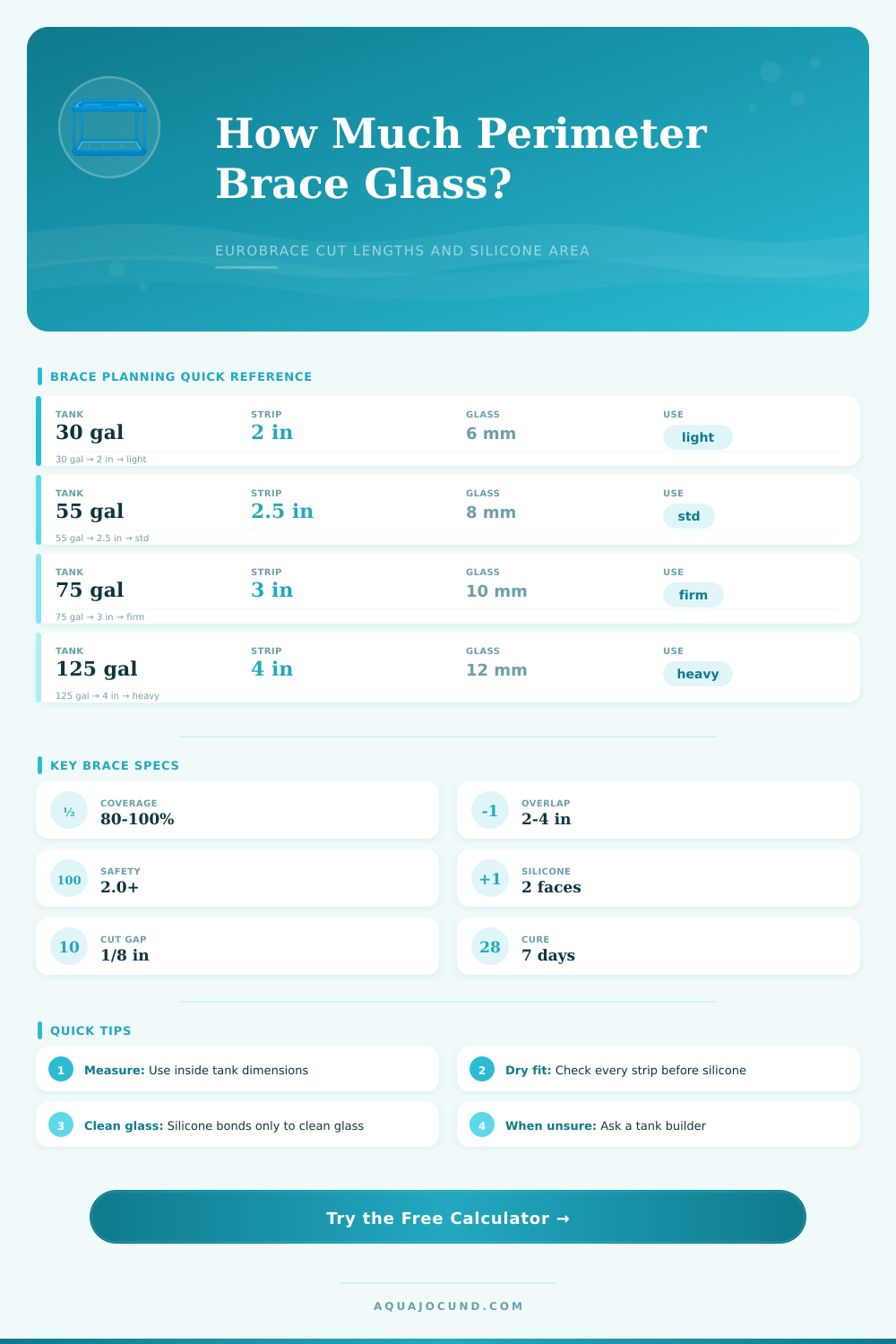
Coverage percentage pertain to the strips of glass that are used to create the perimeter brace. If an individual reduces the coverage percentage, there will be a gap in the perimeter brace for features such as overflows and feeding hole. Additionally, because coverage percentage directly relate to the total length of the perimeter brace that will be cut, the reduction of the coverage percentage will also lead to a reduction in the area that the perimeter brace will bond to the aquarium.
Thus, the estimated safety factor will be lower if the coverage percentage is reduced. Many builders use a reduced percentage for rimless tanks with under thirty gallon of capacity for water. In contrast, many aquarium builder use full coverage percentage for tanks with over fifty gallons.
The reduction in percentage may seem small, but it becomes noticeable when the tank is filled with water and the glass begins to bear the weight of the water. The area of the perimeter brace that will bond to the aquarium is also an important output of the calculator. This output is referred to as the silicone contact area.
There are two main faces of the perimeter brace that will be bonded to the aquarium. The perimeter brace will be bonded to the top edge of the side glass of the aquarium. Additionally, the perimeter brace will be bonded to the underside of the perimeter brace.
The two-face contact method is preferred because it is stronger than the single-face contact method. Based off the area of the faces of the perimeter brace that are to be in contact with the aquarium and the coverage percentage of the perimeter brace, the calculator will calculate the total area of contact. Ensuring that the glass panels are kept clean will ensure that the perimeter brace will bond to the aquarium rather than to any dust particle that may be on the side glass of the aquarium.
If the calculated area for the perimeter brace to bond to the aquarium is relatively small in comparison to the area of the aquarium itself, the user can increase the width of the perimeter brace, or the user can change the layout of the perimeter brace to a nested layout. The individual’s selection of the joint style of the perimeter brace will determine the cut length of the perimeter brace. If the perimeter brace is to be nested, the shorter end strip of the perimeter brace can be placed into the longer run of the perimeter brace.
The advantage of this joint style is that it wastes less of the perimeter brace strips because corners can be cut to create even edge for the perimeter brace. A butt joint is a simple joint to cut but require precise gap to be made at each corner of the aquarium. A mitered corner joint is the most visually appealing when viewing the aquarium from different angle.
However, this joint style is more difficult to cut as precise mitered corner must be made for each corner of the aquarium. The calculator calculates the total length of the perimeter brace that will be cut according to the layout of the perimeter brace that is selected. The gaps between the perimeter brace strips are cut to allow space for the silicone to bond to the edge of the perimeter brace strips.
The gap between the perimeter brace strips is usually the width of an eighth of an inch. This gap in the perimeter brace is important in that it will prevent the perimeter brace from “binding” to the side glass of the aquarium. Common size for aquariums will have reference table that display the dimensions of the perimeter brace strips that have commonly been used for tanks of those size.
For example, a twenty-long aquarium will typically use perimeter brace strips that are one-and-a-half to two inch wide. Those strips will typically be six millimeter glass. Seventy-five gallon display tank will use perimeter brace strips that are three inch wide and made of ten millimeter glass.
However, these measurement may have to be increased if the aquarium is to be placed in an area that is often visit or if there will be heavy equipment that rests on the tank. Rimless tanks that use thin side glass will require more conservative estimate for the perimeter brace because thin side glass does not provide much support to the aquarium structure. The safety factor is another planning value that is not a certified measurement of the strength of the aquarium and its structure.
The safety factor is a number that is calculated from the parameters of the aquarium and the perimeter brace. The safety factor will be used to compare the safety of the aquarium with various estimate of the parameters of the aquarium and the perimeter brace. For example, if the safety factor is above the target safety factor that is set by the fish keeper, then the parameters of the aquarium are likely safe.
If the safety factor is below the target, various adjustment can be made to the parameters of the aquarium to increase the safety factor. While the calculator can calculate the parameters of the aquarium, the installation of the perimeter brace has some human factor that cannot be included in the calculations. For example, each piece of perimeter brace has to be dry fitted to the aquarium prior to placing silicone on the piece to be joined.
Each piece of perimeter brace must be kept clean to ensure that it will strongly bond to the side glass of the aquarium. Finally, the perimeter brace will have to be allowed to cure for at least seven day prior to filling the aquarium with water. This seven-day period allow the perimeter brace to fully bond to the side glass of the aquarium.
The main value of calculating each of these parameters will be the ability of the fish keeper to quickly compare the various option for the perimeter brace for their aquarium. By understanding each of these parameter and the way that they relate to each other, each fish keeper can form their own opinion regarding the safety factor that they would like to incorporate into their aquarium design. This knowledge will help the fish keeper to ensure that their rimless aquarium will not develop any structural problem with time after it is filled with water and fish.