Aquarium Center Brace Width Calculator
Estimate center brace strip width, deflection check, safety factor load, and silicone contact area from tank span and water depth.
Brace Width Estimate
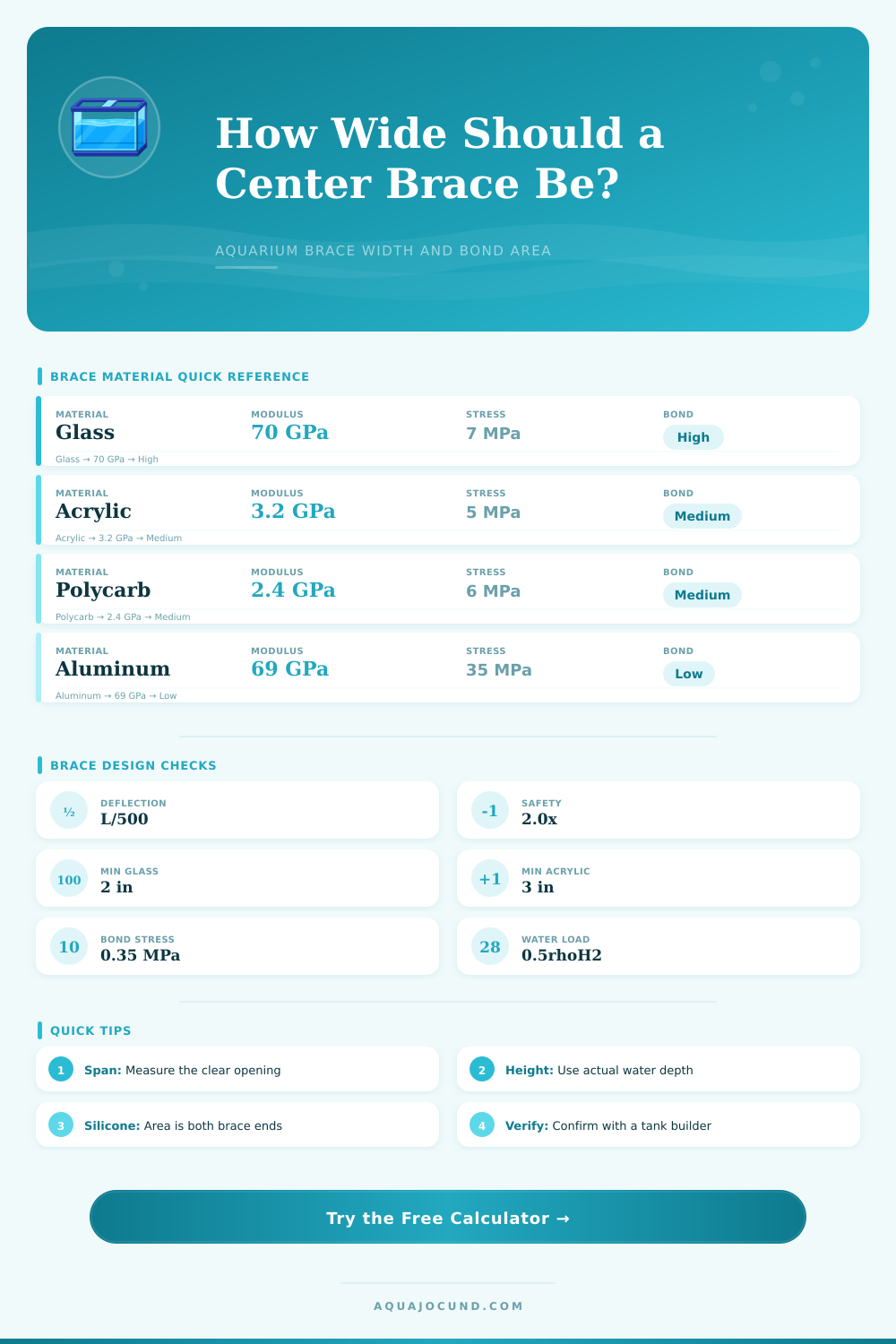
| Brace Material | Modulus | Allowable Stress | Practical Minimum | Silicone Note |
|---|---|---|---|---|
| Annealed glass strip | 70 GPa | 7 MPa | 2.0 in / 50 mm | Best match for glass tanks when bonded correctly. |
| Tempered glass strip | 70 GPa | 12 MPa | 2.0 in / 50 mm | Cannot be cut after tempering; edges must be finished first. |
| Cast acrylic strip | 3.2 GPa | 5 MPa | 3.0 in / 75 mm | More flexible; silicone-to-acrylic bond is weaker than glass. |
| Polycarbonate strip | 2.4 GPa | 6 MPa | 3.0 in / 75 mm | Impact resistant but flexible; roughen bonding zones. |
| Aluminum flat bar | 69 GPa | 35 MPa | 1.0 in / 25 mm | Do not rely on silicone alone; use mechanical fastening. |
| Tank | Typical Dimensions | Brace Span | Water Height | Typical Brace |
|---|---|---|---|---|
| 20 long | 30 x 12 x 12 in | 12 in / 30 cm | 11 in / 28 cm | Usually rim or narrow strip |
| 40 breeder | 36 x 18 x 16 in | 18 in / 46 cm | 15 in / 38 cm | 2 to 3 in glass |
| 55 gallon | 48 x 13 x 21 in | 13 in / 33 cm | 20 in / 51 cm | Factory center brace |
| 75 gallon | 48 x 18 x 21 in | 18 in / 46 cm | 20 in / 51 cm | 3 to 4 in glass |
| 90 gallon | 48 x 18 x 24 in | 18 in / 46 cm | 23 in / 58 cm | Wider center brace |
| 125 gallon | 72 x 18 x 22 in | 18 in / 46 cm | 21 in / 53 cm | Two braces common |
| 180 gallon | 72 x 24 x 24 in | 24 in / 61 cm | 23 in / 58 cm | Twin wide braces |
| Check | Formula Used | What Raises Width | Result Meaning |
|---|---|---|---|
| Hydrostatic panel force | 0.5 x rho x g x H² x L | More water height, longer panel | Total outward load on one long panel. |
| Brace tension | Panel force x load share x safety factor | Higher share or safety factor | Design load assigned to this center brace. |
| Strength width | Tension / stress / thickness | Thin brace or lower stress limit | Width needed to keep tensile stress below the limit. |
| Deflection width | Tension x span / E / thickness / deflection | Long span, flexible material, tight deflection | Width needed to limit axial stretch of the brace. |
| Silicone area | 2 x width x bond length | Wider brace or longer overlap | Total contact area across both bonded brace ends. |
An aquarium center brace are a strip of material that run from the front of the aquarium to the back of the aquarium, and the width of that strip is a critical measurement for the stability of that aquarium. If the width of the aquariums center brace is too narrow for the aquariums size, the water in the aquarium may exert pressure that causes the glass panels of that aquarium to bow outward. Such bowing of the aquariums panels can lead to instability of the aquarium, which presents a risk of one of the seams of the aquarium failing.
Thus, the width of the center brace that is selected for an aquarium must be one that can withstand the outward pressure of the water in the aquarium, as well as a width that allows for the necessary area for the silicone to secure the center brace to the aquarium. The water in the aquarium creates a pressing force against the walls of the aquarium, and the strength of that pressure is related to the depth of the water in the aquarium. The center brace intercepts some of the pressure that the water exerts against the long, front wall and the long, back wall of the aquarium.
How to Choose the Right Width for an Aquarium Center Brace
The amount of pressure that the center brace must intercept is related to the depth of the water in the aquarium, as well as the unsupported length of the long panels of the aquarium. The material of the aquarium center brace can impact the required width of that center brace. Center braces made of materials like glass or aluminum is stiff materials, and will allow for a narrower center brace than those made of more flexible materials like acrylic or polycarbonate.
Additionally, the material of the center brace also impacts the way that the silicone attaches the center brace to the aquarium; silicone adheres well to glass, but not as well to aluminum. Finally, the width of the center brace must be calculated with consideration of deflection limits for the aquarium, as well as the safety factors for the aquariums construction. Deflection is the amount that the center brace or the aquarium glass bend under the pressure of the water in the tank, and that deflection must be limited to an amount that ensures the safety of the aquarium.
Safety factors are necessary due to the fact that the conditions of the aquarium are not always going to be predictable. Changes in temperature for example, can change the load that the aquarium center brace has to bear. Furthermore, to reduce the amount of deflection that occurs within the aquarium, the builder has to increase the width of the aquarium center brace.
Similarly, if safety factors are to be increased, then the width of the aquarium center brace has to also be increased. The surface area of the silicone that makes contact with the aquarium center brace is a vital part of the calculation of the aquarium center brace. The aquarium center brace will help to distribute the tension load that the aquarium places upon the ends of the aquarium center brace where the aquarium center brace makes contact with the aquarium walls.
If the area of contact for the silicone is too small, then the silicone may fail due to the fact that it is not able to handle the tension load of the aquarium center brace. Thus, it is necessary to make sure that the total surface area of the silicone that will be in contact with the aquarium center brace is large enough to handle the design load of the aquarium center brace. There are alot of mistakes that individuals who wish to calculate the dimensions of an aquarium center brace make.
For example, individuals often measure the outside dimensions of the aquarium rather than the dimensions of the area that the aquarium center brace must span. In addition to measuring the total height of the aquarium, individuals may also measure the height of the water line in the aquarium, as measuring the total height of the aquarium leads to the placement of an incorrect calculation of the pressure that acts upon the aquarium center brace. Finally, many individuals may make the mistake of assuming that the factory rim of the aquarium will be able to support the aquarium and its contents, but the factory rim may sag beneath the load, so the assumption that it will be able to support the aquarium center brace is an incorrect assumption.
In addition to calculating the dimensions of the aquarium, the aquarium builder should also perform an inspection of the aquarium prior to the installation of the aquarium center brace. For instance, the silicone may have aged over time to the point where it has lost its elastic properties. Additionally, any glass that contains micro-cracks will not experience the same behavior as the glass that is free of any cracks.
In rimless aquarium builds, the aquarium center brace will have to bear more of the load upon the aquarium structure since there is no top frame to help to support the aquarium. Thus, another of the goals of the determination of the width of the aquarium center brace is to ensure that the stress and stretch of the aquarium remain within safe limits. Finally, another of the goals is to ensure that the aquarium center brace is wide enough to provide for adequate contact area for the silicone to remain attached to the aquarium center brace.