🌡 Aquarium Temperature Recovery Time Calculator
Estimate heater recovery hours from tank volume, sump volume, heat loss, lid type, and safe ramp rate.
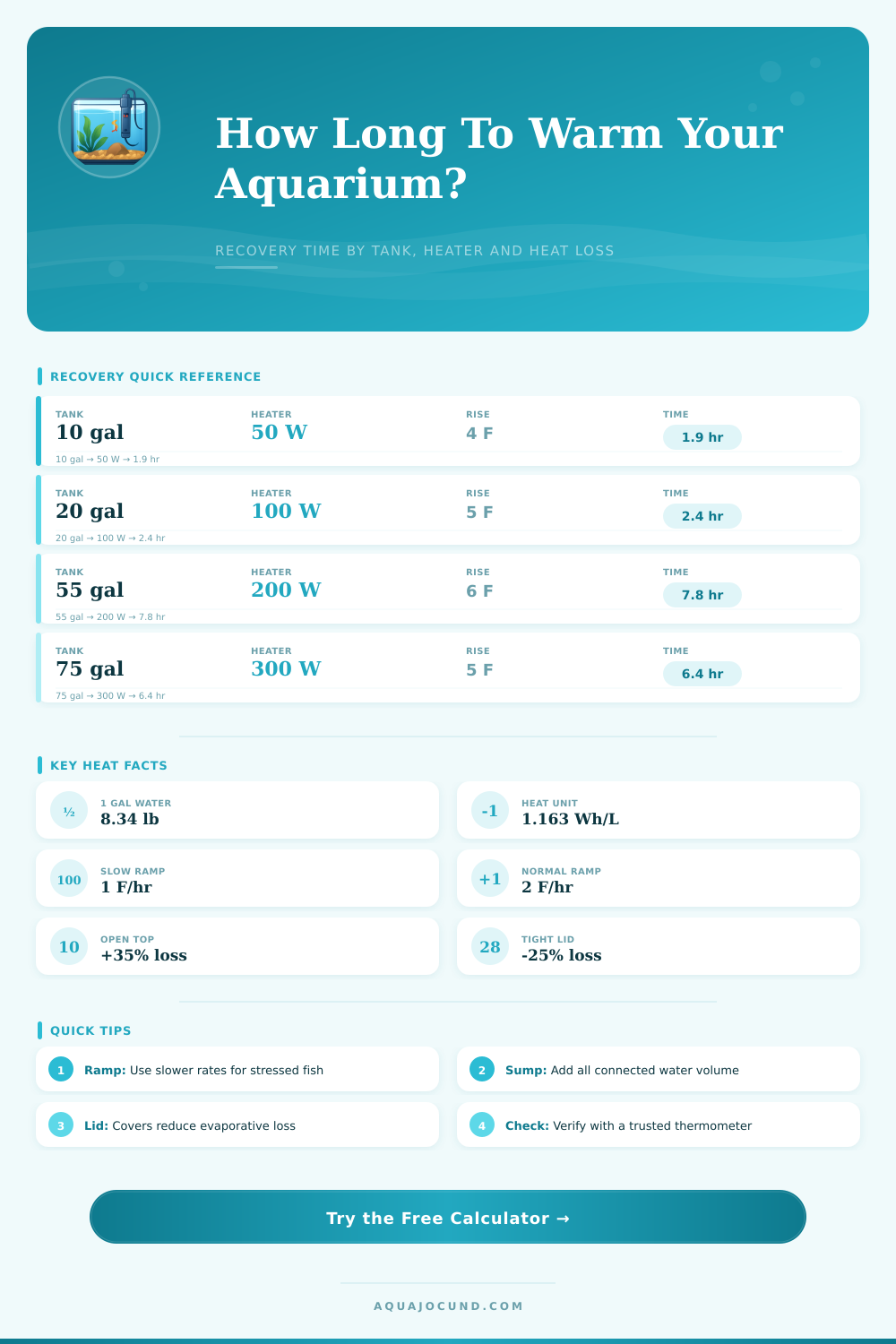
| Setup | Water Volume | Heater | Temp Rise | Typical Loss | Estimated Time |
|---|---|---|---|---|---|
| Betta tank | 10 gal / 38 L | 50 W | 4 °F / 2.2 °C | Low | About 1.7-2.3 hr |
| 20 long community | 20 gal / 76 L | 100 W | 5 °F / 2.8 °C | Moderate | About 2.2-3.2 hr |
| 55 gal cichlid | 55 gal / 208 L | 200 W | 6 °F / 3.3 °C | Moderate | About 7-9 hr |
| 75 gal reef | 90 gal / 341 L | 300 W | 5 °F / 2.8 °C | High | About 7-10 hr |
| 125 gal display | 140 gal / 530 L | 500 W | 5 °F / 2.8 °C | Moderate | About 7-9 hr |
| Ramp Setting | Use For | Hourly Limit | Notes |
|---|---|---|---|
| Sensitive | New arrivals, shrimp, stressed fish | 1 °F/hr / 0.6 °C/hr | Best when livestock is already stressed. |
| General | Most tropical community tanks | 2 °F/hr / 1.1 °C/hr | Good default for planned recovery. |
| Hardy | Cichlids, goldfish, robust adults | 3 °F/hr / 1.7 °C/hr | Use only when fish are behaving normally. |
| Emergency | Short urgent corrections | 4 °F/hr / 2.2 °C/hr | Monitor temperature and fish closely. |
| Factor | Calculator Value | Typical Situation | Recovery Effect |
|---|---|---|---|
| Low heat loss | 0.10 W/gal | Warm room, covered tank, mild flow | Faster recovery |
| Moderate loss | 0.18 W/gal | Most home aquariums | Normal recovery |
| High loss | 0.28 W/gal | Cool room, sump, strong surface ripple | Slower recovery |
| Open top lid | 1.35x loss | Rimless tanks, evaporative cooling | Can add hours |
| Tight lid | 0.75x loss | Glass top or insulated cover | Reduces heater load |
- Heater-only time is the raw physics estimate after heat loss, circulation, and buffer are applied.
- Recommended recovery also respects your safe ramp rate, so it may be longer than the heater can physically manage.
- Heat loss is most important in open-top tanks, cool rooms, sumps, reef overflows, and tanks with strong surface agitation.
- Sump volume matters because every connected gallon or liter must be warmed, even when the display tank looks small.
- Verify with a separate thermometer: heater dials are often several degrees off from the actual water temperature.
- Do not chase tiny swings: many tanks naturally drift a little between day and night without needing fast correction.
- Use slower ramps for stressed fish: new arrivals, sick fish, shrimp, and breeding fish usually tolerate gradual changes better.
- Check oxygen: warmer water holds less oxygen, so keep circulation and surface exchange steady during recovery.
An aquarium temperature change can occur overnight or after changing the water in the aquarium, and a change in the temperature of the water can cause stresses to the fish living in the aquarium. A change in the temperature of the water impacts the amount of dissolved oxygen in the water, and the activity levels of the fish in that tank. The speed with which the aquarium’s temperature changes will impact the health of the fish in that tank.
In order to input the parameters necessary for the temperature calculator to provide the appropriate amount of time for the aquarium’s water to reach the desired temperature, it is necessary to input the total volume of the aquarium and any sump connected to the aquarium. The volume of the aquarium and sump will impact the total number of gallon of water that need to be warmed. You must enter the difference between the current and target water temperatures into the calculator.
How to Use an Aquarium Temperature Calculator
The difference in water temperatures will impact the amount of energy necessary to warm the water. The wattage of the heater necessary to warm the water should also be entered into the calculator. The wattage of the heater will impact the amount of heat that can be provide to the water.
Finally, you can enter the expected rate of heat loss from the water into the calculator along with the type of lid that covers the top of the aquarium. The ramp rate will determine the speed at which the temperature of the water in the aquarium will rise to the selected target temperature. Those who attempt to warm there aquarium water often overlook ramp rates.
A slow rate of warming is better for the fish then rapid warming of the water, even if the heater contains enough wattage to heat the tank to the desired temperature in a short period of time. The calculator’s comparison of the wattage of the heater to the ramp rate that is selected will ensure that the recovery time of the aquarium water heaters is sufficiently long if the desired ramp rate is slower than the maximum output of the heater. Many variables exists within the real world that impact the variables that are accounted for in the theoretical models created by the developer of the aquarium temperature calculator.
For instance, the sump connected to the aquarium will increase the volume of water that must be warmed. Increased water volume require more energy to heat the water. The activity of the pump that agitates the water will increase the evaporation of water from the tank.
The more water that evaporates from the aquarium, the more the water will lose heat. Open-top aquariums will lose heat at a greater rate than aquariums covered with a glass lid or an insulated cover. These variables can be accounted for within the calculator; therefore, the owner dont have to guess at the rate at which the water will lose heat from the aquarium.
The reference tables provide examples of various aquarium setups and the range of time that the water will take to reach the desired temperature. These tables are, however, not to be relied upon instead of the calculator. For example, the tables show that a 55-gallon aquarium with a 200 watt heater will take a certain amount of time to reach the desired temperature.
Small changes in any of the variables will impact the time that is required for the aquarium to reach that desired temperature. Therefore, you should always use the calculator to determine the exact time that it will take for the aquarium water to reach the desired temperature. The estimates for cooling the water in the aquarium is different from the estimates for heating the water in the aquarium.
The cooling estimates are used to calculate the amount of time that is necessary for the temperature of the water to drop to a target temperature through passive heat loss from the water. Fans, chillers, or changes in the temperature of the room where the aquarium is located do not affect the cooling of the aquarium water. Therefore, these estimates are only a warning to the aquarium owners of the time that it will take for the water to cool passive.
In order to effectively use this aquarium temperature calculator, it is first necessary to measure the volume of water in the aquarium. It will also be necessary to determine the ramp rate at which the water temperature will rise in the aquarium, which is dependent upon the type of fish that live in the tank. Finally, you must use the aquarium temperature calculator to determine if the wattage of the heater that is used within the aquarium is sufficient to heat the tank to the desired temperature.
If the calculator reveals that it will take many hours for the water to reach the target temperature, additional heater wattage will be necessary to heat the aquarium, or the aquarium may need to be insulated better or the room in which the aquarium is located warmed to prevent rapid changes in the temperature of the water in the aquarium. It’s important to make sure you dont miss any steps when you is setting up your new tank. You should of checked the volume first.
Many people makes this mistake and it can lead to a lot of problems with the aquarium’s temp. Youll want to be carefull.