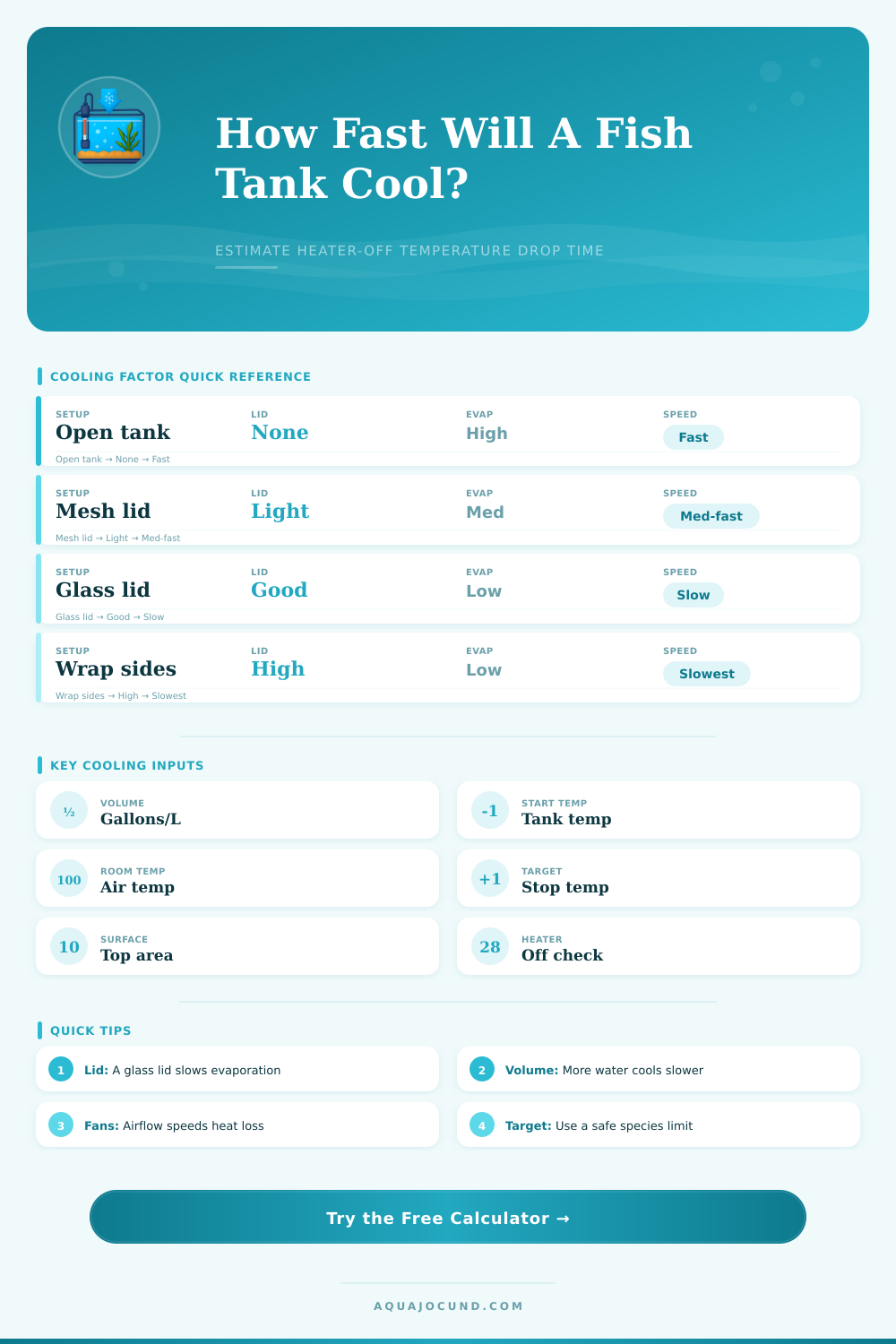
🌡 Fish Tank Temperature Drop Time Calculator
Estimate how many hours a heater-off aquarium may take to cool from the starting temperature to your target temperature.
| Setup | Top U Value | Side Multiplier | Evap Multiplier | Best Use |
|---|---|---|---|---|
| Open top, bare glass | 10.0 W/m²K | 1.00 | 1.30 | Worst-case heater outage estimate |
| Mesh or screen lid | 8.5 W/m²K | 1.00 | 1.10 | Reef or high-gas-exchange tanks |
| Partial lid | 7.0 W/m²K | 0.95 | 0.85 | Mixed canopies and feeding gaps |
| Glass or acrylic lid | 4.8 W/m²K | 0.90 | 0.35 | Most covered freshwater tanks |
| Acrylic tank with lid | 4.2 W/m²K | 0.72 | 0.30 | Acrylic display tanks |
| Insulated back and sides | 4.8 W/m²K | 0.55 | 0.35 | Fish room racks or foam panels |
| Emergency wrap sides | 4.5 W/m²K | 0.35 | 0.25 | Temporary heater failure response |
| Tank | Dimensions | Top Area | Typical Volume | Cooling Note |
|---|---|---|---|---|
| 10 gallon | 20 × 10 × 12 in / 51 × 25 × 30 cm | 200 sq in / 0.129 m² | 10 gal / 38 L | Small mass cools quickly |
| 20 long | 30 × 12 × 12 in / 76 × 30 × 30 cm | 360 sq in / 0.232 m² | 20 gal / 76 L | Wide top increases surface loss |
| 40 breeder | 36 × 18 × 16 in / 91 × 46 × 41 cm | 648 sq in / 0.418 m² | 40 gal / 151 L | Large top needs lid control |
| 55 gallon | 48 × 13 × 21 in / 122 × 33 × 53 cm | 624 sq in / 0.403 m² | 55 gal / 208 L | Moderate surface for volume |
| 75 gallon | 48 × 18 × 21 in / 122 × 46 × 53 cm | 864 sq in / 0.558 m² | 75 gal / 284 L | High surface, high water mass |
| 125 gallon | 72 × 18 × 22 in / 183 × 46 × 56 cm | 1296 sq in / 0.836 m² | 125 gal / 473 L | Large mass buffers outages |
| Condition | Evap Factor | Cooling Effect | When To Use |
|---|---|---|---|
| Humid room, little evaporation | 0.45 | Low | Closed room or covered tank |
| Calm room air | 0.70 | Mild | Low airflow freshwater tanks |
| Normal surface agitation | 1.00 | Baseline | Filter outlet ripples surface |
| Dry room air | 1.25 | Moderate | Winter heating or dehumidified room |
| Fan across water | 2.00 | Strong | Fans, open top, emergency cooling |
When teh heater in a fish tanks fails or is unplugged for maintenance, the water temperature within the tank will begin to change as the temperature of the water tend to reflect the temperature of the room in which the tank is located. The rate at which the water temperature within the tank change will determine the length of time that the owner have before the temperature of the water becomes dangerous for the fish within the tank. In many cases, those who owns fish tanks underestimate the change in water temperature.
Additionally, if the water within the fish tank has the ability to evaporate and if there is airflow into the tank, the rate of which the water can lose heat from the tank will be even further increased. The calculator that is located on this page allow for the owner to estimate the length of time that the water temperature within the tank will take to reach a certain level. Such an estimate is determined based off the volume of water within the tank, the surface areas of the tank, the temperature of the room in which the tank is located, and the type of lid that is placed upon the tank.
How Long Will My Fish Tank Stay Warm Without a Heater
Using a lid for the tank will reduce the rate at which the water will lose heat from the tank; using an open lid will allow for warm and moist air to leave the tank, which will cause the water temperature within the tank to drop at a faster rate then if the tank was covered in a lid. Additionally, insulating the sides of the tank will also make it so that the water within the tank will lose less heat to the tank; adding blankets to the sides of the tank, for example, will increase the length of time that the owner has before the temperature of the water within the tank drops to a dangerous level for the fish. One of the factors that will have the greatest impact upon the rate at which the water within the tank can lose heat is evaporation.
Many owners of fish tanks does not consider how the rate of evaporation can impact the rate of heat loss from the water within the tank. For instance, moving water within the tank will cause an increased rate of evaporation. Additionally, if the air within the room within which the fish tank is located is dry, the rate of evaporation will increase.
The use of an evaporation multiplier within the calculator accounts for each of these factor; the use of fan across the water will result in the loss of more heat from the water than if the setting was to the calm-room setting. Additionally, the use of water circulation will affect the length of time that the owner has before the temperature of the water drops; high circulation within the tank will allow for the heat within the water to be lost at a faster rate then low circulation. Thus, the high-circulation setting will result in a shorter length of time than the low-circulation setting.
The temperature within the room may not remain constant. For instance, the temperature within the room may drop during the night during the winter month. The length of time that the owner has before the temperature within the tank drops to a dangerous level for the fish will be further reduced if the temperature within the tanks room drop.
Thus, if the temperature within the room is certain to increase over time, it will take longer for the temperature within the tank to drop to a dangerous level for the fish; a warming room will provide more time to the owner than a cooling room. It is important for the owner to not set the target temperature within the tank to a level that is too low. More specifically, the target temperature is the temperature of the water that the owner intends to use as the target for the water heater in the tank.
Thus, while any temperature can be entered into the calculator, a more appropriate target temperature will be selected so as to allow for some error in the water temperature. Small tanks will lose heat more rapid than large fish tanks. For instance, it is likely that a ten gallon fish tank with an open top will reach a lower temperature in a shorter length of time than a seventy-five gallon tank with a lid of glass or acrylic and insulated sides to the tank.
The tables located on this page can help to provide information regarding how different types of lids for the tank can lead to the loss of heat at different rates from those tanks with different level of evaporation within the tanks. For instance, each table can help to illustrate the length of time that an owner has before the temperature of the water within the tank drops if that owner chooses to use some side insulation for the tank, or if the owner decides to use a lid for the tank that is more “tight” than others. Additionally, a comparison table of common tank sizes also exists to provide an understanding of the size of the tank prior to entering the calculator.
The information provided from this calculator will provide the owner with an estimate of the length of time until the temperature of the water within the tank reaches a dangerous level for the fish within the tank. This information will provide an incentive for the owner to regularly check the temperature within the tank. For instance, if the temperature within the tank is dropping at a faster rate then estimated by the calculator, this would indicate a need for more insulation of the tank.
Or if the temperature within the tank is increasing at a slower rate then estimated by the calculator, it may indicate that the owner should wait until the morning for the temperature to stabilize. Thus, this calculator provides information that helps the owner to make a decision regarding the care of the fish within the tank. The main goal of this calculator is not to provide an accurate estimate of the length of time that will pass before the temperature of the water within the tank becomes dangerous to the fish within that tank.
However, the goal of the calculator is to provide enough information to the owner to make a decision about the care of the fish within the tank. Decisions can be as specific as whether or not the owner can wait until the morning, whether a backup heater should be prepared, or whether the owner should provide more insulation to the tank to retain its heat. The owner should of checked the water temp regularly.
It is a luxurius feeling to have a healthy tank, but you must be carefull. Dont forget that the water temp can change actualy fast. There is alot of variables.
Youll need to monitor the fishs health too. Its important to keep everything stable. You should of checked the heater first.