🌡 Aquarium Heater Wattage Calculator
Size aquarium heaters from tank volume, room temperature, target temperature, sump volume, and backup strategy.
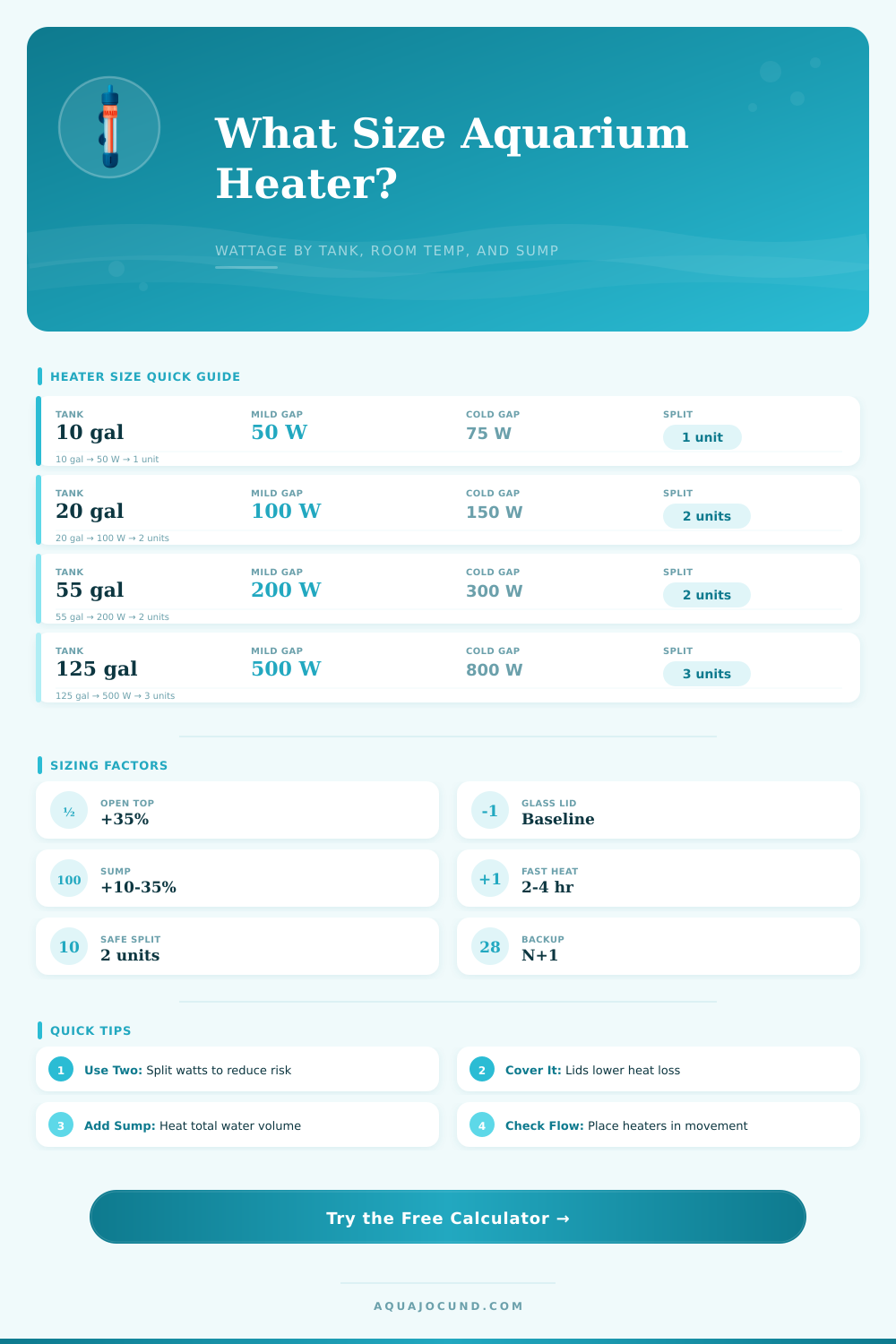
| Display Tank | Typical Dimensions | 5°F Lift | 10°F Lift | 15°F Lift | Suggested Split |
|---|---|---|---|---|---|
| 5 gallon | 16 x 8 x 10 in | 25 W | 25-50 W | 50 W | One small heater |
| 10 gallon | 20 x 10 x 12 in | 50 W | 50-75 W | 100 W | One heater |
| 20 long | 30 x 12 x 12 in | 75 W | 100-150 W | 150-200 W | One or two heaters |
| 29 gallon | 30 x 12 x 18 in | 100 W | 150 W | 200 W | Two small heaters |
| 40 breeder | 36 x 18 x 16 in | 150 W | 200 W | 250-300 W | Two heaters |
| 55 gallon | 48 x 13 x 21 in | 200 W | 250-300 W | 400 W | Two heaters |
| 75 gallon | 48 x 18 x 21 in | 250 W | 350-400 W | 500 W | Two heaters |
| 125 gallon | 72 x 18 x 22 in | 400 W | 600 W | 800 W | Two or three heaters |
| Room to Tank Gap | Use Case | Risk Level | Wattage Note |
|---|---|---|---|
| 0-5°F / 0-3°C | Warm room, mild tropical tank | Low | Small heater usually enough |
| 6-10°F / 3-6°C | Typical home aquarium | Moderate | Most tanks need standard wattage |
| 11-15°F / 6-8°C | Cool room or warm species | High | Use margin and split heaters |
| 16°F+ / 9°C+ | Basement, garage, very warm target | Very high | Use controller and backup plan |
| Factor | Setting | Multiplier | Why It Matters |
|---|---|---|---|
| Lid | Open top | x1.35 | Evaporation and room airflow pull heat out quickly. |
| Lid | Glass or solid lid | x1.00 | Baseline for most covered aquariums. |
| Lid | Canopy / enclosed | x0.78 | Reduced evaporative and convective heat loss. |
| Flow | Low flow corner | x1.12 | Heat spreads slowly and thermostat cycling can lag. |
| Flow | Sump chamber | x0.94 | Consistent movement improves heat transfer. |
| Sump | Standard sump | +20% | Extra water volume increases heat-up and holding load. |
| Plan | How It Sizes | Best For | Tradeoff |
|---|---|---|---|
| Single heater | One heater covers the full target watts. | Small tanks, simple setups | No backup if it fails off. |
| Two balanced | Total watts split evenly across two units. | Most tanks above 20 gallons | One failed heater may not fully hold temp. |
| Two at 70% | Each heater covers about 70% of demand. | Cool rooms and valuable livestock | More installed wattage. |
| Two full backup | Each heater can cover the full demand. | Controller-managed systems | Requires careful thermostat control. |
| Three balanced | Total watts split across three smaller units. | Long tanks and sumps | More equipment to place and inspect. |
- Size for the coldest normal room temperature: A heater that works in the afternoon may struggle before dawn if the room drops several degrees.
- Use total system volume: If the sump shares water with the display, heat the display plus the sump, not just the glass box you see.
- Round up to common heater sizes: The calculator rounds to standard heater wattages so the recommendation maps to real equipment.
- Use an external thermometer: Heater dials are approximate. Confirm the actual aquarium temperature after the system stabilizes.
- Split heaters across flow: Place heaters where water moves steadily, such as near a filter return, overflow path, or sump baffle.
- Reduce single-point failure: Two smaller heaters are usually safer than one oversized heater because either thermostat has less total power.
- Protect sump systems: If all heat is in the sump, make sure the return pump failure plan will not leave the display unheated for long.
- Use a controller for high wattage: Large systems and backup heater setups benefit from independent temperature control and alarms.
When choosing an aquarium heater for your freshwater aquarium, you must consider many different factors. The primary reason for including an aquarium heater for your aquarium is to maintain the temperature of the water within the aquarium. The factors that you should consider when buying an aquarium heater include the volumes of the aquarium, the temperature of the environment in which the aquarium is located, the recovery time for the system, the total volume of the water system (including the sump), the concept of redundancy, the placement of the heater within the aquarium, and the temperature of the room in which you place your aquarium.
When you purchase an aquarium heater for your system, you will want to ensure that the heater will maintain the temperature of the water within your aquarium. Many people will consider the volume of the tank when they purchases an aquarium heater. However, it is insufficient to only consider the volume of the tank alone.
How to Choose an Aquarium Heater
Several factors will contribute to the loss of heat within your aquarium, such as the difference between the room temperature and the desired water temperature within the aquarium. Additionally, the area of the water that is in contact with the air will contribute to the loss of heat from the water in your aquarium. If your aquarium includes a lid, it will help to retain some of the heat that the water emits in your tank.
However, if your aquarium dont have a lid, some of the heat will escape from the tank. These environmental factors will impact the purchasing decision that you must make as the owners of the aquarium. Another factor to consider when purchasing an aquarium heater is the recovery time of the aquarium system.
The recovery time is the length of time that it will take for the water in your aquarium to return to its target temperature after either performing a water change for your aquarium or if one of the aquarium heaters within the system should fail. Some aquarium fish species can tolerate slow changes in the temperature of the water within there tanks. However, other species requires rapid changes in the tank temperature to avoid killing the fish.
To provide rapid recovery times for the aquarium water temperature, you require a higher wattage aquarium heater. Therefore, you must consider the type of fish that live in your tank when you purchase your aquarium heater. Another factor to consider when purchasing an aquarium heater is the total volume of the water system.
This includes the sump (if any) that may be a part of your aquarium system. Aquarium heaters are often only sized for the display tank alone. However, the aquarium heater must be able to warm not only the display tank but also the sump tank if it exist within the aquarium system.
The total volume of the water system impacts the wattage that is required for the aquarium heater. The greater the volume of water in the system, the more greater the wattage that is required to heat the water in the aquarium system. Therefore, you must include the sump in your calculations for the aquarium system to ensure that the heater is powerful enough to heat the entire volume of water in your system.
The concept of redundancy within your aquarium system is another factor to consider when buying an aquarium heater. Redundancy is the idea that you use more than one aquarium heater to heat your tank. Using two aquarium heaters is generally better than one larger heater of the same wattage.
If one heater should fail, the other will continue to provide heat for the aquarium. Additionally, two heaters will provide even heat distribution throughout the tank. This is helpful for long aquarium tanks in which the water may not circulate as even throughout the tank.
The placement of your aquarium heater within the tank can also have an impact on the way in which it performs. Placing the heater in the corner of your tank will allow it to heat the area different than if it were placed in an area of the tank with high water movement. Poor water circulation will require your heater to work harder to ensure that the water within the aquarium reaches the desired temperature.
Therefore, placing your heater in an area of the tank with high water movement will allow the heater to distribute the heat more effectively to the water within your tank. Finally, you should always check the temperature of the room in which your aquarium is located. When performing calculations for your aquarium system, you should use the lowest normal temperature of the room in which you place the aquarium.
This is because the aquarium heater must be able to overcome the coldest temperatures within the room. If the room becomes very cold, your heater will have to work harder to keep the water in the aquarium to the desired temperature. You should of rounded up to the next available standard size when calculating the wattage requirements for your aquarium heater.
This will ensure that your heater has enough power to heat the water in your tank. Finally, select an aquarium heater and ensure that it maintains the proper water temperature in your aquarium by using an independent thermometer to test the water temperature in the tank.