❄ Aquarium Chiller BTU Calculator
Estimate BTU/hr and chiller HP from tank volume, temperature drop, equipment heat, ambient room temperature, lid, insulation, and pull-down time.
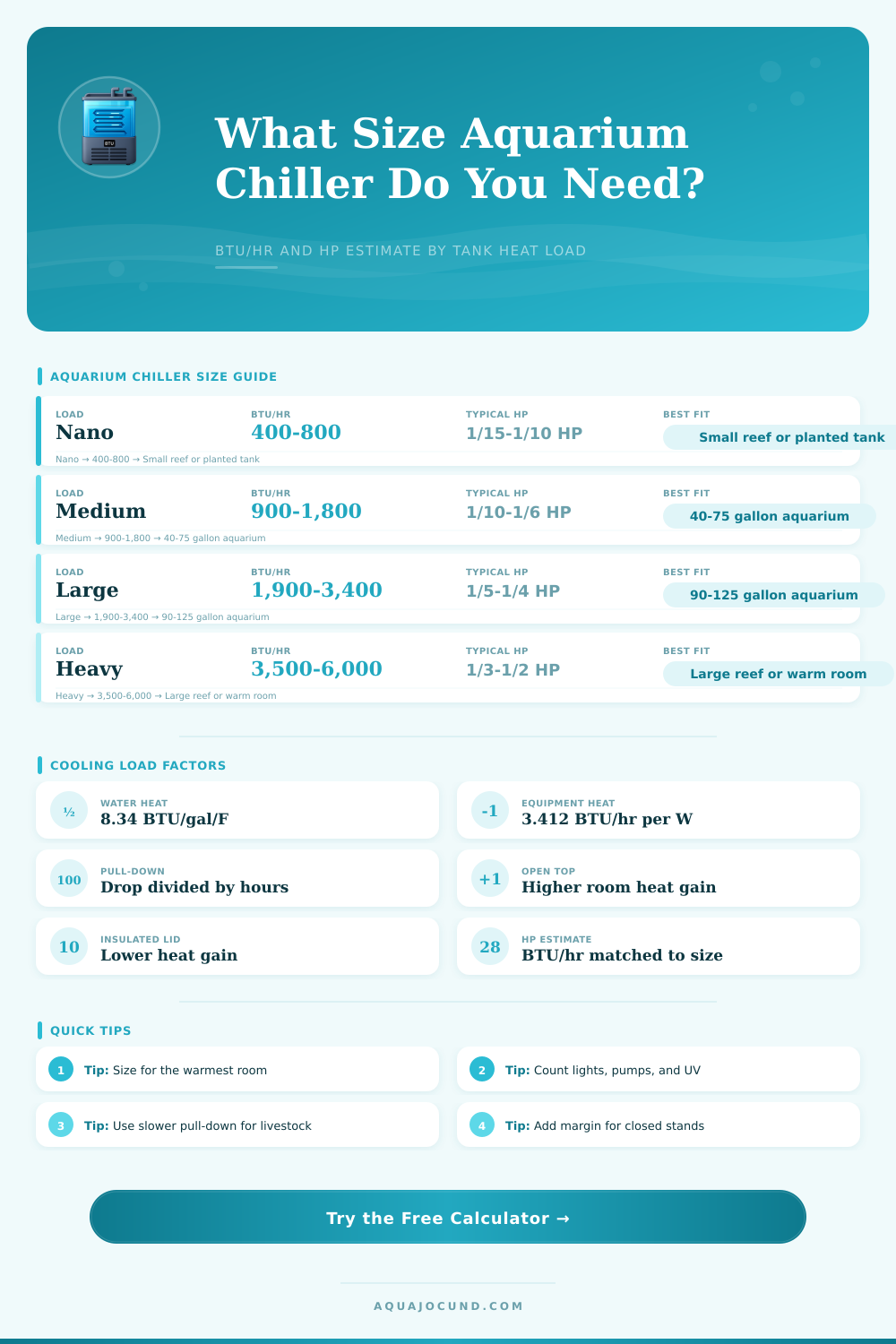
| Common Size | Nominal BTU/hr Range | Typical Aquarium Range | Notes |
|---|---|---|---|
| 1/15 HP | 400-700 | 10-30 gal | Nano tanks with modest lighting |
| 1/10 HP | 700-1,200 | 20-55 gal | Small reef or planted aquarium |
| 1/6 HP | 1,200-2,000 | 40-90 gal | Medium tanks with moderate equipment |
| 1/5 HP | 1,800-2,600 | 55-110 gal | Warm rooms or stronger lighting |
| 1/4 HP | 2,400-3,400 | 75-150 gal | Large reef or fast pull-down target |
| 1/3 HP | 3,400-4,800 | 100-200 gal | High heat load systems |
| 1/2 HP | 4,800-7,000 | 150-300 gal | Large aquariums and fish rooms |
| 1 HP | 9,000-12,000 | 300 gal+ | Commercial or multi-tank systems |
| Tank | Dimensions | Volume | Example Heat Watts | Starting Size |
|---|---|---|---|---|
| 20 Long | 30 × 12 × 12 in / 76 × 30 × 30 cm | 19 gal / 72 L | 40-90 W | 1/15-1/10 HP |
| 40 Breeder | 36 × 18 × 16 in / 91 × 46 × 41 cm | 45 gal / 170 L | 90-180 W | 1/10-1/6 HP |
| 55 Gallon | 48 × 13 × 21 in / 122 × 33 × 53 cm | 57 gal / 216 L | 120-220 W | 1/6 HP |
| 75 Gallon | 48 × 18 × 21 in / 122 × 46 × 53 cm | 79 gal / 299 L | 160-300 W | 1/6-1/5 HP |
| 90 Gallon | 48 × 18 × 24 in / 122 × 46 × 61 cm | 90 gal / 341 L | 200-380 W | 1/5-1/4 HP |
| 125 Gallon | 72 × 18 × 22 in / 183 × 46 × 56 cm | 123 gal / 466 L | 280-520 W | 1/4-1/3 HP |
| 180 Gallon | 72 × 24 × 24 in / 183 × 61 × 61 cm | 180 gal / 681 L | 400-750 W | 1/3-1/2 HP |
| Condition | Heat Gain Factor | Best Use | Calculator Effect |
|---|---|---|---|
| Open top / rimless | 1.25 | Reef tanks needing gas exchange | Highest room heat gain |
| Mesh screen lid | 1.05 | Jump prevention with airflow | Slightly above baseline |
| Glass or acrylic lid | 0.85 | Freshwater and axolotl tanks | Lower air exchange load |
| Insulated sides or canopy | 0.65 | Fish rooms, coldwater displays | Reduced steady heat gain |
| Open sump or wet-dry | 1.35 | Reef sumps and trickle filters | Extra exposed water surface |
To determine the apropiate chillers for an aquarium, it is first necessary to calculate the cooling loads of the aquarium. Chillers doesnt work according to the volume of the aquarium water to be cooled, and must overcome the heat that comes into the aquarium from other source. The heat that comes into the aquarium include the heat from the room in which the aquarium is located, as well as the heat from the electrical equipment used within the aquarium.
Thus, the user must account for each of these heat sources in the calculations that help determine the correct size of a chiller for the aquarium. The first part of the calculation is determining the pull-down requirement for the aquarium, which is the amount of energy that is require to cool the water of the aquarium by a certain number of degree. This calculation requires the decision of both the number of degree that the water should be cooled, and the amount of time that the aquarium should take to reach that water temperature.
How to Choose the Right Chiller for Your Aquarium
The longer that the aquarium takes to cool, the less energy that will be required for each unit of time; thus, providing for the livestock of the aquarium is better served by choosing a longer time period for the water temperature to drop. Included in the calculator is the tool that helps determine the pull-down requirement for the aquarium, based off the number of degrees that the water is to be cooled, and during how many hour the cooling is to occur. The second part of the calculation for chiller size is determining the heat load of the equipment that is placed within the aquarium, such as the aquarium light and pumps.
The electrical power that these devices use will become heat as it enter the water of the aquarium; the more electrical power (in the unit of watts) that run into the aquarium, the more heat that will be introduced into the system. This heat load should be added to the pull-down requirement to determine the total cooling load that the chiller must handle. The third part of the calculation is determining the contribution of the room temperature to the aquarium.
If the temperature of the room is hotter than the aquarium water, heat will flow from the air into the aquarium through the glass. An aquarium with an open top will reach higher room temperatures than one with a lid covering the water. Thus, the lid condition for the aquarium is an essential part of the calculations.
This part of the calculation will determine how much heat from the room is contribute to the aquarium. The fourth part of the calculation is adding a margin to the total cooling load that is calculated for the aquarium. A sizing margin is a percentage of extra cooling power that is added to the calculations for the chiller; this extra capacity will help to provide for the possibility of higher temperatures within the room.
A margin of between 15 and 30 percent is often add to the calculations. This extra percentage ensures that the chiller will be able to overcome days with higher water and room temperatures. The answer to these calculations will reveal the BTU per hour that the chiller should provide.
Chiller manufacturer use this same unit to describe the capacities of their chillers. Now that the BTU per hour requirement for the aquarium has been calculated, it is necessary to determine the chiller model that will best provide these necessary BTUs. Chillers are often described by their horsepower, but the BTU ratings provided by the manufacturers are the most accurate descriptions of the chillers capabilities.
A reference table within the tool describes the BTUs that is provided by chillers of different horsepower ratings; this table will be utilized to find a suitable chiller for the aquarium based upon the BTU per hour calculation. It is important to avoid two mistakes in the selection of chillers for an aquarium. The first error is to size the chiller according to the volume of water only; such a chiller will not account for the heat of the aquariums inhabitants and its environment.
The second error is to select a chiller that is too small for the aquarium; a chiller that is too small will need to run constantly to provide the required cooling, and may not be able to maintain the water temperature that is required for the aquariums livestock. It is also important to ensure that there is good airflow around the chiller; poor air circulation of the chiller will reduce its effectiveness. Thus, if each of these factor are included in the calculations, the outcome will be a chiller that will maintain a steady temperature within the aquarium.