🍂 Indian Almond Leaf Dosing Calculator
Estimate catappa leaf dosing from tank volume, leaf weight, tint target, buffer, water changes, and botanical mix.
✅ Dosing Recommendation
| Leaf Format | Typical Dry Weight | Medium Leaf Equivalent | Best Use |
|---|---|---|---|
| Mini leaf or piece | 0.3 to 0.5 g | 0.45 | Nano tanks, shrimp, fry |
| Small whole leaf | 0.6 to 1.0 g | 0.75 | Light tint adjustments |
| Medium whole leaf | 1.1 to 1.8 g | 1.00 | Baseline dosing unit |
| Large whole leaf | 2.0 to 3.0 g | 1.70 | Medium tanks, amber tint |
| XL whole leaf | 3.0 to 4.5 g | 2.50 | Large tanks, dark tint |
| Crushed leaf measure | 1.0 g measured | 0.90 | Filter bags or steeping |
| Tint Goal | Medium Leaf Equiv. | Visual Result | Suggested Pace |
|---|---|---|---|
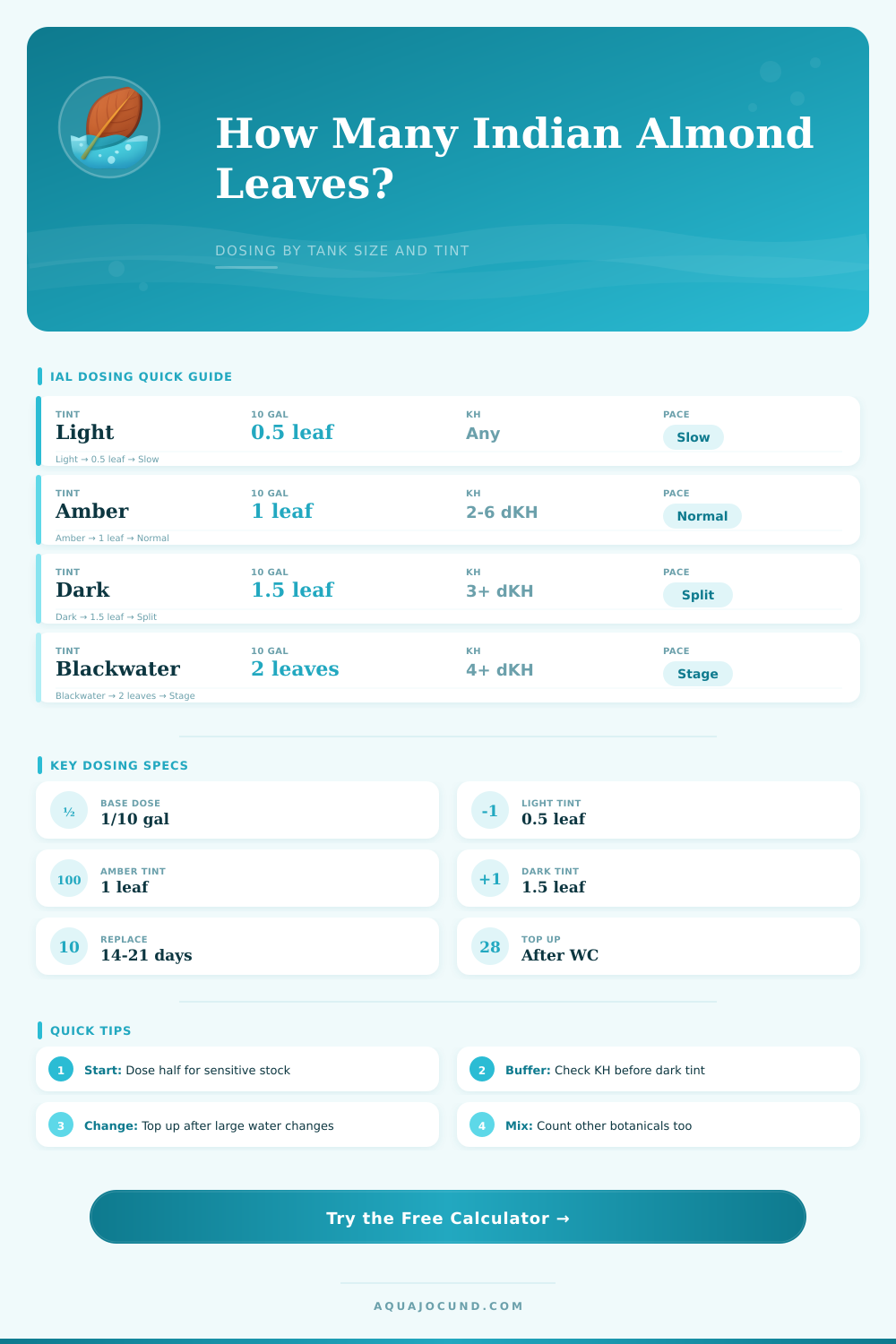
| Very light tea tint | 0.35 per 10 gal | Barely warm color | Add all at once |
| Light amber | 0.65 per 10 gal | Noticeable pale amber | Add all or split |
| Medium amber | 1.00 per 10 gal | Classic catappa tint | Split for delicate stock |
| Dark tea tint | 1.45 per 10 gal | Strong brown tea color | Split across 2 days |
| Blackwater style | 2.00 per 10 gal | Deep tannin water | Stage across 3 to 5 days |
| Tank | Light Tint | Medium Amber | Dark Tint | Typical Use |
|---|---|---|---|---|
| 5 gal | 0.3 leaf | 0.5 leaf | 0.8 leaf | Quarantine, nano |
| 10 gal | 0.6 leaf | 1 leaf | 1.5 leaves | Betta, shrimp |
| 20 gal | 1.3 leaves | 2 leaves | 3 leaves | Community, fry grow-out |
| 29 gal | 1.9 leaves | 3 leaves | 4 leaves | Dwarf cichlids |
| 40 gal | 2.6 leaves | 4 leaves | 6 leaves | Planted community |
| 55 gal | 3.6 leaves | 6 leaves | 8 leaves | Discus, angelfish |
| 75 gal | 4.9 leaves | 8 leaves | 11 leaves | Blackwater display |
| 125 gal | 8 leaves | 13 leaves | 18 leaves | Large botanical tank |
| Factor | Setting | Multiplier | What It Does |
|---|---|---|---|
| Species sensitivity | Very sensitive | 0.55 | Starts gently for fry, shrimp, and new stock |
| Species sensitivity | Cautious community | 0.80 | Reduces sudden tannin changes |
| Species sensitivity | Blackwater-adapted | 1.25 | Supports stronger tint goals |
| KH / pH buffer | Low KH | 0.75 | Limits acidifying organic load |
| KH / pH buffer | High KH | 1.25 | Compensates for weaker visible tint |
| Botanicals mix | Heavy mix | -40% | Credits pods, cones, bark, and seed litter |
| Water change removal | 25% change | 25% tint loss | Adds a proportional top-up after changing water |
| Replacement interval | 21 to 30 days | Higher | Accounts for leaf breakdown over longer intervals |
Indian almond leaves is often used in freshwater aquariums because the tannins that the leaves release can lower the pH of the water, discourage certain type of bacteria, and provide a sense of security for shy fish. The aquarium owner must determine the amount of Indian almond leaves that are to be added to the aquarium. Too many Indian almond leaves will darken the water in the aquarium.
The amount of Indian almond leaves that are required to be added to the aquarium can vary depending on the size of the aquarium, the type of fish that lives in the aquarium, and the frequency that the water change in the aquarium. Water changes remove the tannins from the water, so the frequency of the changes can impact the amount of Indian almond leaves that should be added to the aquarium. The goal that the aquarium owner establishes will determine how many Indian almond leaves should be added to the aquarium.
How Many Indian Almond Leaves to Use in a Fish Tank
For community tanks, the owner will add fewer Indian almond leaves than to tanks with blackwater species that requires a stronger color and a lower pH for the water. The calculator included with these instructions will calculate the amount of Indian almond leaves that should be added based on the size of the aquarium and the desired shade of the water. Other settings on the calculator allow for shrimp and fry (newly-hatched fish) to be included in the aquarium without being exposed to sudden changes in the chemistry of the aquarium water.
Such changes could occur based off the carbonate hardness of the water; the calculator allows for the user to adjust for both high and low carbonate hardness settings. Another factor that plays a role in the calculation of the amount of Indian almond leaves to be added to the aquarium is the size of the Indian almond leaves. One large Indian almond leaf can contain as much tannin as two or three small Indian almond leaves.
Thus, the Indian almond leaves are typically counted by the piece rather than by weight. However, a few dry Indian almond leaves can be weighed to determine the average weight of an Indian almond leaf; this weight can be entered into the calculator to determine the number of Indian almond leaves that should be added to the aquarium. The calculator will convert the weight of the Indian almond leaves to a starting number that should be added to the aquarium.
The calculator will also indicate the number of Indian almond leaves that should be added to the aquarium after each water change. Water changes will remove some of the tannins from the water; approximately 25% of the color can be removed by performing a 25% water change. The length of time that the Indian almond leaves are to remain in the aquarium can also impact the amount of Indian almond leaves that are required.
Indian almond leaves will break down at different rates with warmer water versus cooler water. Thus, the length of time that the leaves are to remain in the aquarium will impact the amount of Indian almond leaves that are required; the longer the leaves are to remain in the aquarium, the fewer leaves that will be required. Such a setting can be adjusted on the calculator to reflect the length of time that the Indian almond leaves are to remain in the aquarium.
The adjustment to the dose of Indian almond leaves ensures that there is no buildup of the Indian almond leaves; buildup can result from adding the leaves on a fixed schedule. In addition to Indian almond leaves, other botanicals can also impact the amount of Indian almond leaves that are required for the aquarium. If the aquarium contains other botanicals that contain tannins (such as seed pods, alder cones, or oak leaves), the calculator will adjust the amount of Indian almond leaves.
Aquariums with other botanicals will require fewer Indian almond leaves than aquariums without other botanicals. In addition to the type of fish that are to live in the aquarium, the tolerance of the species to Indian almond leaves can also be a factor for the aquarium owner to consider. Indian almond leaves are typically used in aquariums that contain the types of fish that live in soft water with tannins.
Conversely, fish species that live in hard water may develop stress if exposed to high amounts of tannins from Indian almond leaves. Stress can manifest itself as clamped fins or a loss of appetite in affected aquarium fish. The settings for the calculator allow the addition of Indian almond leaves in stages to allow for the water parameters to remain stable.
This staged addition allows for the tannins to be released slowly over several days. Another factor that can impact the amount of Indian almond leaves to be added to the aquarium is the number of water changes that are performed in a given period. For instance, small changes may be performed each week, while a large change may be performed once each month.
The amount of Indian almond leaves that are to be added to the aquarium will change with the size of the water change. The calculator will provide an estimate of the additional amount of Indian almond leaves that should be added to the aquarium immediately after each water change is performed. Adding Indian almond leaves immediately after a water change will prevent the Indian almond leaves from fading from the aquarium water prior to adding more Indian almond leaves.
Finally, the calculator allows the aquarium owner to create a routine for adding Indian almond leaves to the aquarium. Beyond the amount that can be added to create the desired color and pH to the water, additional small adjustments can be made. The calculator removes the guesswork involved in adding Indian almond leaves to the aquarium.
Youll find that the calculator makes it much more easy to manage the aquariums health. It is actualy a very useful tool that you should of used sooner.