🧪 Fishless Cycle Ammonia Dose Calculator
Calculate aquarium ammonia dosing from tank volume, product strength, current ppm, target ppm, drops per ml, nitrogen conversion, and a safety cap.
| Solution Type | Strength | NH3 per ml | 1 ml raises 10 gal |
|---|---|---|---|
| Very weak bottle | 0.5% | 5 mg | 0.13 ppm |
| Weak solution | 2% | 20 mg | 0.52 ppm |
| Household strength | 5% | 50 mg | 1.31 ppm |
| Strong solution | 10% | 99 mg | 2.62 ppm |
| Lab ammonium hydroxide | 25% | 225 mg | 5.95 ppm |
| Tank | Dimensions | Volume | 5% Dose to 2 ppm |
|---|---|---|---|
| 5 gal nano | 16 x 8 x 10 in | 19 L | 0.76 ml |
| 10 gal | 20 x 10 x 12 in | 38 L | 1.53 ml |
| 20 long | 30 x 12 x 12 in | 76 L | 3.06 ml |
| 29 gal | 30 x 12 x 18 in | 110 L | 4.44 ml |
| 40 breeder | 36 x 18 x 16 in | 151 L | 6.10 ml |
| 55 gal | 48 x 13 x 21 in | 208 L | 8.39 ml |
| 75 gal | 48 x 18 x 21 in | 284 L | 11.47 ml |
| 125 gal | 72 x 18 x 22 in | 473 L | 19.11 ml |
| Reading | Convert To | Factor | Example |
|---|---|---|---|
| NH3/TAN as NH3 | NH3-N | x 0.822 | 2 ppm = 1.64 |
| NH3-N | NH3/TAN as NH3 | x 1.216 | 1 ppm = 1.22 |
| NH3-N | NO2-N | x 1.00 | 1 ppm = 1.00 |
| NH3-N | NO3 as nitrate | x 4.43 | 1 ppm = 4.43 |
| NH3/TAN as NH3 | NO3 as nitrate | x 3.64 | 2 ppm = 7.28 |
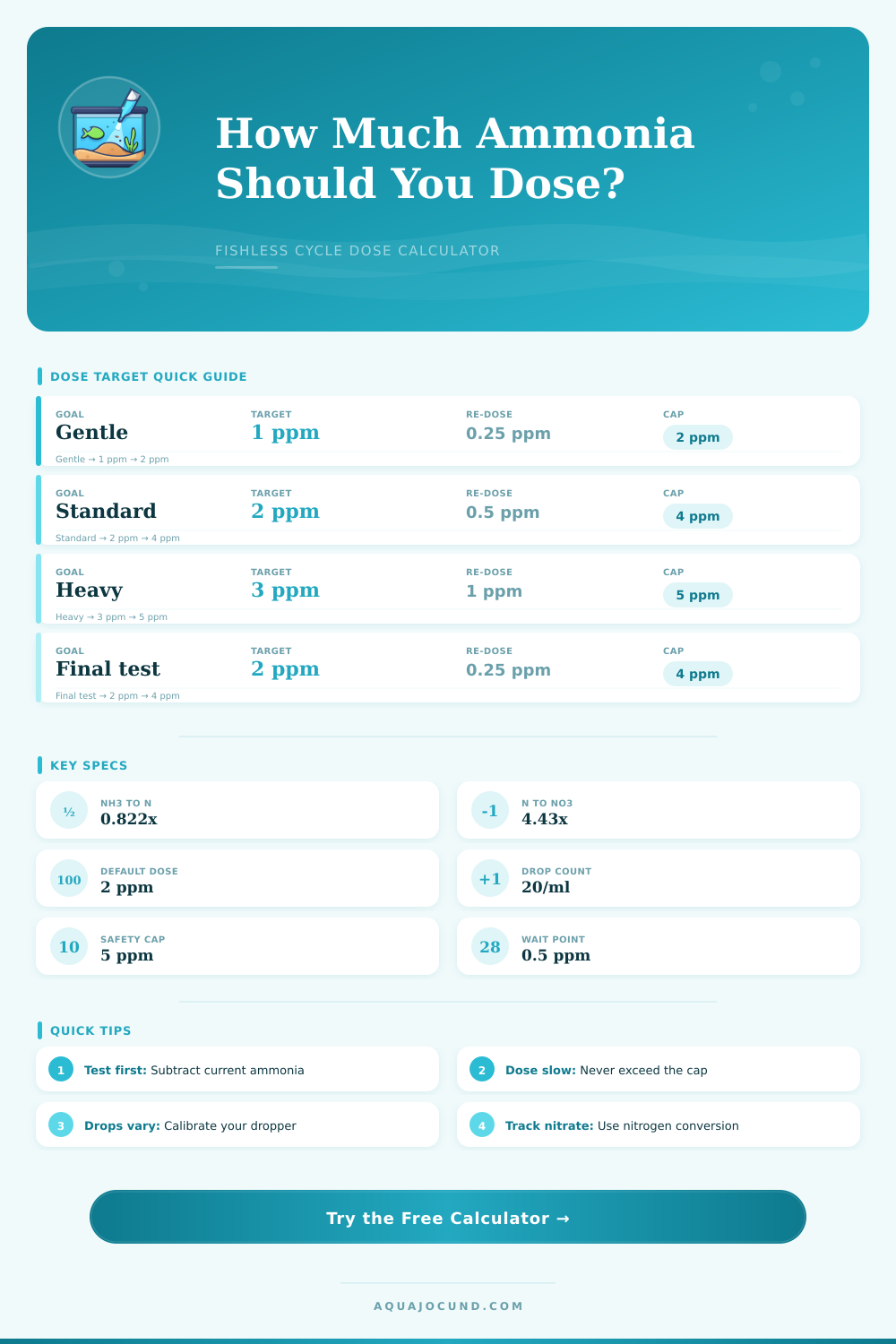
| Cycle Stage | Target Dose | Re-dose When | Safety Cap |
|---|---|---|---|
| Starter or small bioload | 1 ppm | 0.25 ppm | 2 ppm |
| Typical fishless cycle | 2 ppm | 0.5 ppm | 4 ppm |
| Large stocked tank prep | 3 ppm | 1 ppm | 5 ppm |
| Final processing check | 2 ppm | 0.25 ppm | 4 ppm |
A fishless cycle is when you add ammonia to the tank to feed the beneficial bacteria before you add any fishes to the tank. The most important part of adding ammonia to the tank is that you must ensures that the amount of ammonia you add during each round of feeding is the correct amount. If you add too little ammonia, the beneficial bacteria will not be able to grow strong enough to handle the waste from the fish that you will add to the tank.
If you add too much ammonia, however, you may stall the fishless cycle or make it more difficultly to manage the tank once the fish are added. Because ammonia products contain different concentration of ammonia and because test kits contain different scales of testing for ammonia, precise measurement of the amount of ammonia to add must be used. The calculator include several different specific inputs that will assist in the management of the fishless cycle.
How to Add Ammonia for a Fishless Cycle
You must first enter the volume of the tank into the calculator. The volume of the tank will determine how much the ammonia will be diluted once it is added to the tank. Additionally, you must also enter the strength and density of the ammonia product into the calculator.
The strength and density of the ammonia will allow for the calculator to determine how much actual ammonia will be added to the tank with every drop of the product. Many people prefers to use drops instead of a syringe to add the ammonia to the tank, so the number of drops per milliliter can also be entered. Additionally, both the target and current reading for the ammonia in the tank must be entered into the calculator.
The calculator will automatically subtract the current reading from the target reading to ensure that you dont add too much ammonia at once. Additionally, you can also enter thresholds for the re-dose of ammonia and a safety cap so that you ensure that the beneficial bacteria are allowed to process the ammonia before adding more ammonia to the tank. The target ammonia reading that the fishless cycle targets is not a fixed number.
The target reading may need to change with the specific goals for the aquarium. For instance, if the aquarium is to be home to shrimp, the target reading may only need to be set to one part per million (ppm) of ammonia. If, however, the aquarium is to be home to many fish, the target reading for the ammonia will need to be higher to allow the beneficial bacteria to learn how to process more ammonia.
Furthermore, the safety cap on the ammonia product will prevent you from adding an amount of ammonia that can create a nitrite spike within the tank that the beneficial bacteria cannot handle. Some people may be confused by the difference between the ammonia scale of NH3 and the scale of nitrogen that is present in the water. Some ammonia test kits will report the level of NH3 in the tank while others will report the nitrogen levels in the tank.
These two scales are not the same and so the calculator will perform the conversion between NH3 and nitrogen so that you are not introduced to the possibility of error in comparing the ammonia levels within the tank. In addition to the basic settings for the calculator, there are also different dosing style. For instance, you can choose the settings so that the amount of ammonia is rounded to the nearest drop, which may be beneficial if you are using a dropper bottle.
If you are using a syringe, however, you may prefer to round the amount of ammonia to the nearest half milliliter. Additionally, there is a conservative setting that will calculate the amount of ammonia to ninety percent of the total amount of ammonia needed. This may be beneficial for those who wish to avoid adding too much ammonia to the tank during the initial few fishless cycle rounds.
The reference tables included on this page can assist in your decisions. For instance, the strength of ammonia tables will allow you to view how different type of ammonia solutions will behave within your tank of a specific volume. This will allow you to decide if it will be easy to use the ammonia bottle that you currently have.
The other table includes the conversion of ammonia to nitrogen and will allow you to determine the amount of ammonia that will eventually turn to nitrate. This may be of benefit to those who are adding plants to the planted tank, as high levels of nitrate can negatively impact the plants. In order to manage the fishless cycle effectively, it is recommended that you test the water prior to each dose of ammonia.
By testing the water, you can determine the current reading of the ammonia in the tank prior to adding more ammonia. By subtracting the current reading from the target ammonia reading, you can ensure that you do not add too much ammonia into the tank. Additionally, you should keep notes of the amount of time that it takes for the ammonia levels to reach the re-dose threshold.
The time that is required for the ammonia levels to reach the threshold will shorten over time as the beneficial bacteria develops, indicating that the fishless cycle is nearly complete. Although the calculator that is provided will allow for an individual to calculate the amount of ammonia that should be added to the tank during the fishless cycle, factors like the temperature of the water, the pH of the tank, and the amount of dissolved oxygen in the tank will impact the rate at which the beneficial bacteria are able to process the ammonia. However, these factors are outside of the scope of the calculator and the individual with the calculator is assumed to manage them.
If, for instance, the temperature of the tank is low, the beneficial bacteria will take longer to process the ammonia. The same is true for low levels of pH in the tank. Prior to adding the fish to the tank, it is recommended that you perform one final test of the processing of ammonia by the beneficial bacteria.
For this test, you will add two ppm of ammonia to the tank and allow the beneficial bacteria to process the ammonia for twenty-four hour. If, after the twenty-four hour period, the level of both ammonia and nitrite in the tank have reached zero, then the beneficial bacteria have developed the capacity to process the waste from the fish that you will be adding to the tank. Using the calculator will allow you to accurately add the amount of ammonia to the tank for this test.
Once the beneficial bacteria have become established in the tank, however, the amount of ammonia that was added during the fishless cycle no longer matters. The goal of performing the fishless cycle was to establish beneficial bacteria that can allow for the tank to become stable and ready for the addition of the fish.