🦠 Beneficial Bacteria Dose Calculator
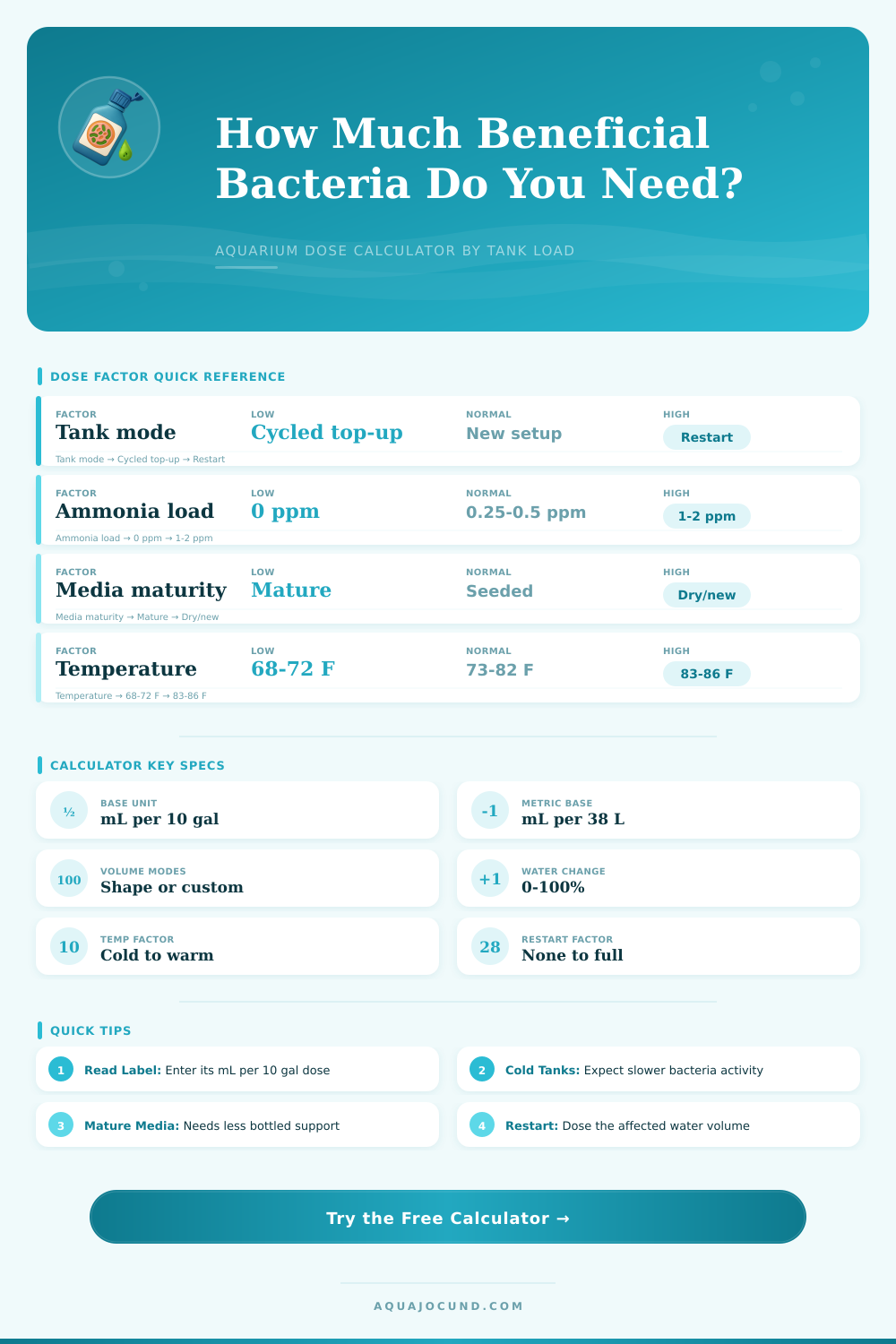
Estimate aquarium bottled bacteria dosing from tank volume, system maturity, ammonia load, water change size, restart needs, and temperature.
| Input | Setting | Factor | Calculator Use |
|---|---|---|---|
| Tank mode | Cycled top-up | ×0.60 | Maintenance after partial water change |
| Tank mode | New tank | ×1.00 | Full starter label dose |
| Tank mode | Fishless ammonia | ×1.35 | Extra support for measurable ammonia |
| Media maturity | Dry/new media | ×1.35 | More starter culture needed |
| Media maturity | Mature media | ×0.45 | Existing colony carries more load |
| Restart | Full restart | ×1.80 | Biofilter disruption allowance |
| Temperature | 73-82 F / 23-28 C | ×1.00 | Normal nitrifier activity range |
| Temperature | Under 65 F / 18 C | ×1.25 | Slower colonization allowance |
| Tank | Dimensions | Volume | Standard Starter Dose | 50% Cycled Top-Up |
|---|---|---|---|---|
| 10 Gallon | 20 x 10 x 12 in / 51 x 25 x 30 cm | 10 gal / 38 L | 5 mL | 1.5 mL |
| 20 Long | 30 x 12 x 12 in / 76 x 30 x 30 cm | 20 gal / 76 L | 10 mL | 3 mL |
| 29 Gallon | 30 x 12 x 18 in / 76 x 30 x 46 cm | 29 gal / 110 L | 15 mL | 4.5 mL |
| 40 Breeder | 36 x 18 x 17 in / 91 x 46 x 43 cm | 40 gal / 151 L | 20 mL | 6 mL |
| 55 Gallon | 48 x 13 x 21 in / 122 x 33 x 53 cm | 55 gal / 208 L | 28 mL | 8 mL |
| 75 Gallon | 48 x 18 x 21 in / 122 x 46 x 53 cm | 75 gal / 284 L | 38 mL | 11 mL |
| 125 Gallon | 72 x 18 x 22 in / 183 x 46 x 56 cm | 125 gal / 473 L | 63 mL | 19 mL |
| 180 Gallon | 72 x 24 x 24 in / 183 x 61 x 61 cm | 180 gal / 681 L | 90 mL | 27 mL |
| Temperature | Factor | Activity Note | Dose Interpretation |
|---|---|---|---|
| Under 65 F / 18 C | ×1.25 | Slow | Higher calculated support dose |
| 65-72 F / 18-22 C | ×1.10 | Reduced | Small cold-water allowance |
| 73-82 F / 23-28 C | ×1.00 | Normal | Baseline label-rate dose |
| 83-86 F / 28-30 C | ×0.95 | Warm | Slightly lower factor |
| Over 86 F / 30 C | ×1.15 | Heat stress | Use added allowance cautiously |
Adding beneficial bacteria to an aquarium require that you find the dose of beneficial bacteria that will match the conditions of the aquarium. Beneficial bacteria perform a vital function in the aquarium by converting ammonia into nitrite and then converting nitrite into nitrate. The beneficial bacteria live on the surface of the aquarium, they live inside the filter media, and they also live on the substrate of the aquarium.
If the colony of beneficial bacteria living in the aquarium are small or if it is disrupted, the level of ammonia in the aquarium will increase. If the level of ammonia increase in the aquarium, then the fish in the aquarium may suffer. The calculator determine the dose of beneficial bacteria to add to the aquarium by using several inputs.
How to Use a Bacteria Calculator for Your Aquarium
These inputs allows the calculator to arrive at the correct dose of beneficial bacteria without requiring that you perform the calculations yourself. The various inputs for the calculator are necessary because each input will alter the dose of beneficial bacteria that is required. The number of days that the aquarium has been established is one of these inputs.
In a new aquarium, which has dry filter media, there is no colony of beneficial bacteria living in the filter. In an aquarium that has been established for several months, however, there is a large population of beneficial bacteria that lives in the filter media. The level of ammonia in the aquarium is another of these inputs.
An aquarium with low level of ammonia requires less beneficial bacteria than an aquarium with high levels of ammonia. The reason that high levels of ammonia will require more beneficial bacteria is because the beneficial bacteria perform the essential function of break down ammonia into nitrite. High levels of ammonia in the water mean that there is alot of work for the beneficial bacteria to accomplish.
The temperature of the water in the aquarium is another of these inputs. The speed with which the beneficial bacteria convert ammonia into nitrite appear to change with the temperature of the water. Beneficial bacteria slow down in water that is colder than their preferred temperature.
Beneficial bacteria speed up in water that is at their preferred temperature. Therefore, if the temperature of the aquarium is sixty degrees, for instance, more beneficial bacteria will be required to treat that aquarium than if the temperature is seventy-eight degrees, which is the preferred temperature of the beneficial bacteria. Other inputs include the percentage of the water that will be changed, whether the aquarium will be restarted, and how many days the beneficial bacteria will be dosed.
Determining these factors allow the beneficial bacteria to be dosed appropriately. Splitting the dose of beneficial bacteria over several days may be necessary if the aquarium bacteria calculator calculated the dose. A very large dose of beneficial bacteria can overwhelm the capacity of the aquariums water surface area for beneficial bacteria to attach to the surfaces of the substrate, plants, and filter media.
Smaller doses over the course of several days allows the beneficial bacteria to establish themselves in the aquarium before adding more beneficial bacteria. In addition to the bacteria dose determine by the bacteria calculator, your own observations of the aquarium may help to determine the dose of beneficial bacteria that should be added. For instance, if the aquarium contains many fish that excrete a lot of ammonia, then more beneficial bacteria may be required than for a lightly stocked planted tank.
Finally, after adding the beneficial bacteria to the aquarium, it is important to observe the aquarium to determine whether the beneficial bacteria is performing their essential tasks of breaking down ammonia and nitrite. If the level of ammonia and nitrite does not decline after adding beneficial bacteria, then you should add more beneficial bacteria to the aquarium. Using this bacteria calculator will help you to no longer treat every bottle of beneficial bacteria for the aquarium the same way.
By using the bacteria calculator, you can determine the dose of beneficial bacteria that should be added according to the conditions of you’re aquarium. Thus, you will know what to do in each situation. Through using this bacteria calculator, you can be sure that you understand the conditions of your aquarium and the actualy conditions of your water and aquarium.