🧪 Aquarium Nitrogen Cycle Time Calculator
Estimate when a new or seeded aquarium can process ammonia and nitrite safely.
✅ Estimated Nitrogen Cycle Timeline
| Tank Volume | Gentle Cycle Dose | Standard Fishless Dose | Heavy Biofilter Test | Use Case |
|---|---|---|---|---|
| 5 gal / 19 L | 0.5-1 ppm | 1-2 ppm | 2 ppm max | Betta, shrimp, nano plants |
| 10 gal / 38 L | 1 ppm | 2 ppm | 3 ppm | Small community or quarantine |
| 20 gal / 76 L | 1 ppm | 2 ppm | 3-4 ppm | Community fishless cycle |
| 40 gal / 151 L | 1-2 ppm | 2-3 ppm | 4 ppm | Breeder tank or planted display |
| 75 gal / 284 L | 1-2 ppm | 2 ppm | 3 ppm | Cichlid or large community |
| 125 gal / 473 L | 1 ppm | 2 ppm | 3 ppm | Large display, slow stocking |
| Starting Condition | Ammonia Bacteria | Nitrite Bacteria | Typical Delay | Best Practice |
|---|---|---|---|---|
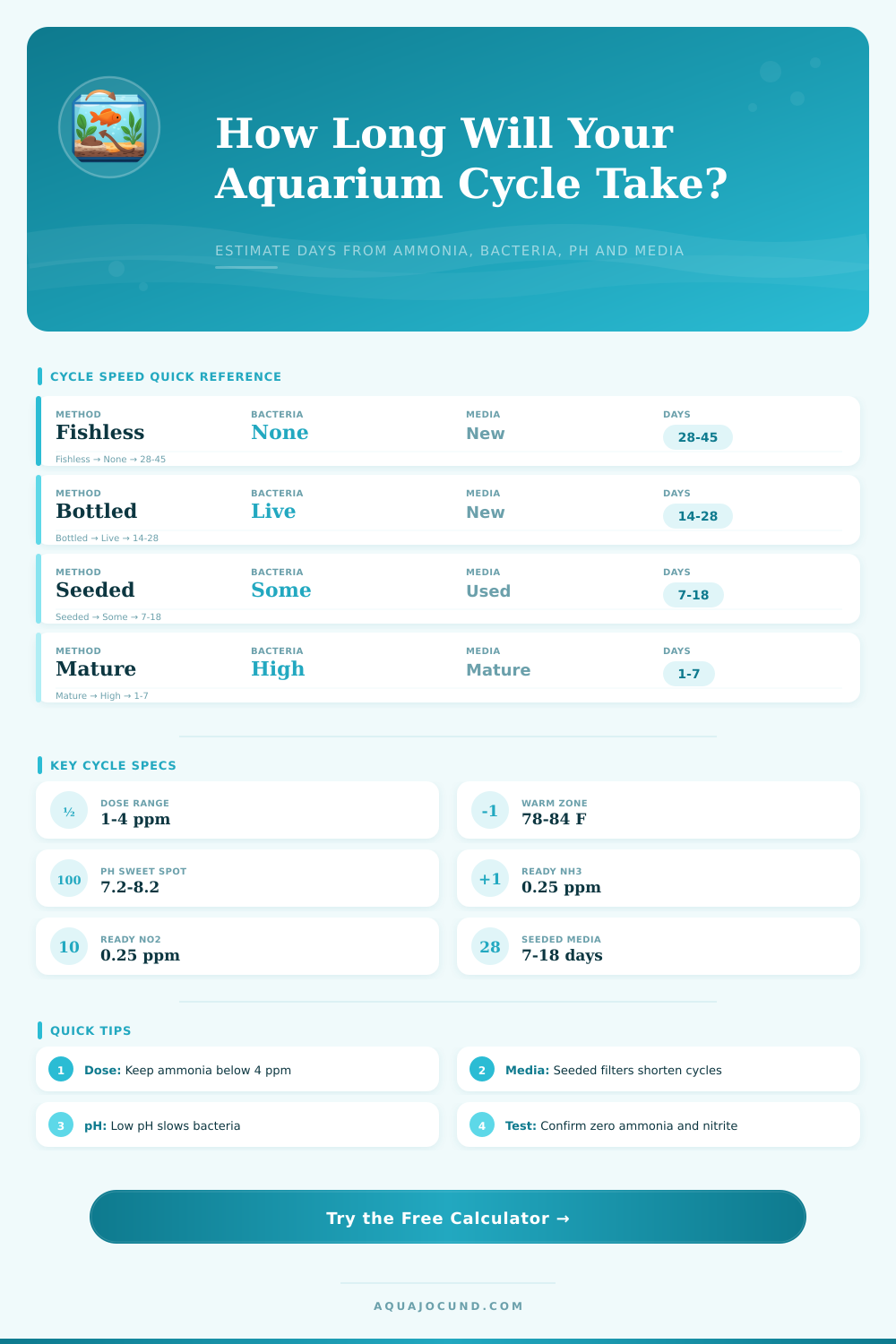
| Dry new filter media | None | None | 4-7 weeks | Feed ammonia steadily and keep filter running |
| Bottled bacteria | Low to moderate | Often slower | 2-4 weeks | Use fresh product and dose ammonia lightly |
| Mature filter squeeze | Moderate | Moderate | 10-24 days | Add mulm near intake and avoid rinsing media |
| Partial seeded bio-media | Strong start | Medium to strong | 7-18 days | Keep old media wet and oxygenated |
| Fully mature media move | High | High | 1-7 days | Test with a small ammonia dose before stocking |
| Marine live rock | Variable | Variable | 10-35 days | Watch die-off and nitrate rise before livestock |
| Condition | Fast Range | Slow Range | Cycle Effect | Watch Point |
|---|---|---|---|---|
| Freshwater temperature | 78-84°F | Below 70°F | Cold water may add 20-50% | Match future livestock needs later |
| Marine temperature | 76-82°F | Below 72°F | Cool reef starts often lag | Avoid big heater swings |
| pH | 7.2-8.2 | Below 6.8 | Low pH can stall nitrifiers | Check KH if pH drifts down |
| Ammonia dose | 1-3 ppm | Above 5 ppm | Too much ammonia can inhibit nitrite stage | Dilute with a water change |
| Nitrite | Under 2 ppm | Above 5 ppm | High nitrite can extend stage two | Water change if readings peg the kit |
| Water Change Plan | Best For | Timeline Effect | Target Use | Caution |
|---|---|---|---|---|
| No routine changes | Fishless dosing | Fast if ammonia stays reasonable | 2 ppm testing | Nitrite can peg the kit |
| 10% weekly | Stable fishless tanks | Minimal delay | Low nitrate control | Does not fix high toxins quickly |
| 25% weekly | Most new aquariums | Small delay, safer readings | Balanced approach | Redose ammonia after changes |
| 25% twice weekly | High nitrite cycles | Moderate delay | Prevent stalls | Keep bacteria fed |
| Fish-in changes | Existing fish present | Longer but safer | Ammonia and nitrite control | Test daily until stable |
| Large reset changes | Overdosed tanks | Can restart momentum | Above 5 ppm toxins | Match temperature and dechlorinate |
The nitrogen cycle are a biological process that occurs in an aquarium. The nitrogen cycle takes the toxic ammonia in an aquarium and converts it to nitrite and then continues to converting the nitrite to nitrate. The ammonia that is in the aquarium come from the waste that the fish contribute and the decaying matter in the aquarium.
The ammonia that is present in aquarium is toxic to the fish. The nitrite in the aquarium is also toxic to the fish, but the nitrate is less harmful to the fish. Understanding the nitrogen cycle allows an aquarium owner to understand how quick he or she can add fish to the aquarium.
How the Nitrogen Cycle Works in an Aquarium
If the nitrogen cycle isnt complete in the aquarium, then it is impossible to add fish to the aquarium due to toxic levels of ammonia and nitrite in the aquarium. Two of the factors that affect the speed of the nitrogen cycle is the temperature in the aquarium and the pH of the water in the aquarium. The beneficial bacteria that perform the nitrogen cycle work best within the specific ranges of both the temperature and the pH of the aquarium water.
If the temperature or the pH of the water is outside of these ranges, then the beneficial bacteria will work at a slower rate. For instance, if the temperature of the aquarium water is too low for the parameters of the aquarium, the beneficial bacteria will grow at a slower rate, and the nitrogen cycle will take place at a slower rate due to the sensitivity of these bacteria to cold water. Additionally, if the pH level drop below 6.8, the nitrifying bacteria will lose efficiency, and the nitrogen cycle will slow down.
You can use a nitrogen cycle calculator to determine how the temperature and the pH of the water impact the cycle. The calculator will display how far the parameters are from the ideal range required for the beneficial bacteria population to perform the nitrogen cycle. The source of the ammonia and the amount of ammonia that is added to the aquarium also affect the nitrogen cycle.
For instance, if you add pure ammonium chloride to the aquarium, then the amount of ammonia will be more predictable. However, if you add fish food or decaying shrimp to the aquarium, then the amount of ammonia that is released will be unpredictable. Additionally, if the amount of ammonia that is added to the aquarium increases, the speed of the nitrogen cycle will increase, and more beneficial bacteria will be able to grow.
Using a moderate amount of ammonia will allow the beneficial bacteria population in the tank to grow. However, if the amount of ammonia that is added to the aquarium increases to more than four part per million, the high level of ammonia will prevent the beneficial bacteria from performing their vital nitrogen cycle function. However, if you use established filter media in the aquarium, the cycle can be speeded up.
Established filter media contains the beneficial bacteria populations that will assist in transferring these beneficial bacteria to the aquarium water. The use of water change and the addition of aquarium plants will impact how the nitrogen cycle function within the aquarium. For instance, some aquarium owners will perform no water changes during the nitrogen cycle to allow for the beneficial bacteria to grow and reproduce at the necessary rate.
However, other aquarium owners will perform water changes once a week to keep the level of ammonia in the aquarium within an acceptable range. Additionally, using fast-growing plants in the aquarium will shorten the amount of time that it takes to complete the nitrogen cycle. This is due to the fact that fast-growing plants will remove ammonia from the water.
However, even with fast-growing plants removing the ammonia from the aquarium water, there will still need to be time for the beneficial bacteria population to mature in the aquarium to maintain the stability of the aquarium. Although the nitrogen cycle calculator will provide beneficial information for planning the aquarium, the results of the calculator are not a replacement for manually testing the water in the aquarium. The result from the calculator will indicate the range of days that the cycle will take to complete.
This range of days will allow the owner of the aquarium to begin manually testing the water with a liquid test kit. The calculator cannot account for each individual detail of the aquarium water. For instance, the calculator cannot account for whether the filter is providing enough water movement through the aquarium for nitrogen cycle functions or the heater for the aquarium water.
The aquarium must be manually monitored. However, if the owner understands the effects of temperature, pH level, seeding, and dosing on the nitrogen cycle, an owner can manage the cycle more effective. You’re going to need alot of patience.
Its important to know that the bacteria should of been growing naturaly. If you dont monitor teh water, things could go wrong. The owners aquarium needs care.
The bacterias growth is important. The process is different than what most people think. The tank is more better when it is stable.
The fish will recieve help from the cycle. Use a moddern approach. It is more better to be safe.
The water is different than before. Its harder than it looks. You should of checked the pH.
The bacteria will be there. The tank is its own ecosystem. A aquarium needs attention.
The water level is too low. The fish needs food. The cycle is almost done.
The water looks clear. The nitrogen cycle is a process that is important. The owner should of checked the filter.
The ammonia is gone. The nitrite is gone. The nitrate is there.
The cycle is complete.