💧 Pond UV Dwell Time Calculator
Estimate UV contact time, adjusted dose, bypass flow, lamp aging, and pond turnover in one pass.
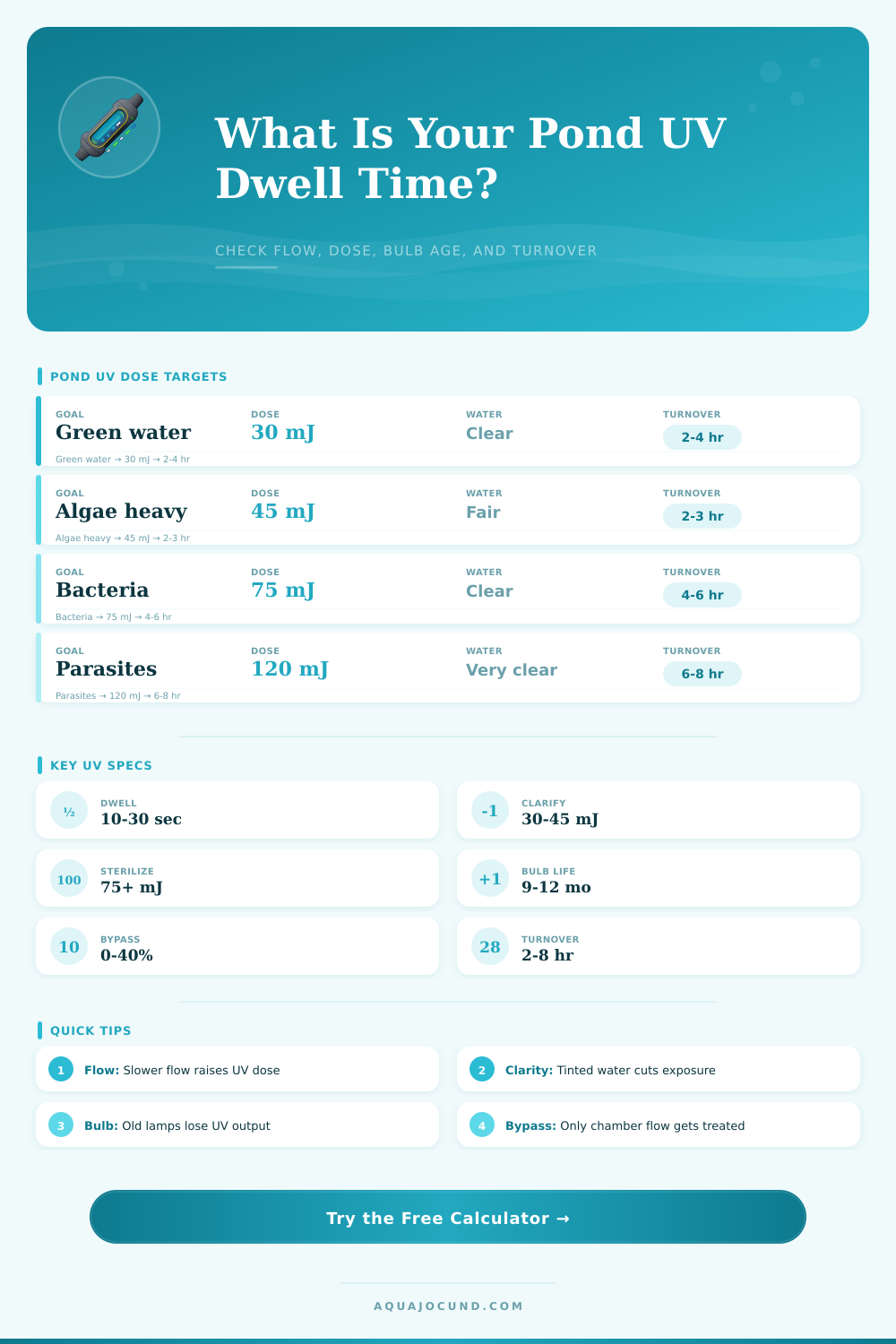
| UV Goal | Typical Dose | Flow Approach | Best Clarity | Turnover Aim |
|---|---|---|---|---|
| Green water clarification | 30 mJ/cm² | Moderate to fast | Clear to light green | 2 to 4 hours |
| Heavy algae correction | 45 mJ/cm² | Moderate | Prefiltered water | 2 to 3 hours |
| Bacteria reduction | 75 mJ/cm² | Slower contact pass | Low suspended solids | 4 to 6 hours |
| Protozoa / parasite pass | 120 mJ/cm² or more | Slowest useful flow | Very clear water | 6 to 8 hours |
| Lamp Type | UV-C Output Factor | Useful For | Notes |
|---|---|---|---|
| Low pressure UV-C bulb | 0.32 | Most pond sterilizers | Efficient at germicidal wavelengths |
| Amalgam high output bulb | 0.38 | Large ponds and koi loops | Higher output at warmer chamber temps |
| Compact clarifier bulb | 0.24 | Small green water units | Often needs slower flow for dose |
| Older magnetic ballast unit | 0.26 | Legacy clarifiers | Check quartz sleeve and lamp hours |
| Pond Setup | Pond Volume | Typical UV | Flow Range | Common Aim |
|---|---|---|---|---|
| Patio pond | 300 gal / 1136 L | 9 to 18 W | 150 to 400 gph | Clear green tint |
| Small garden pond | 1000 gal / 3785 L | 18 to 25 W | 400 to 900 gph | Clarification |
| Medium koi pond | 2500 gal / 9464 L | 40 to 57 W | 1000 to 2200 gph | Algae control |
| Large koi pond | 6000 gal / 22712 L | 80 to 120 W | 2500 to 5000 gph | High clarity |
| Slow sterilizing loop | Any size | 40 W plus | Low bypass flow | Higher dose pass |
| Factor | Setting | Multiplier | Calculator Use |
|---|---|---|---|
| Water clarity | Very clear | 1.00 | Minimal UV loss through the chamber |
| Water clarity | Light tint | 0.85 | Typical pond water after filtration |
| Water clarity | Green tint | 0.70 | Reduced transmittance from suspended algae |
| Water clarity | Cloudy | 0.55 | Fine solids reduce exposure |
| Water clarity | Muddy / tannin | 0.40 | UV may need prefiltration first |
| Bulb age | 0 to 6 months | 1.00 to 0.86 | Strong output with clean quartz sleeve |
| Bulb age | 9 to 12 months | 0.79 to 0.72 | Replace many pond UV lamps in this window |
| Bulb age | 18 months | 0.58 | Visible light can remain while UV-C is weak |
Maintaining a healthy pond require an understanding of the concept of dwell time. Dwell time is the amount of time that the ponds water spends within an UV chamber. UV dwell time is an important measurement for ponds because the dwell time determine if the harmful algae, bacteria, or parasites is exposed to enough UV energy to neutralize them.
While many pond owner believe that the wattage of the UV lamp is the only important factor to consider in regard to pond health, the wattage is not the only factor that impact the health of the pond. Other factors to consider include the speed of the pond pump, the size of the chamber, the clarity of the pond water, and the age of a UV lamp. Dwell time is defined as the number of seconds that a specific amount of water remain within the UV chamber with the UV lamp.
How Long Water Stays in the UV Chamber
If the water takes longer to pass through the chamber, it will absorb more UV energy. If the user increases the pump in flow rate, the water will spend less time within the UV chamber. If the flow rate of the pump are decreased, the water will take longer to pass through the chamber.
However, if the flow rate of the water is too slow through the chamber, the pond may not circulate enough water to remain clearly within the pond environment. The bypass of the pond filter affects the amount of water that enter the chamber. If the percentage of bypass is high, the amount of water that pass through the chamber is less.
As a result, the dwell time of the water within the chamber is increased. A high percentage of bypass is a problematic element within the pond filter. For instance, if the pond filter has a 15 percent bypass, the UV system may not be effectively treating the pond water, especially if the pond contain fast-growing algae during the warmer weather seasons.
The clarity of the pond water impact how much UV energy the water will absorb. If the water is clear, the UV light will effectively travel through the water. However, if the water is cloudier with suspended particles, the UV light will not effectively travel through the water to the algae.
For instance, if the pond water has a slight tint to it, there could be a 15 percent reduction of UV light that pass through the water. If the pond is muddy with suspended soil particles, there could be a 50 percent reduction in UV light that effectively travels through the water. The effectiveness of the UV system can be improved by ensuring that the water is pre-filter prior to entering the chamber and by regularly cleaning the UV sleeve to ensure the UV light can reach the water within the pond.
The age of the UV lamp can impact the effectiveness of the UV system. New UV lamps provides the full amount of UV-C energy that the lamp manufacturer states that it will emit. Over time, however, the UV lamp lose its effectiveness even if the UV light continues to emit from the lamp.
After nine or ten months of use, the UV lamp may lose 25 percent of its UV-C light output. Because the UV output of a lamp decreases over time, pond owners should consider the age of the UV lamp when setting up a pond and managing the ponds dwell time. The goal of the UV system determine the amount of UV energy that is required to accomplish that goal.
For instance, if the goal of the pond owner is to clarify the water that has the growth of green algae, less UV energy is required than if the goal is to eliminate the number of parasite in the pond. The goal of the UV system will impact the dose of UV energy that is required to accomplish that specific goal. Therefore, each pond owner should determine the goal of the UV system to ensure that the dose of UV energy that is released into the pond is set to that required level.
Turnover time is another measurement of the UV system that determines how long it will take for the entire pond to pass through the UV system. This measurement is separate from dwell time, yet still important to understand. The turnover time will show how many hours the water will need to circulate the pond to move the total volume of the pond through the UV chamber one time.
Using this measurement, pond owners can ensure that the pump that is installed within the pond is the correct size for the UV chamber and that the size of the UV chamber is appropriate for the size of the ponds pump. The conditions within the pond may change frequent. For instance, the clarity of the pond water changes due to fish waste and the amount of leaf that fall into the pond.
Additionally, the warmer weather seasons may result in rapid growth of algae within the pond. The change in conditions requires that pond owners calculate the dwell time for the pond more frequent. If it rains into the pond or if the filter media fills with pond waste, the dwell time should be calculated again to ensure that the UV system is performing correctly within the pond.
Small changes, such as adjusting the flow rate of the pond pump or cleaning the UV sleeve, may help to improve the effectiveness of the UV system without the need to purchase new pond equipment. Dwell time is not a fixed number for each pond. The dwell time is the result of the size of the chamber, the flow of the pond pump, the clarity of the pond water, and the condition of the UV lamp.
Each of these factor can be changed. For instance, if the flow of the pump is changed, the dwell time will change. If the clarity of the pond water is changed, the effectiveness of the UV light will change.
If the lamp within the chamber is changed, the output of the UV light will change. Once pond owners understand the effect that each of these factor can have upon the dwell time of the pond, they can better make decisions regarding the flow rate of the pond pump and the time that it take for the ponds UV lamp to be replaced. You should of checked the pump size first.