🌿 Liquid Fertilizer Dilution Calculator Planted
Mix a planted aquarium dosing bottle from stock solution strength, nutrient target ppm, tank volume, dilution ratio, and daily or weekly dose schedule.
✅ Dosing Bottle Result
| Nutrient Type | Common Weekly Target | Dose Style | Use Case |
|---|---|---|---|
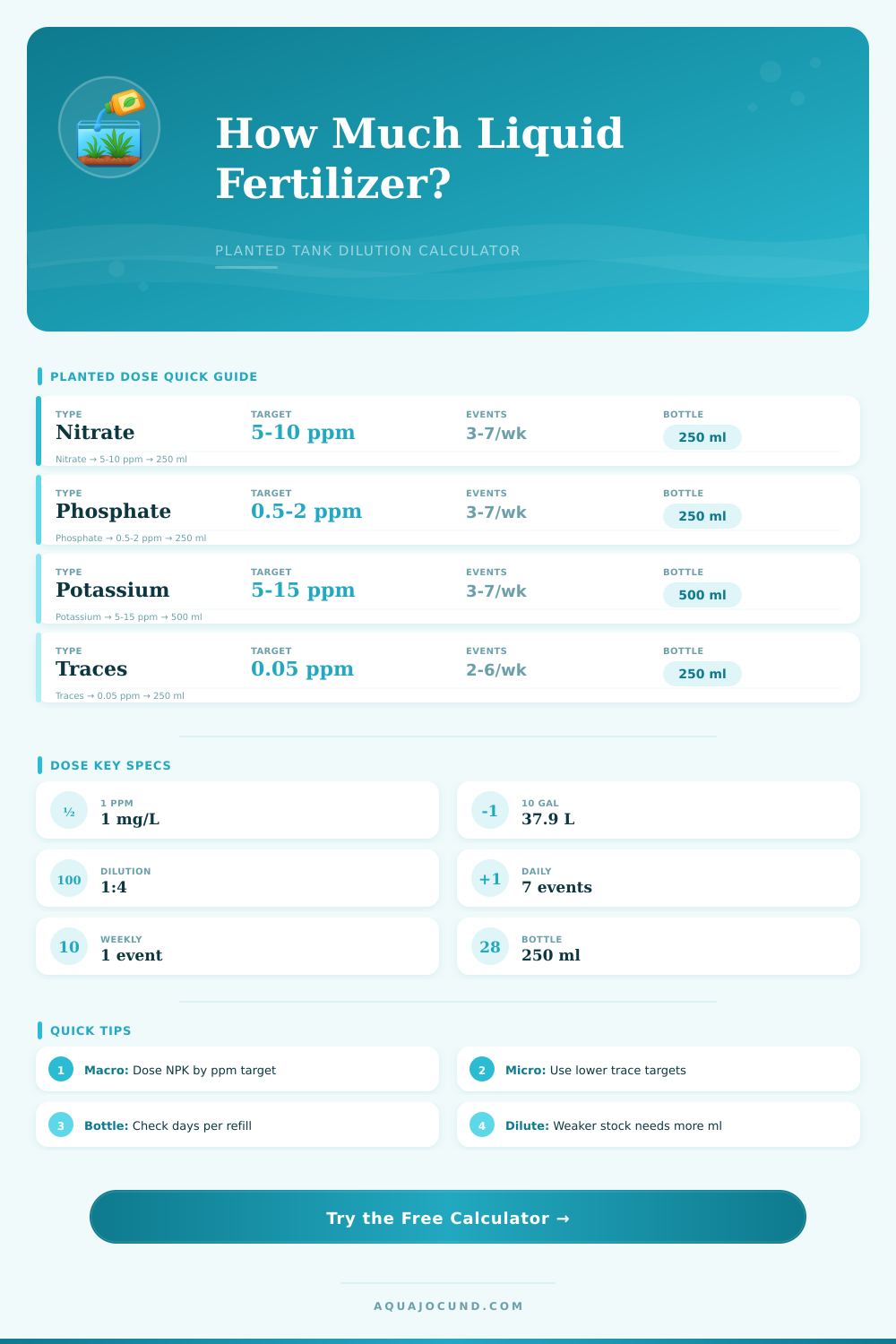
| Macro - nitrate as NO3 | 5 to 10 ppm | Daily or 3x weekly | Stem plants, bright tanks |
| Macro - phosphate as PO4 | 0.5 to 2 ppm | Daily or 3x weekly | CO2 tanks, fast growth |
| Macro - potassium as K | 5 to 15 ppm | Daily or weekly | General planted tanks |
| Micro - iron as Fe | 0.02 to 0.1 ppm | Daily or 2-3x weekly | Trace dosing reference |
| Micro - trace mix | Label based | 2-6x weekly | Sensitive shrimp tanks |
| All-in-one blend | Product based | Daily or weekly | Simple maintenance dosing |
| Tank | Water Volume | 5 ppm Nutrient | 10 mg/ml Dose |
|---|---|---|---|
| 5 gal nano | 18.9 L | 94.6 mg | 9.5 ml/week |
| 10 gal planted | 37.9 L | 189 mg | 18.9 ml/week |
| 20 gal long | 75.7 L | 379 mg | 37.9 ml/week |
| 40 breeder | 151 L | 757 mg | 75.7 ml/week |
| 55 gal display | 208 L | 1041 mg | 104 ml/week |
| 75 gal high tech | 284 L | 1420 mg | 142 ml/week |
| 125 gal planted | 473 L | 2366 mg | 237 ml/week |
| Ratio Entered | Stock Share | Final Strength | What Changes |
|---|---|---|---|
| 1:0 | 100% | Same as stock | Smallest ml dose |
| 1:1 | 50% | Half strength | Double ml dose |
| 1:4 | 20% | One fifth strength | Easy nano dosing |
| 1:9 | 10% | One tenth strength | Fine micro dosing |
A dilution calculator allow a person to determine the amount of liquid fertilizer to add to the planted tank. A person must consider several pieces of information before dosing the planted tank with liquid fertilizer. Such information includes the strength of the liquid fertilizer that is being used, the desired concentration of nutrients in the planted tank, the volume in liters of the planted tank, the dilution ratio of the fertilizer to water, and the dosing schedule.
Without using a dilution calculator, a person may either add too much liquid fertilizer to the planted tank, or too little to effective supply the nutrients to the planted tanks inhabitants. A dilution calculator takes all of the various measurements and provides for a person a single measurement of the amount of fertilizer to be added to the planted tank using a syringe or pipette. Liquid fertilizers are often sold in concentrated stocks.
How to Use a Dilution Calculator for Planted Tank Fertilizer
These stocks are too strong to be directly added to the planted tank. To dose the planted tank with the fertilizer, a person must mix the concentrated fertilizer with water to create a diluted fertilizer solution. The dilution ratio determine how much water is mixed with the fertilizer to create the diluted fertilizer solution.
Using these ratios makes it more easier to measure the amount of fertilizer that is prepared for the planted tank. For instance, using a 1:4 dilution ratio indicates that 1 part of the fertilizer will be mixed with 3 parts of water to create a diluted solution that is 1/5 as strong as the original fertilizer solution. Using these ratios reduces the chance that too many nutrient will be added to the planted tank at once.
The volume of the planted tank is one of the pieces of information that the dilution calculator requires. The volume of the planted tank determine the total milligrams of fertilizer that will be required to reach the target parts-per-million (PPM) concentration for the planted tank. The dilution calculator will convert the volume of the planted tank from gallons to liters.
The dilution calculator will then multiply the number of liters in the planted tank by the target PPM concentration to determine how many milligram of fertilizer will be required for that planted tank. For instance, a 40 gallon planted tank contains approximately 150 liters of water. If the target concentration for that planted tank is 5 parts-per-million of nitrate, then 750 milligrams of nitrate will be required.
The dilution calculator will divide the total milligrams required of the fertilizer by the strength of the diluted fertilizer solution to determine the total number of milliliters of the prepared fertilizer that will be required for the planted tank. Finally, the dilution calculator will divide this total number of milliliters by the number of times that the fertilizer will be dosed to determine how many milliliter of the prepared fertilizer should be dosed into the planted tank each time. A safety adjustment can be set on a dilution calculator.
A person uses a safety adjustment to dose the planted tank at a percentage that is lower than the target percentage. A person may use a safety adjustment if they are changing the fertilizer brand or if the light intensity being provided to the planted tank is being increased. Using a safety adjustment provides the possibility of introducing the fertilizer into the planted tank and observing the reaction of both the plants and the livestock before increasing the fertilizer concentration to the target concentration.
For instance, increasing the safety percentage allows a person to slowly add the fertilizer to the planted tank. Furthermore, a person can always increase the fertilizer concentration later, but decreasing the safety percentage allow a person to take small steps and to observe the reaction of the planted tank to the added fertilizer. Depending upon the nutrient that is to be dosed to the planted tank, there may be different target concentrations for those nutrients.
For instance, nutrients like nitrate and potassium have a range of concentrations, but nutrients like phosphate and iron contain smaller target concentrations. The reason for these range targets is because the demand for nutrients will change depending upon the plants that are growing in the planted tank. For instance, planted tanks with many fast growing plants that are exposed to high levels of light will contain higher levels of nitrate than planted tanks with few fast growing plants.
Therefore, different types of planted tanks will have different demands for nutrients, though they may all fall within the same general target range. Though a dilution calculator can prepare a person with a mathematical understanding of the fertilizer that should be added to the planted tank, the dilution calculator cannot take into consideration the specific way in which the plants will respond to the fertilizer. For instance, adding too much fertilizer or too little may be required at certain times of the year if the planted tank experiences a change in the amount of light that it is exposed to.
If the plants are not growing at the desired rates, the target concentration of fertilizer may be increased. If too many algae is being produced in the planted tank, the concentration of fertilizer may be decreased or the time between dosing events may be increased. Beyond calculating the amount of fertilizer that will be required for the planted tank, the dilution calculator can also provide information regarding the life of the fertilizer bottle.
The dilution calculator allows for a person to select their dosing schedule and the system will calculate how many weeks the bottle of fertilizer will last. Furthermore, the system will also provide information as to how many milliliters of concentrated fertilizer and how many milliliters of water will be required to mix the next batch of fertilizer. By providing this information, a person will always know how to prepare the fertilizer without guessing at how many milliliter of each component should be used to prepare the next batch of the fertilizer.
The main advantage to using a dilution calculator is that it allows for the dosing of the fertilizer to become repeatable. Regardless of how often that a person dosing the planted tank with fertilizer, if a person selects the correct dilution ratio and selects the appropriate bottle size, those same measurement can be used each time that the fertilizer is dosed into the planted tank. Should a change in volume or target be required, the dilution calculator can be easily modified to provide the measurements necessary to make such adjustments.
Furthermore, using a dilution calculator helps to a person to spend less time thinking about the amount of fertilizer that should be added to the planted tank. A person can spend more time observing the way in which the plants are growing under the determined light and CO2 settings of the planted tank. Consistency is another advantage of using the dilution calculator to determine the amount of fertilizer to add to a planted tank.
Consistency in adding fertilizer to a large planted tank allows for the same mathematical process to be used to dose the large tank as was used to dose the small planted tank.