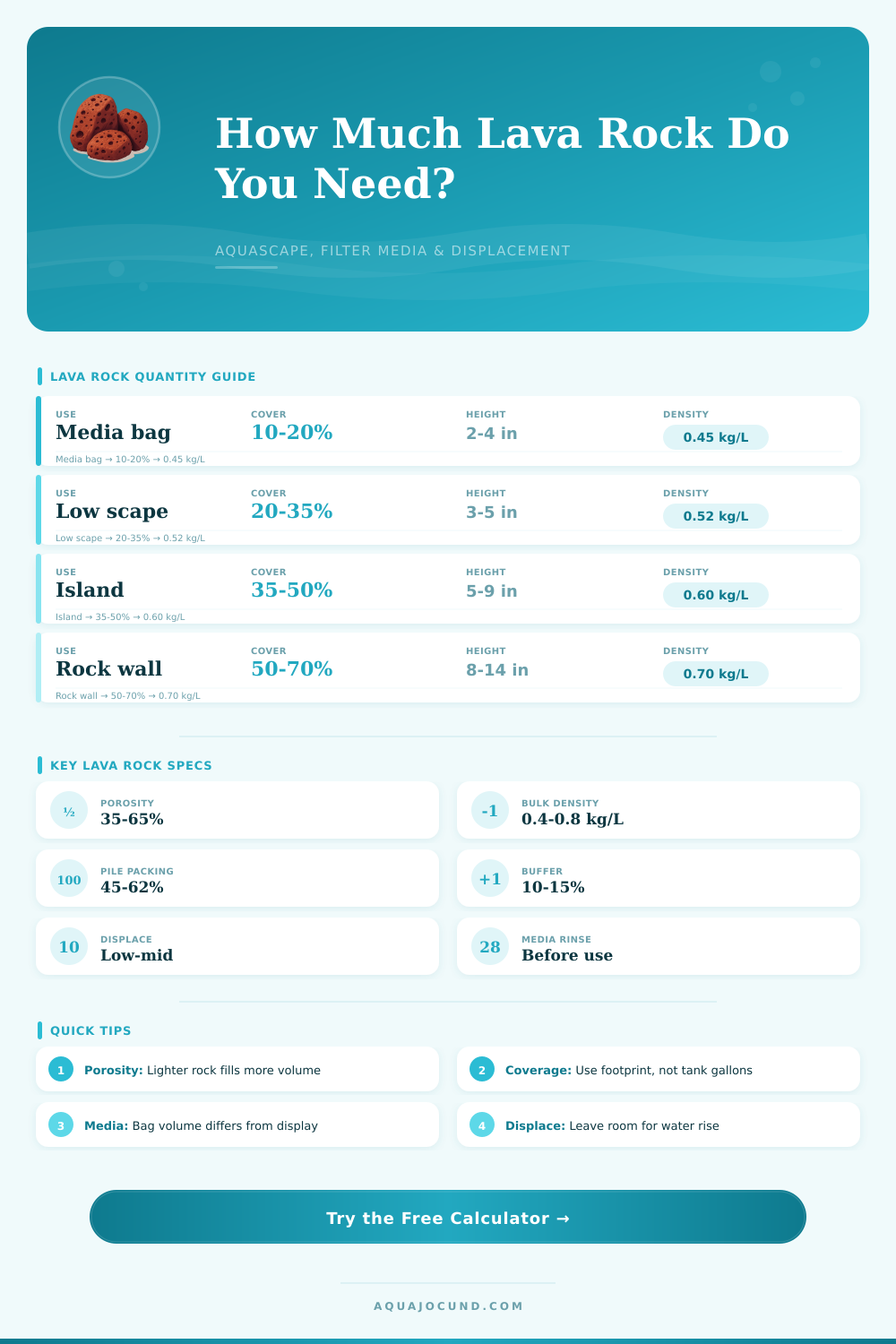
Lava Rock Quantity Calculator
Estimate lava rock weight, pile volume, filter-media volume, and water displacement from your tank footprint and rock porosity.
| Rock type | Loose density | Porosity | Packing | Best use |
|---|---|---|---|---|
| Red porous lava rock | 0.52 kg/L / 32 lb/ft3 | 55% | 50% | Light aquascapes, caves, shrimp tanks |
| Black coarse lava rock | 0.72 kg/L / 45 lb/ft3 | 42% | 56% | Display piles and cichlid structures |
| Light pumice-lava blend | 0.40 kg/L / 25 lb/ft3 | 64% | 47% | Low-load layouts and media bags |
| Mixed aquascape chunks | 0.60 kg/L / 37 lb/ft3 | 48% | 52% | General scapes with mixed sizes |
| Coarse filter media lava | 0.48 kg/L / 30 lb/ft3 | 58% | 54% | High-flow biological media |
| Crushed lava filter media | 0.66 kg/L / 41 lb/ft3 | 45% | 62% | Media baskets with tighter fill |
| Dense display boulders | 0.82 kg/L / 51 lb/ft3 | 35% | 58% | Tall focal piles and rock walls |
| Tank | Dimensions | Volume | Typical lava rock amount |
|---|---|---|---|
| 10 gallon | 20 x 10 x 12 in / 51 x 25 x 30 cm | 38 L | 5-9 lb / 2-4 kg for media or low decor |
| 20 long | 30 x 12 x 12 in / 76 x 30 x 30 cm | 76 L | 12-22 lb / 5-10 kg for a low island |
| 40 breeder | 36 x 18 x 16 in / 91 x 46 x 41 cm | 151 L | 24-45 lb / 11-20 kg for mixed cavework |
| 55 gallon | 48 x 13 x 21 in / 122 x 33 x 53 cm | 208 L | 32-58 lb / 15-26 kg for cichlid caves |
| 75 gallon | 48 x 18 x 21 in / 122 x 46 x 53 cm | 284 L | 55-95 lb / 25-43 kg for a rock wall |
| 125 gallon | 72 x 18 x 21 in / 183 x 46 x 53 cm | 473 L | 80-140 lb / 36-64 kg for large display piles |
| Layout target | Coverage | Pile height | Displacement planning note |
|---|---|---|---|
| Filter media only | 10-20% equivalent footprint | 2-4 in / 5-10 cm | Displacement is usually small, but media baskets reduce sump freeboard. |
| Low scattered scape | 20-35% | 3-5 in / 8-13 cm | Expect modest water rise from solid rock and partly sealed pores. |
| Island or cave mound | 35-50% | 5-9 in / 13-23 cm | Fill the tank slightly low before final hardscape placement. |
| Back wall or tall ridge | 50-70% | 8-14 in / 20-36 cm | Check glass load points and waterline before livestock or equipment. |
Lava rock can be used in aquariums for two different purpose; either as visible hardscape for the fish and shrimp to claim or graze upon, or it can be used as biological filtration media for the beneficial bacteria to live upon. The amount of lava rock that you need to purchase for your aquarium will depend upon the volume of space that the lava rock will occupy within your tank. Thus, the amount of lava rock that you need will not be solely based off the number of gallon that your aquarium will hold; two aquariums of the same size may require different amounts of lava rock based upon the shape of the tanks footprint, or the height of the lava rock piles within each tank.
To calculate the amount of lava rock that is required for your aquarium, you first must determine the area upon which the lava rock will be placed. Additionally, you will have to calculate the percentage of the area that will be covered by lava rock… A scattered lava rock layout can only cover a portion of the footprint of the aquarium, but a mound or back wall of lava rock may cover a much larger portion of the area of the tank footprint.
How Much Lava Rock Do I Need for My Aquarium?
Finally, once you have determined the area that will be covered by lava rock, you can determine the height to which the lava rock piles should rise; lava rock is a porous material, and the different types of lava rock have different weight and water displacements. Some lava rock products are comprised of lighter rocks that contain many hole throughout the rocks, while other brands of lava rock are comprised of more dense rocks that contain fewer holes in the rocks. Additionally, when you place lava rock into aquarium water, the water will fill the pores within the lava rock; however, the water will not completely fill each of the pores within each of the lava rock pieces, which is why an estimation of the rise of the water level need to be made in advance of placing lava rock into the aquarium.
Furthermore, an estimation of the amount of space that the lava rock will occupy within the aquarium will take into consideration the packing factor of the lava rock; the smaller the pieces of lava rock, the more tight that the pieces will “nest” with one another, and the less amount of lava rock that will be required to reach the desired height of the lava rock piles within the aquarium. An additional factor that will be considered is the buffer percentage; because some of the lava rock may need to be rinsed or discard when placing lava rock into the aquarium, it is important to purchase some extra lava rock to account for this process by many aquarium keepers. The calculator will provide several different outputs that may assist you in your decision about the purchase and placement of lava rock within your aquarium.
For instance, the calculator can determine the weight of the lava rock that is required for your aquarium; it can determine the volume of lava rock that will fit within a specific filter. Additionally, the calculator will also show the amount of freeboard that is required for the lava rock within the aquarium to prevent the aquarium’s water from overflowing over the designated parameter of the tank; the calculator also provides the wet weight of the lava rock, which is important if you need to move the lava rock or understand the load limit of the stand upon which the aquarium is placed. Aquariums are not always of the size of perfect rectangles.
For instance, bow front aquariums will have more area upon which the lava rock can be placed at the bow of the aquarium than those shaped like tall cubes. Additionally, cylindrical aquariums will have the bulk of their lava rock placed towards the center of the aquarium. Finally, custom aquarium designs may contain feature like tunnels or overhangs.
Thus, the footprint of each aquarium is different than the others. However, it is important to enter the direct footprint of each aquarium into the calculator to ensure that the estimation of the amount of lava rock that is required is accurate. Many aquarium keepers make a few mistake when calculating the amount of lava rock to purchase for their aquariums.
For instance, many incorrectly calculate how much lava rock is necessary when purchasing lava rock by the pound; they do not consider how much area the lava rock will cover within the aquarium. Furthermore, people may not consider the difference between the bulk density of the lava rock when it is in its loose state as opposed to when it has been packed into the aquarium; thus, they purchase less lava rock than that which is actualy required. Finally, many people do not consider that the saturation of the lava rock will increase its weight; when placed into the aquarium, the water will fill the pores within the lava rock, increasing its weight.
The tables included at the bottom of the calculator are used to compare the amount of lava rock that may be required for tanks of different sizes. For instance, a 20-gallon long and shallow tank may only require a small island of lava rock within the tank, while a 75-gallon tank may require a large wall of lava rock to cover the area of the tank footprint. Additionally, the tables also include the coverage area for lava rock bags, and those for the various display structure within the aquarium.
These tables can help to indicate in what way you may wish to use your lava rock. The placement of lava rock within the aquarium will change the aquarium in a variety of ways. For instance, lava rock will create a sense of visual weight to the aquarium; it will change the way that the water move within the aquarium, and it will create areas within the aquarium for the inhabitants of the aquarium to live within.
Each of these changes may impact the behavior of the fish within the aquarium, which is, therefore, one of the reasons that many aquarium owners decide to utilize lava rock within their aquariums. Additionally, while the lava rock calculator provides recommendations to the aquarium owner regarding the amount of lava rock that is required for their aquarium, the final decision about the placement of the lava rock within the aquarium is up to the aquarium owner. You should of checked the weight first.
It is a moddern way to do it. The rocks is heavy.