Dirted Tank Soil Calculator
Estimate mineralized soil, cap material, slope volume, compaction, bags, quarts, and gas-pocket risk from your tank footprint.
| Material | Typical density | Best input use | Calculator note |
|---|---|---|---|
| Mineralized topsoil | 0.95-1.25 lb/qt | Main dirt layer | Use lower density when very dry |
| Sifted organic topsoil | 0.75-1.05 lb/qt | Light soil beds | Higher moisture raises carried weight |
| Clay-heavy soil blend | 1.20-1.55 lb/qt | Rooted heavy feeders | Compacts more than sandy soil |
| Pool filter sand | 2.75-3.05 lb/qt | Clean inert cap | Fine enough to hold soil down |
| Fine gravel | 2.55-2.95 lb/qt | Easy planting cap | Needs enough depth to block soil |
| Aquarium soil cap | 1.35-1.80 lb/qt | Lightweight capped blend | May soften total slope height |
| Tank | Inside footprint | Approx area | Typical dirted amount |
|---|---|---|---|
| 10 gallon | 20 x 10 in / 51 x 25 cm | 200 sq in | 3-5 qt soil, 12-18 lb cap |
| 20 long | 30 x 12 in / 76 x 30 cm | 360 sq in | 6-9 qt soil, 22-34 lb cap |
| 29 gallon | 30 x 12 in / 76 x 30 cm | 360 sq in | 6-10 qt soil, 25-38 lb cap |
| 40 breeder | 36 x 18 in / 91 x 46 cm | 648 sq in | 11-17 qt soil, 40-65 lb cap |
| 55 gallon | 48 x 13 in / 122 x 33 cm | 624 sq in | 11-16 qt soil, 40-62 lb cap |
| 75 gallon | 48 x 18 in / 122 x 46 cm | 864 sq in | 15-23 qt soil, 55-85 lb cap |
| Risk level | Typical trigger | Layer signal | Planning response |
|---|---|---|---|
| Low | Thin mineralized soil | Average soil under 1.25 in | Normal cap depth and gentle slope |
| Moderate | Deep back slope or wet soil | Average soil 1.25-1.75 in | Reduce soil or increase cap coverage |
| High | Deep compacted pockets | Soil over 1.75 in or total bed over 4 in | Use terraces, inert filler, or thinner soil |
The dirted tank method are a means of turning a layer of mineralized soil into a source of nutrients for live plants in the planted tank. Furthermore, the dirted tank method is a process that many aquarists use once they have moved past basic gravel setups for there tank. To utilize the dirted tank method, the aquarist adds a thin bed of enriched soil to the tank, and on top of that soil is added a cap of sand or gravel.
The sand and gravel will help to keep the soil layer in place such that the plants can draw nutrients from the soil instead of requiring weekly dose of liquid nutrients to those plants. Before adding the soil and cap to the tank, however, the aquarist must decide several variable regarding the dirted tank method. First, the thickness of the soil layer must be determined.
How to Use the Dirted Tank Calculator
Second, the depth of the sand or gravel cap must be determined. Third, the aquarist must determine the slope of the soil layer in relation to whether the soil will create pocket that become anaerobic. Pockets within the soil that do not receive any oxygen to those pocket can lead to the release of gas bubbles from the soil.
These gas bubbles can either push upward through the cap of sand or gravel, or the gas bubbles can lift the plants out of place. The stability of the dirted tank is established based off the amount of soil located at the back wall of the tank, the amount of soil located at the front of the tank, and the amount of moisture that exist within the soil. The calculator that is provided take into account each of these variables; it calculates the volume of the dirted tank by converting the footprint of the tank into volume, and it also add the volume of the soil compaction and overage of that soil.
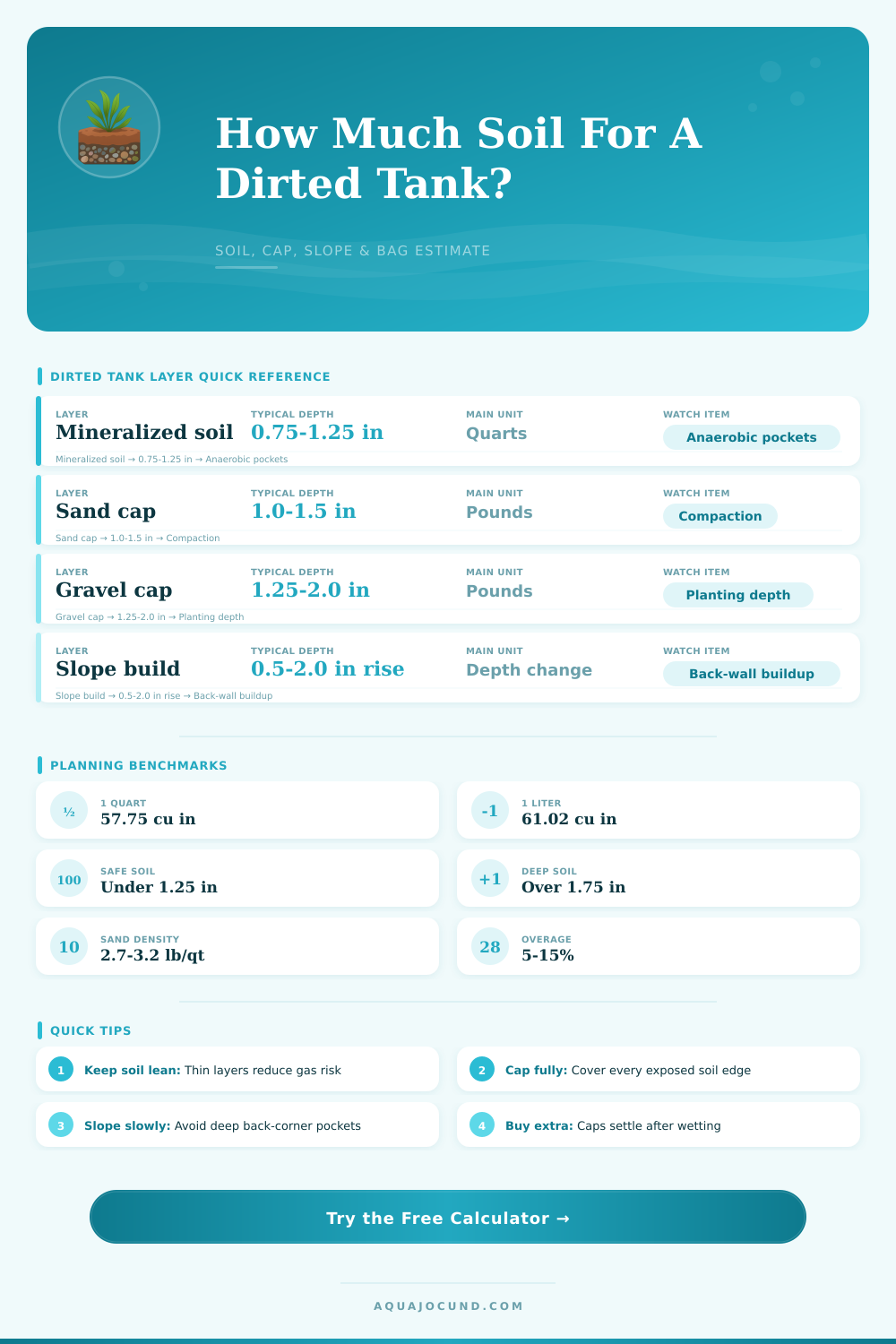
As a result, the calculator can provide the aquarist with an estimate of the amount of dirted soil that should be purchased (the loose purchase amount), as well as a risk rating for the dirted tank. Most dirted tanks utilizes between three-quarters of an inch and one and a quarter inches of soil that is placed at the front of the tank. The soil naturaly slope towards the back of the tank, and the calculator factors the rise of that slope into the calculations that occur within the tool.
For instance, if the aquarist desires for the back of the tank to include more soil than the front of the tank, the calculator can make mathematical adjustment for that determination. The depth of both the front and back caps of sand and gravel should also be entered into the calculator; if only the front of the tank is covered by sand and gravel, the soil may emerge through the sand and gravel once it settles. The density of the soil and the moisture content of that soil will change based upon whether it is dry soil or wet soil.
Dry mineralized soil will weigh less than wet mineralized soil, which can affect how much of the soil will compact upon placement within the planted tank. Therefore, the calculator allow for adjustments to the soil density and soil moisture content, which will determine the number of bag of soil that are required to be purchased. Additionally, the calculator can take into account the sizes of the bag of soil that the aquarist owns, to ensure that they dont buy one large bag of soil when two smaller bag would be more convenient for moving and rinsing the soil.
The risk rating for the dirted tank is another feature that the calculator provide to the aquarist. A high risk rating indicate that the depth of the soil and sand/gravel cap is too deep for the planted tank (exceeding four inches in one spot), or that the moisture content of the soil is too high that bacterial growth within the soil is likely. To fix these problems, the aquarist can reduce the depth of the soil, an inert filler layer can be added to the tank under the slope of the soil, or the aquarist can accept the risk that the first water change will be much larger than the standard water change to allow for settling of the soil within the planted tank.
This calculator also accounts for planted tanks that are not in the shape of rectangle. For instance, many planted tanks have bow fronts and built-in overflow boxes. The calculator allows for the custom area of the planted tank to be entered, which allows for the mathematics within the calculator to remain accurate even for nonrectangular tanks that may include a false bottom or a filter chamber for the planted tank.
Furthermore, the type of sand and gravel that the aquarist is to utilize for covering the dirted tank can also have an impact upon the planted tank. For instance, pool filter sand is one of the most dense material that may be used to cover the dirted soil in a planted tank. However, if the sand is too dense, it may lead to the growth of roots of the plants being unable to penetrate through the sand if the cap of sand is deeper than two inches in the planted tank.
Alternative materials to pool filter sand include fine gravel, which will drain more more easily of standing water than sand, but which may shift within the planted tank if it is vacuumed. Such differences in materials are accounted for within the calculator in that the calculator provides the weight of each type of sand and gravel such that the aquarist can determine how many bag of sand and gravel will be required to cover the slope of the dirted soil within the planted tank. Calculating the dirted tank method in advance allow for the aquarist to see the trade-off between the depth of the dirted soil layer and the amount of maintenance that may be required for the planted tank.
If the dirted soil layer is thin at the front of the planted tank, there will be less risk of gas buildup from the soil layer, since most of the root activity of the live plants occur within the first inch of soil within the dirted soil layer. However, the back of the tank can contain a deeper layer of dirted soil for those plants whose roots grow to greater length. Therefore, calculating the dirted tank method before purchasing the soil allows for the aquarist to have a better understanding of which variable to consider and adjust.
The dirted tank calculator can be used to calculate the amount of soil that will be needed for the planted tank. However, the measurements for the footprint of the planted tank must first be obtained after placing the rocks and hardscape into the planted tank. Furthermore, another determination to be made is whether the dirted soil layer will be dry soil or damp soil.
Once these measurements are entered into the dirted tank calculator, the aquarist can use the calculated amount of dirted soil and cap material to purchase the necessary materials for their planted tank.