🌱 Aquasoil Quantity Calculator
Estimate aquasoil liters, bags, and weight from footprint, slope, density class, cap layer, settling, and layout style.
✅ Aquasoil Estimate
| Density class | Bulk density | Granule style | Best calculation use |
|---|---|---|---|
| Light porous | 0.72 kg/L | Soft normal granule | Nano tanks and gentle slopes |
| Standard aquasoil | 0.85 kg/L | Normal planted substrate | General planted layouts |
| Dense baked | 0.98 kg/L | Firm granule, less crush | Deep slopes and hardscape |
| Fine powder | 1.05 kg/L | Small cap particles | Top layer for carpets |
| Mixed normal and powder | 0.90 kg/L | Blended bag plan | Normal base with powder front |
| Tank | Footprint | Typical slope | Approx aquasoil |
|---|---|---|---|
| 5 gal | 16 x 8 in / 41 x 20 cm | 1 to 2 in | 3 to 5 L |
| 10 gal | 20 x 10 in / 51 x 25 cm | 1.5 to 3 in | 8 to 12 L |
| 20 long | 30 x 12 in / 76 x 30 cm | 1.5 to 4 in | 18 to 28 L |
| 29 gal | 30 x 12 in / 76 x 30 cm | 2 to 4 in | 22 to 32 L |
| 40 breeder | 36 x 18 in / 91 x 46 cm | 2 to 4 in | 38 to 55 L |
| 55 gal | 48 x 13 in / 122 x 33 cm | 1.5 to 4 in | 35 to 55 L |
| 75 gal | 48 x 18 in / 122 x 46 cm | 2 to 5 in | 60 to 90 L |
| 125 gal | 72 x 18 in / 183 x 46 cm | 2 to 5 in | 90 to 130 L |
| Layout style | Soil factor | Typical front/back | Why it changes volume |
|---|---|---|---|
| Low carpet slope | x 1.02 | 1.5 / 3 in | Thin front with modest back rise |
| Iwagumi stone slope | x 1.08 | 2 / 4 in | Extra soil packed around stones |
| Dutch planted rows | x 1.04 | 2 / 3 in | Stem beds need even depth |
| Nature aquarium | x 1.10 | 1.5 / 5 in | Deep back corners and mounds |
| Island mound | x 1.14 | 1 / 5 in | High central mound volume |
| Valley path | x 0.88 | 1 / 4 in | Open sand path removes aquasoil |
| Terraced hardscape | x 1.12 | 2 / 6 in | Retaining walls hold deep pockets |
To ensure that the planted tank has the proper amount of aquasoil, it is necessary to first determine how much aquasoil is necessary to provide a stable base for the plant to grow into. If there isnt enough aquasoil, the slope of the aquasoil may collapse, which will prevent the plants from being able to properly root into the substrate. However, if there is too much aquasoil, then the aquasoil will cost more money than necessary to the aquasoil farmer, and there will be bag of aquasoil left over in the storage area of the farmer.
In calculating the amount of aquasoil necessary for the planted tank, it is important to take into account the density of the different brands of aquasoil. Aquasoil can be light and porous to other brand that hold their shape with the addition of hardscape into the planted tank. Thus, it is essential to select the correct density class of aquasoil within the online calculator to ensure that the weight of the aquasoil is correct for the brand of aquasoil that are to be purchase.
How Much Aquasoil Do You Need for a Planted Tank
Another factor to take into account is the slope of the substrate that the user will create with the aquasoil within the planted tank. Because the substrate will have a slope to it, the volume of aquasoil will be increased in comparison than a flat planted tank substrate. Most individual will desire for the planted tank to have a rise from the front of the tank to the back of the tank.
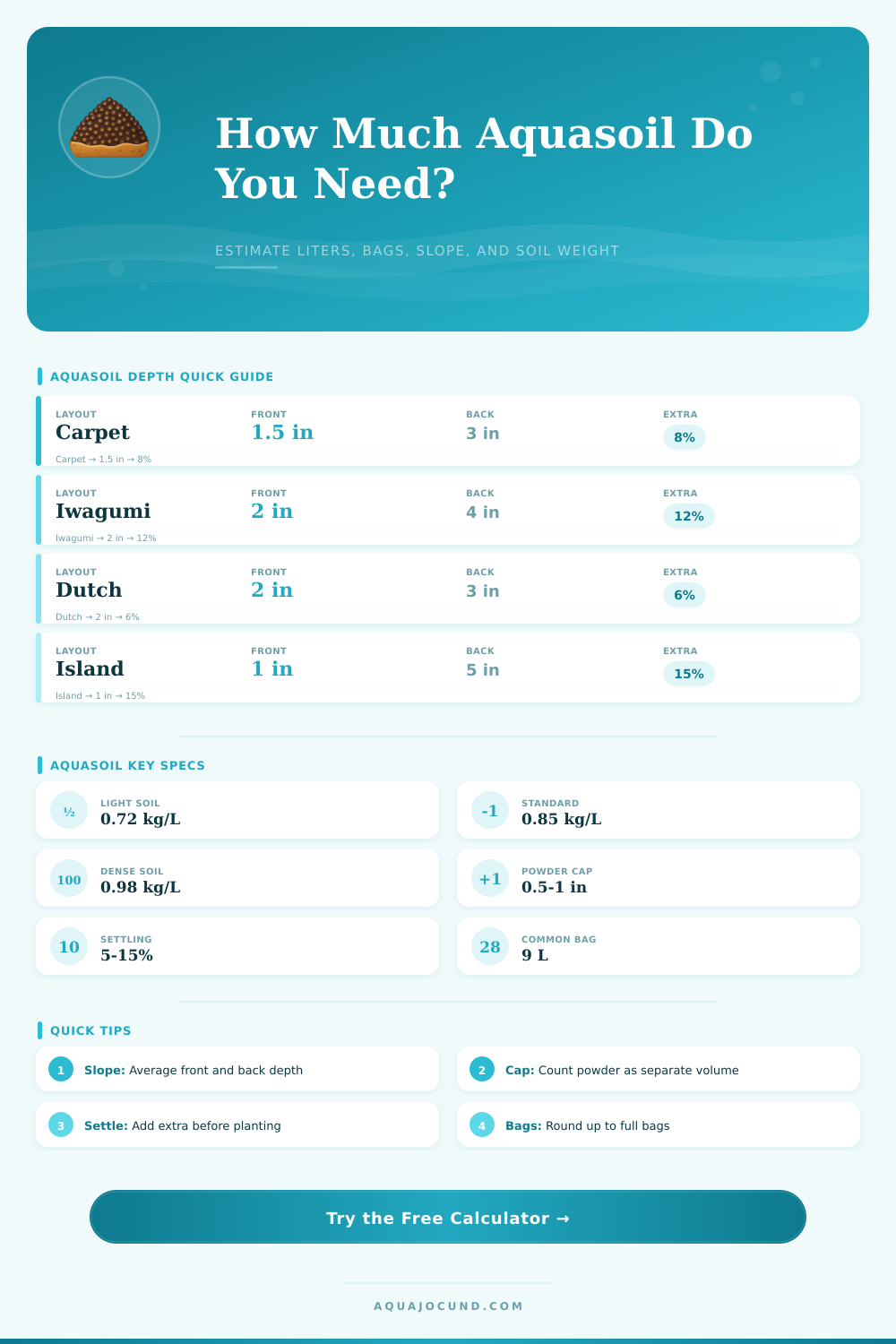
The type of planted tank layout that is selected will impact the amount of aquasoil that is necessary. For instance, an Iwagumi planting layout will require more aquasoil than a valley planting layout due to the removal of aquasoil from certain area of the planted tank to provide sand for the substrate to adhere to. Thus, the layout of the planted tank will impact the volume of aquasoil that is necessary, and this factor must be accounted for in the online aquasoil calculator.
The third factor to take into account is the use of a cap layer for the aquasoil, and in what way the aquasoil will settle within the planted tank. A cap layer will cover the aquasoil with a thin layer of material to allow the small plants to become rooted to the substrate. Thus, it is necessary to determine whether or not the cap layer is to be include in the budget for the aquasoil, or whether that separate material will be purchased.
Furthermore, it is necessary to account for the settling of the aquasoil. Freshly add aquasoil will compact over the first few weeks after adding the water to the planted tank. Thus, it is recommended that a small percentage of extra aquasoil is added to the planted tank at the beginning to allow for the substrate to settle without dropping below the desired depth of the aquasoil after it has settled.
The fourth factor to take into account is the footprint of the planted tank. The footprint of the planted tank will change based off the placement of internal filter, rim lips, and rocks. Thus, the custom area box in the online aquasoil calculator will allow for the planned obstacles within the planted tank to be accounted for.
Any large hardscape item within the planted tank will displace some of the volume of aquasoil that is to be use in that planted tank. Thus, it is essential to account for this in the aquasoil calculator. Furthermore, an overage of aquasoil will be necessary to account for the amount of aquasoil that may fall onto the floor of the planted tank during the planting process.
Because of the different size and types of planted tanks, there will be different amounts of aquasoil that is used within each tank. For example, a 20” long planted tank with an Iwagumi layout will contain more aquasoil than a 20” long planted tank with a flat carpet planted tank layout. Thus, the reference table will provide example amount of aquasoil that can be used within different sized planted tanks and with different types of planted layouts.
However, these amount are not rules that must be followed, but only provide an example of the amount of aquasoil that can be use within each type of planted tank. In addition to the factors mentioned above, there are some additional factor that will impact the amount of aquasoil to be use within the planted tank. For instance, the level of humidity within the planted tank during the planting process will impact the amount of settling that the aquasoil will experience before the water is added to the planted tank.
Similarly, the method in which the aquasoil is rinse will impact how much the aquasoil will compact within the planted tank. Additionally, some brands of aquasoil will contain more particulate than other brands, which may cloud the water within the planted tank. However, these factors are less important than getting the measurement of the volume of the aquasoil to be correct.
Thus, the goal is to arrive at a number for the amount of aquasoil that is necessary to be purchase for the planted tank to both reach the order for that aquasoil, as well as to ensure that there is enough aquasoil to fill the planted tank in its entirety.