🦐 Brine Shrimp Hatching Calculator
Estimate cyst grams, salt, temperature, aeration and harvest timing for live fry feed batches.
✅ Hatch Batch Estimate
| Cyst Type | Typical Eggs/g | Base Hatch | Best Use |
|---|---|---|---|
| Premium Great Salt Lake | 280,000 | 85-90% | Dense fry batches |
| Standard Aquarium Cysts | 240,000 | 75-85% | Daily hobby hatches |
| Decapsulated Hydrated | 260,000 | 80-88% | Cleaner shells |
| Small Strain High Count | 300,000 | 78-86% | Tiny fry |
| Economy Mixed Batch | 200,000 | 55-70% | Backup hatches |
| Older Opened Tin | 180,000 | 45-65% | Test batches |
| Outdoor Pond Hatch | 220,000 | 60-75% | Large noncritical feed |
| Temperature | Typical Hatch | Yield Effect | Harvest Note |
|---|---|---|---|
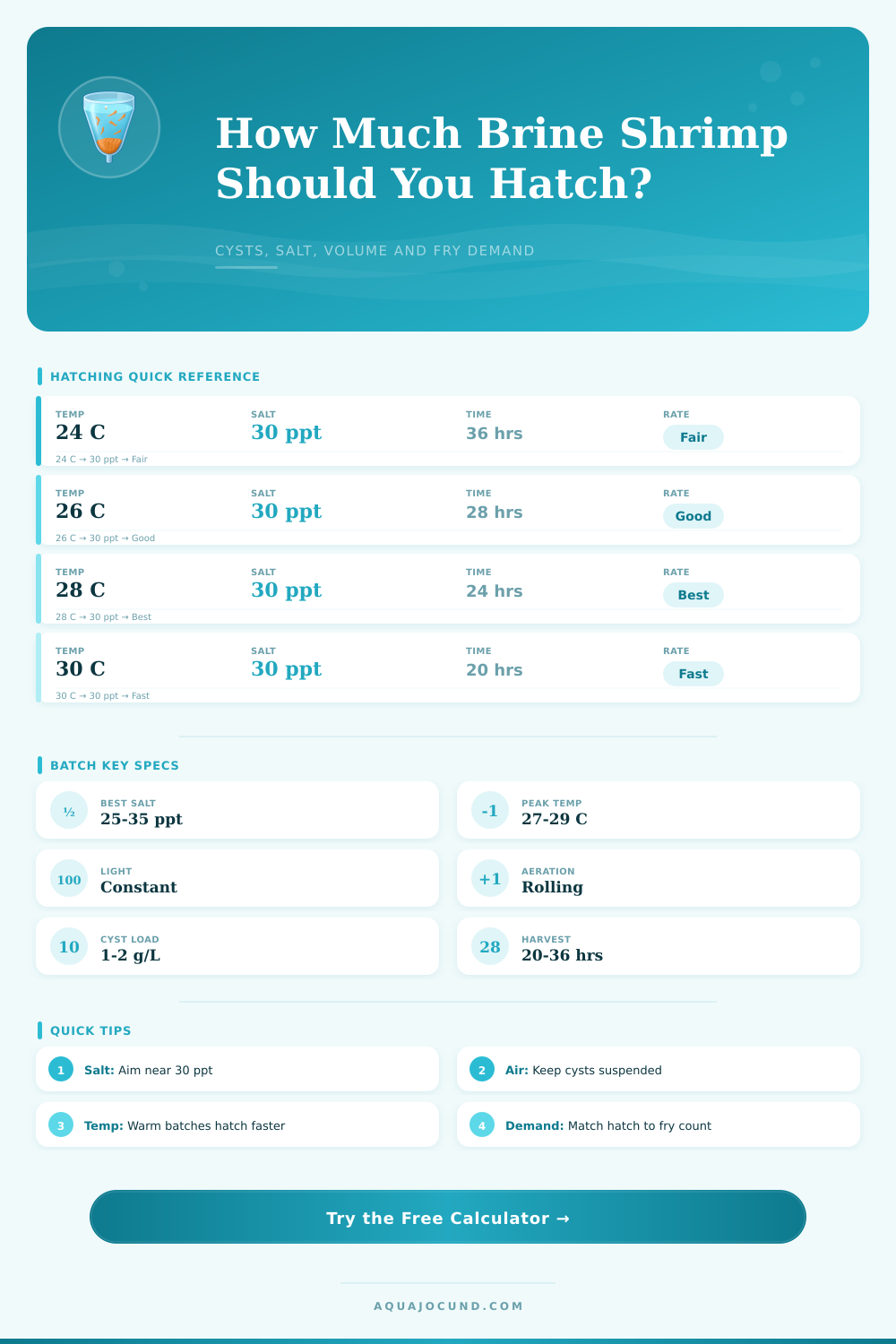
| 72°F / 22°C | 38-44 hours | Reduced | Slow but workable |
| 77°F / 25°C | 30-34 hours | Good | Plan next-day harvest |
| 82°F / 28°C | 22-26 hours | Best | Peak fresh nauplii |
| 86°F / 30°C | 18-22 hours | Fast | Harvest promptly |
| 90°F / 32°C | Under 20 hours | Risky | Lower survival risk |
| Vessel | Volume | Metric Volume | Typical Cysts |
|---|---|---|---|
| Small cone | 0.25 gal | 0.95 L | 0.5-1.0 g |
| 2 liter bottle | 0.53 gal | 2.0 L | 1.0-3.0 g |
| Half gallon jar | 0.50 gal | 1.9 L | 1.0-2.5 g |
| One gallon cone | 1.0 gal | 3.8 L | 3.0-6.0 g |
| Bucket hatch | 2.5 gal | 9.5 L | 8.0-15 g |
| Growout batch | 5.0 gal | 18.9 L | 15-30 g |
| Fry Type | Nauplii/Fry/Day | Feedings | Batch Strategy |
|---|---|---|---|
| Betta fry | 500-1,000 | 3-5 | Small daily hatches |
| Livebearer fry | 700-1,200 | 2-4 | Moderate daily hatch |
| Corydoras fry | 900-1,500 | 3-4 | Fresh small portions |
| Angelfish fry | 1,200-2,000 | 4-5 | Stagger two bottles |
| Clownfish larvae | 1,500-3,000 | 4-6 | Strict timing batches |
Brine shrimp hatching is a process that are necesary for the survival of many species of young fish. Brine shrimp nauplii are small organisms and the small size of these organisms provide the correct movement to trigger feeding responses in young fish. Dry feeds often fails to provide the correct movement to trigger feeding responses in fry, thus making brine shrimp nauplii a more effective food source.
The number of brine shrimp nauplii that are produced need to be matched to the number of mouths that need to be fed, and there are several different variable to consider in achieving this match. The quality of the cysts that is used to produce brine shrimp nauplii is one of the first variables that needs to be considered. Different grade of cysts contain different amounts of eggs per gram of cyst, and the potency of the cyst decrease with time if the cysts are of an older batch.
Hatching Brine Shrimp to Feed Baby Fish
A calculator can be used to select the type of cyst that will be used, and by selecting the type of cyst, the math adjust for the expected hatch percentage of that specific type. The salt concentration that is used both during the hatching of the cysts and after the emergence of the brine shrimp nauplii is another variable. Using a specific salt concentration prevent the embryos from swelling when the salt is added, yet the same salt concentration prevents the embryos from dehydrating.
Many people who use brine shrimp to feed their fry dont maintain the correct salt concentration, which can impact the health of the brine shrimp nauplii. Another variable to consider is the temperature of the water. Using warmer water will speed up the development of the brine shrimp nauplii, but warmer water will also cause the nauplii to exhaust their yolk reserves more quick.
After the brine shrimp nauplii exhaust their yolk reserves, their nutritional value diminishes. The calculator takes into consideration both the salt and temperature variables. Aeration is one of the requirement for the brine shrimp hatching process.
Aeration will suspend the cysts within the water, as well as supply oxygen to those cysts. The strength of the aeration for the brine shrimp hatching process is another variable. Using a rolling motion with the aeration will keep the cysts from settling on the bottom of the container, yet will also prevent the fragile shells of the embryos from being damaged.
Using violent circulation with the aeration will also damage the nauplii, as well as create foam that can trap the nauplii. The number of fry that the brine shrimp nauplii are to be fed determines the size of the hatch of brine shrimp that will need to take place. Some fry species will graze on food provided to them, while other fry species will require more frequent feedings of food to prevent them from starving.
Providing a safety margin for the number of fry that will be fed will prevent the outcome of providing insufficient food to meet the feeding demands of the fry. The calculator takes into consideration the demands of the fry, as well as the hatch rate of the brine shrimp nauplii batch to indicate how many days of feeding a batch of brine shrimp will provide to the fry. Timing for harvesting the brine shrimp nauplii is another critical part of the hatching process.
When batch after batch of fry is lost due to incorrect harvest timing, the process needs to be evaluated. Brine shrimp nauplii will weaken if they are allowed to remain in the hatching container after they have emerged, and the weakened fry will become less appealing as a food source to the young fry. Calculating the number of hours until the peak emergence of the brine shrimp nauplii allow for the fry to be harvested before there quality declines.
Furthermore, the calculator also factors in typical loss of brine shrimp nauplii during the harvest process, ensuring that the final count of nauplii that will be fed to the fry will not be too high. The size of the vessel in which the brine shrimp are to be hatched may vary from person to person. Regardless of the size or shape of the vessel in which the brine shrimp are hatched, the density of the cysts per liter is a variable that must be considered.
High densities of cysts may reduce the amount of oxygen that can be supplied to the cysts, as well as make it difficult to separate the shells of the newly hatched brine shrimp. The hatch batch calculator will alert the brine shrimp farmer if the load of cysts to be hatched will exceed the recommended range for the type of cysts that will be used. The feeding strategies for the fry may change with the species of fry that are being raised, as well as with the age of the fry.
Fry of certain species will do better with small portions of food being provided to them daily, while other fry may tolerate larger portions of food provided at longer periods. The value of the calculator is apparent with each adjustment of one of the variables within the calculation. For instance, adjusting the temperature will allow the calculator to provide an indication of how many hours it will take until the brine shrimp nauplii hatch.
However, increasing the temperature too high with the water in which the cysts are sitting will also lead to exhaustion of the brine shrimp nauplii. Furthermore, increasing the number of grams of cysts will lead to an increase in the number of brine shrimp nauplii that will hatch. However, increasing the number of grams of cysts will also increase the density within the batch of cysts.
High densities of cysts will require stronger circulation of the water to ensure adequate supply of oxygen to the cysts. Many people may use the same small setup to hatch their brine shrimp for many months. The salt concentrations may increase over time due to evaporation of water, the temperatures may change with the environment in which the aquarium is placed, and the age of the cysts may increase as time passes.
Thus, whenever a person begins a new batch of fry or increases the number of fry that will be fed by the brine shrimp nauplii, the numbers need to be calculated fresh. Calculating the numbers fresh will ensure that the batch of brine shrimp is provided according to the actual demand of the fry that will be fed with those nauplii. The goal for this entire process is not to make a batch of brine shrimp as large as possible.
The goal is to produce the correct number of brine shrimp nauplii at the correct time. This allows the fry to receive the nutrition that they require, without requiring the effort of the fry farmer to provide other food sources. Thus, this entire process from start to finish can become a repeatable process.