🐟 Fish Shipping Water Volume Calculator
Estimate bag water, oxygen space, ammonia risk, transit limits, and shipment weight.
| Bag size | Working volume | 1:2 water fill | Typical use |
|---|---|---|---|
| 4 × 14 in | 0.4 L / 0.11 gal | 0.13 L | Shrimp, fry, tiny fish |
| 6 × 18 in | 1.0 L / 0.26 gal | 0.33 L | Small livebearers |
| 8 × 20 in | 2.0 L / 0.53 gal | 0.67 L | Most small fish |
| 10 × 20 in | 3.2 L / 0.85 gal | 1.07 L | Medium fish |
| 12 × 24 in | 5.5 L / 1.45 gal | 1.83 L | Large tropical fish |
| 16 × 30 in | 10.0 L / 2.64 gal | 3.33 L | Large cichlids |
| 20 × 36 in | 18.0 L / 4.76 gal | 6.00 L | Koi and very large fish |
| Profile | Oxygen rate | Ammonia rate | Use case |
|---|---|---|---|
| Low demand | 200 mg/kg/hr | 18 mg/kg/hr | Betta, shrimp, quiet fish |
| Moderate | 320 mg/kg/hr | 25 mg/kg/hr | Tetra, guppy, rasbora |
| Active | 450 mg/kg/hr | 32 mg/kg/hr | Danio, barb, cory |
| Cichlid | 520 mg/kg/hr | 38 mg/kg/hr | Juvenile cichlids |
| Goldfish | 650 mg/kg/hr | 55 mg/kg/hr | Goldfish and heavy waste fish |
| Discus | 560 mg/kg/hr | 35 mg/kg/hr | Warm water softwater fish |
| Koi | 760 mg/kg/hr | 60 mg/kg/hr | Koi, pond fish, very active fish |
| Sensitive wild fish | 620 mg/kg/hr | 42 mg/kg/hr | Stress-sensitive shipments |
| Condition | Effect on model | Why it matters | Calculator response |
|---|---|---|---|
| Cool, 64-68°F | Lower metabolism | Less oxygen and ammonia per hour | May reduce required water |
| Normal, 70-74°F | Baseline | Standard tropical shipping band | Uses normal rates |
| Warm, 78-82°F | Higher metabolism | More oxygen demand and ammonia output | Raises water and oxygen need |
| Long delay, 36+ hr | Compounding risk | Ammonia concentration keeps rising | Raises risk label quickly |
| Scenario | Bag | Ratio | Typical water |
|---|---|---|---|
| Single betta, overnight | 6 × 18 | 1:2 | 0.4-0.6 L |
| 3 small livebearers | 8 × 20 | 1:2 | 0.6-1.0 L |
| 6 small schooling fish | 8 × 20 | 1:2 | 0.8-1.4 L |
| 2 juvenile cichlids | 10 × 20 | 1:2 | 1.2-2.0 L |
| 1 small goldfish | 12 × 24 | 1:2 | 1.5-2.5 L |
| 2 adult discus | 12 × 24 | 1:2 | 2.0-3.5 L |
| 1 small koi | 20 × 36 | 1:2 | 6.0+ L |
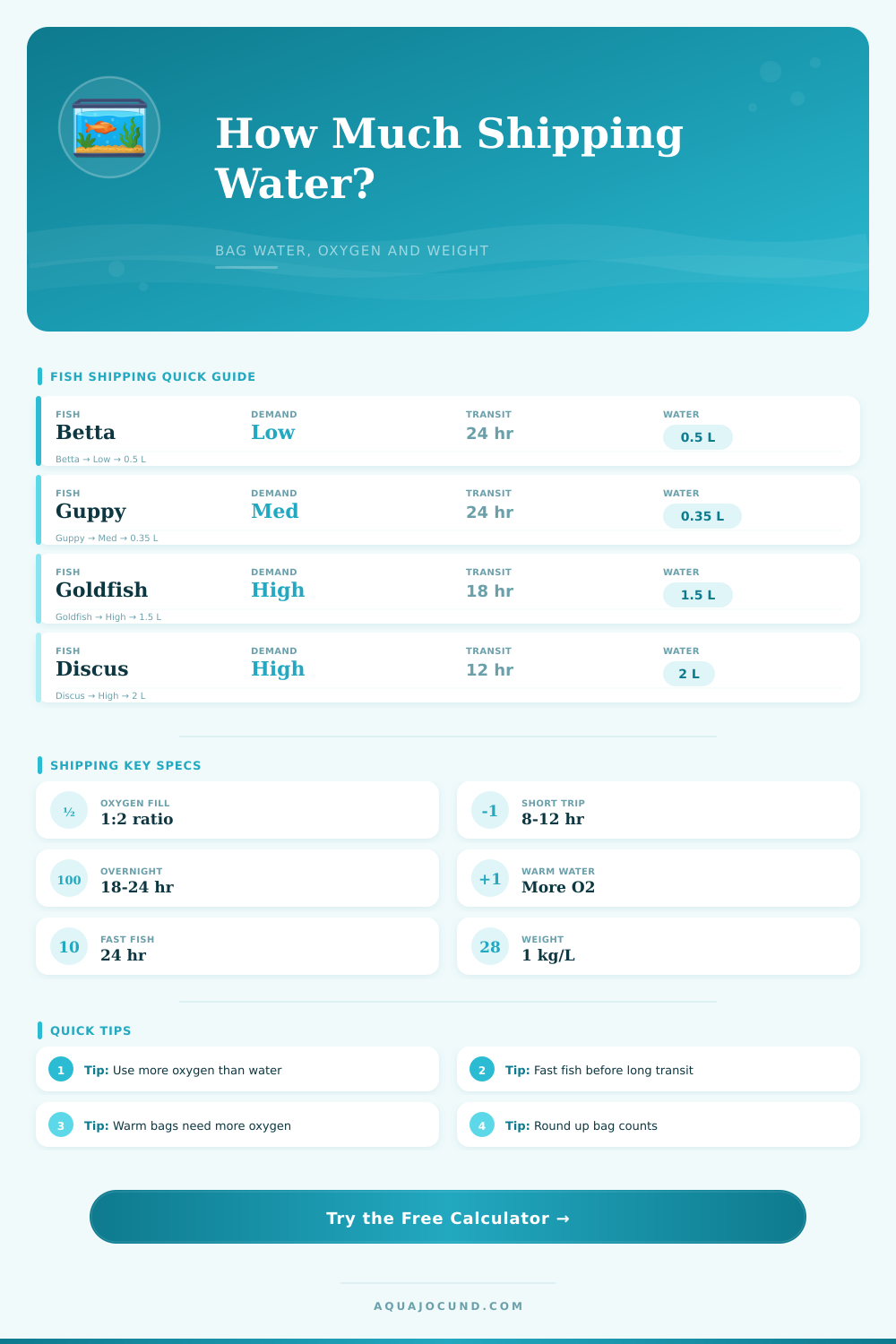
Moving fishes from one tank to another requires considering several different variables. Fish require both an supply of oxygen and a certain amount of water to survive. For each move of the fish from one tank to another, you must provide enough water to keep the fish stable and enough oxygen to allow the fish to breathe.
However, you must ensure that the amount of water provided isnt in such abundance that the bag becomes too heavy to transport. The number of fish to be transported and the length of time that the fish will be in transit will factor into these decisions. Many individuals who transport fish dont account for these variables, which can lead to the fish experiencing stress or even dying during transit.
How to Move Fish Safely with a Calculator
The metabolism of the fish is a continuous processes that does not cease when the fish are transported out of the tank. The metabolism of the fish requires both oxygen and creates ammonia waste as an output. The rate at which the fish metabolize the food that they consume is dependent upon the temperature of the water in which they live.
The more fast the water temperature increases, the faster that the fish will breathe and the rate at which their ammonia waste will build up in there tanks. To account for this, the calculator requires an input for the temperature of the water. If the water temperature is increased from 68 degrees to 80 degrees, for instance, the amount of oxygen that the fish will require and the amount of ammonia that will be released will increase.
The size of the bag to be used to transport the fish requires decision by the transporter in regard to the amount of water that will be included in the bag and the ratio of that water to the amount of oxygen that will be provided for the fish. The calculator uses the water to oxygen ratio to calculate the amount of water that each bag can hold. Based on the number of fish that will be transported, the calculator will determine if the amount of water that can be held in the bags is sufficient to meet the oxygen needs of the fish.
If not enough oxygen is provided based off the transit time, the calculator will indicate that more bags should be used to transport the fish, even if the total amount of water that could be contained in those bags is still sufficient for the fish. Another factor to consider is the rate at which the fish will produce ammonia. Too much ammonia can be harmful to the fish, so it is important to calculate the amount of ammonia that will be produced during the transport of the fish.
This amount can be calculated by inputting the mass of the fish, the number of hours that they will be in transit, and whether or not the fish have been fasted prior to being transported. The calculator can compare the amount of ammonia that will be produced to a pre-set limit. The user can alter this limit with the buffer setting on the calculator.
The buffer does not remove the ammonia from the water, but it will raise the limit of ammonia before the calculator indicates that the transport of the fish may be risky. Using a buffer is helpful for those who intend to use an ammonia remover in the water. Fish can be fasted prior to being transported in the bags.
This will reduce the amount of ammonia that they produce. The calculator has preset settings for fasting periods for the fish. The longer that the fish are fasted, the less ammonia will be produced.
A fish fasted for 24 hours will produce less ammonia than a fish that has just been fed. The weight of the fish to be transported must be considered in the packing of the fish into the bags. Because water is heavy, the total weight of the fish will include the weight of the fish, the bags, and the temperature packs.
The calculator will calculate each of these variables to determine the total weight of the box. This total weight is important to know both in regard to the limits of the shipping carrier and in regard to the physical weight of the packages that must be carried by the individual. The species of the fish to be transported can impact the calculation of the amount of water required to transport the fish.
Different species of fish will have different metabolic rates. For instance, active fish and goldfish will have higher requirements for both oxygen and ammonia output than fish like bettas or shrimp. Therefore, active fish and goldfish will require different considerations for transportation compared to bettas or shrimp.
Each species will have a demand setting in the calculator to determine the metabolic rate of the fish being transported. With this metabolic rate set, the calculator will determine the amount of water and the number of bags of water that are required to transport the fish. For instance, two fish of the same size may require different amounts of water based upon whether one is a slow-moving betta fish or a danio fish that continually swims in its tank.
The individual can set the safety margin for the transport of the fish. Adding water to the transport of the fish without changing any other variables allows for more leeway in case of small changes in temperature or transit times. A 50% safety margin will provide more water for both oxygen and ammonia output than a 15% or 25% safety margin.
Using a safety margin allows for the transportation of the fish in a way that permits for small problems during transit not to result in the death of the fish. The temperature at which the fish will be transported will be difficult for the individual to control. Therefore, it is best for the individual to set the temperature in the calculator.
If the individual knows that the temperature will be high during transit, such as in a warm warehouse or in a hot climate, the individual will set the temperature to that high temperature in the calculator. Additionally, the length of time that the fish will be in transit will impact the amount of water required for the transport of the fish. The longer that the fish will be in transit, the more water will be required for each individual fish.
For instance, a shipment that will take 36 hours to reach its destination will require more water per fish than a shipment that will occur overnight. The calculator can also take into account the number of bags in which the fish will be transported. The more bags in which the fish will be transported, the more weight will be placed upon the shipment.
Bagging the fish three times is common for those with delicate fish species. The calculator will count the weight of these bags. The conditions under which the fish will actualy be transported may not be the same as those that are accounted for in the calculator.
For instance, the shipper may need to leave the box in the sun or a flight may be delayed. The calculator will account for the variables that will impact the transport of the fish. Additionally, the risk label on the calculator will indicate whether or not the parameters that were entered are safe for the fish or if they may result in a risky transport of the fish.
Experienced fish transport ships will use the calculator and then add an additional buffer of time to transport the fish in order to ensure that the fish remain safe. The goal of the calculator is not to show how much water is required to transport the fish if there were to be no problems. Rather, it is to indicate how much water is required to ensure that any small problems that may arise during the transport of the fish will not result in the death of those transported fish.
The calculator is a tool that allows people to understand the relationship between water, oxygen, and ammonia in order to make decisions about the amount of water or the number of bags that will be used to transport the fish. By understanding each of the variables that impact the transport of the fish in the bags, individuals will be able to make decisions that will result in transport that is both reliable and successful.