🦐 Shrimp Breeding Population Calculator
Project starting adults, sex ratio, berried females, survival rate, culling or sales, and tank capacity over multiple generations.
| Gen | Day | Females | Berried | Survivors | Removed | Colony |
|---|
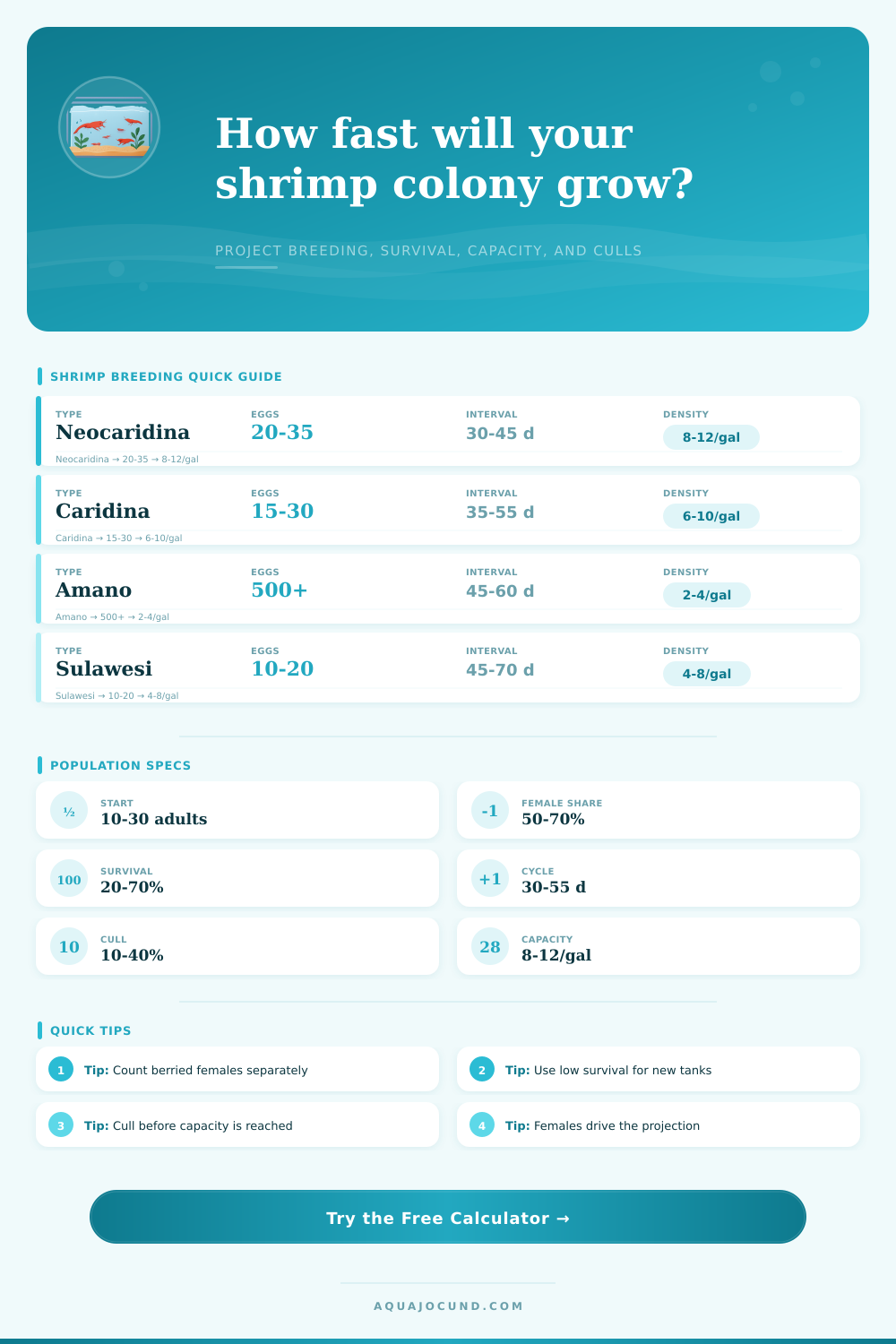
| Shrimp Type | Typical Eggs | Interval | Density Target | Projection Note |
|---|---|---|---|---|
| Neocaridina | 20-35 eggs | 30-45 days | 8-12/gal | Fast colony growth in stable tanks. |
| Caridina | 15-30 eggs | 35-55 days | 6-10/gal | Use conservative survival for sensitive lines. |
| Tiger Shrimp | 20-35 eggs | 35-50 days | 6-10/gal | Moderate growth with selective culling. |
| Sulawesi | 10-20 eggs | 45-70 days | 4-8/gal | Slow projection and lower density target. |
| Amano | 500+ eggs | 45-60 days | 2-4/gal | Larvae need brackish/saltwater stages. |
| Ghost Shrimp | 20-60 eggs | 30-45 days | 6-10/gal | Survival varies sharply with predation. |
| Tank | Common Dimensions | Volume | Starter Adults | Capacity Range |
|---|---|---|---|---|
| 3 gal nano | 12 × 7 × 8 in | 3 gal / 11 L | 6-10 | 18-30 shrimp |
| 5 gal desktop | 16 × 8 × 10 in | 5 gal / 19 L | 10-15 | 40-60 shrimp |
| 10 gal standard | 20 × 10 × 12 in | 10 gal / 38 L | 15-25 | 80-120 shrimp |
| 15 gal cube | 15 × 15 × 15 in | 15 gal / 57 L | 20-30 | 90-150 shrimp |
| 20 gal long | 30 × 12 × 12 in | 20 gal / 76 L | 25-40 | 160-240 shrimp |
| 29 gal rack | 30 × 12 × 18 in | 29 gal / 110 L | 35-60 | 230-350 shrimp |
| 40 breeder | 36 × 18 × 16 in | 40 gal / 151 L | 50-80 | 320-480 shrimp |
| 75 gal growout | 48 × 18 × 21 in | 75 gal / 284 L | 100-150 | 600-900 shrimp |
| Factor | Low | Moderate | High | Use In Calculator |
|---|---|---|---|---|
| Shrimplet survival | 15-30% | 30-55% | 55-75% | Lower for young tanks or mixed fish tanks. |
| Female share | 40-50% | 50-65% | 65-80% | Use observed adults if you can sex them. |
| Berried share | 10-20% | 20-40% | 40-60% | Count visible berried females separately. |
| Cull or sales rate | 0-10% | 10-30% | 30-50% | Raise it once projection nears capacity. |
| Mature breeder share | 25-40% | 40-60% | 60-75% | Controls how quickly young boost reproduction. |
A shrimp breeding population calculator are used to project the growth of you shrimp colony. This type of calculator will help you to determine at what point your shrimp colony will become too large for an aquarium tank that you have. A shrimp farm’s colony can grow to become a very large number of shrimp, and too many shrimp can overwhelms the tank in which they live.
To determine how many shrimp will live within the farm’s colony, it is important to understand how many female shrimp is responsible for breeding, and how many of the young shrimp survives the breeding process. To calculate the number of shrimp that will live within the shrimp breeding farm’s colony, you must provide the calculator with specific information regarding the shrimp farm. You must provide the calculator with information regarding the number of adult shrimp that live within the farm, the number of those shrimp that are female, and how many of the female shrimp are currently carry eggs.
How to Use a Shrimp Breeding Calculator
The calculator can use the number of female shrimp that are carrying eggs to calculate how many shrimp the farm will be born, and the survival rate of those shrimp. Because the calculator employs a generation interval, it can calculate the number of shrimp that will live within the farm after several breeding cycles. Furthermore, the calculator can also provide information regarding the target density of the tank, which is the number of shrimp that the tank can hold before it becomes to crowded with shrimp.
The growth of the shrimp within a shrimp farm can often be underestimate by those who own such farms. The low survival rate of shrimp can lead to the rapid growth of shrimp within a shrimp farm’s breeding colony. For example, if the survival rate is forty percent, and the generation interval is short, the number of shrimp will grow very quick within the farm.
Furthermore, the fish may eat the young shrimp that are being breed within the farm, as the survival rate can be adjusted in the case of new tanks or tanks that contain fish. Additionally, the mature share percentage for the shrimp farm can also be adjusted. This percentage determines how many of the young shrimp that survive will grow to become adult shrimp within the next generation.
These adjustments will help ensure that the population projection that is provided for the shrimp farm is realistic rather than to optimistic. Beyond the factors that can be adjusted within the shrimp breeding calculator, there are additional factors that impact the shrimp population that the calculator cannot account for. For instance, factors like the thickness of the biofilm that grows within the tanks, the water parameters within the tanks, and the number of hiding place for the shrimp can impact the number of young shrimp that survive within the tanks.
Poor water quality in the shrimp tanks will lead to fewer shrimp surviving than the shrimp breeding calculator calculate for that farm. If there are fewer shrimp than the calculator predicted for that farm, then the water quality can be checked for the shrimp tanks. Thus, while the calculator provides a projection for the number of shrimp that will live within a shrimp farm, the actual count of shrimp within the tanks can also be observe.
Furthermore, the number of shrimp within a tank can be adjusted through the process of culling. Culling is the process of removing shrimp from the farm’s tanks. If the shrimp breeding colony becomes too large for the tanks, the quality of the water within the tanks will decline, and the shrimp will begin to be affect by that decline in water quality.
Thus, the calculator allows shrimp farmers to determine the total number of shrimp that should be culled from the tanks, which makes the culling process more easy performable. Furthermore, if the shrimp farm’s breeding colony is approaching the limit of the tanks’ capacity for shrimp, the percentage of shrimp that are culled can be increased. Alternatively, another tank can be prepared in which the shrimp may be kept to increase the number of shrimp that the shrimp farmer cares for.
Because different species of shrimp has different growth rates, shrimp of different species require different settings within the shrimp breeding calculator. For instance, shrimp species like Neocaridina can tolerate very high densities of shrimp within their tanks, and have short generation intervals between the time that shrimp breed and the time that their young grow to become breeding shrimp themselves. Thus, shrimp of this species grow quick within their tanks.
Other species, like Caridina and Sulawesi shrimp, require lower densities within their tanks of shrimp, and have longer generation intervals. Thus, these species grow more slow than species like Neocaridina shrimp. These differences are automatically accounted for by the calculator if the shrimp farmer selects the species of shrimp that are to be breed within the farm.
Another factor that is important to the shrimp breeding calculator is the length of the breeding window for which the shrimp farm will be running the calculations. If the breeding calculator is to be run for a short period of time, such as three month, the calculator may not account for the time that it will take for the new shrimp breeders to begin breeding themselves. However, if the shrimp breeding calculator is to be run for a longer period, such as six month, the shrimp farmer can determine whether additional culling must be performed in the future to maintain the health of the shrimp within the tanks.
Thus, lengthening the length of the breeding window allows for more time to be spent preparing the tanks for the shrimp before the breeding colony becomes too large to be maintain by the shrimp farmer. Furthermore, the shrimp farmer may adjust the settings within the calculator if the number of shrimp within the tanks is different than the shrimp farmer had originally intended to have within those tanks. For instance, if the actual number of shrimp within the tanks is different from the expected number of shrimp, the survival rate or the mature share percentage can be adjusted within the calculator to obtain a new projection of the number of shrimp that may live within the shrimp breeding tanks.
Thus, shrimp farmers can use the shrimp breeding population calculator to adjust their expectation for the number of shrimp that will live within the farm’s tanks. Furthermore, the overall goal of the shrimp farmer is to maintain a healthy shrimp colony within the tanks that are made available to the shrimp farmer. Thus, the shrimp breeding calculator assist the shrimp farmer in achieving its goal by removing the guesswork that must be performed in determining how many shrimp should be added to or remove from the breeding tanks.