🐟 Goldfish Bioload Calculator
Estimate waste load, nitrate production, filtration turnover, water changes, and bioload risk for tanks and ponds.
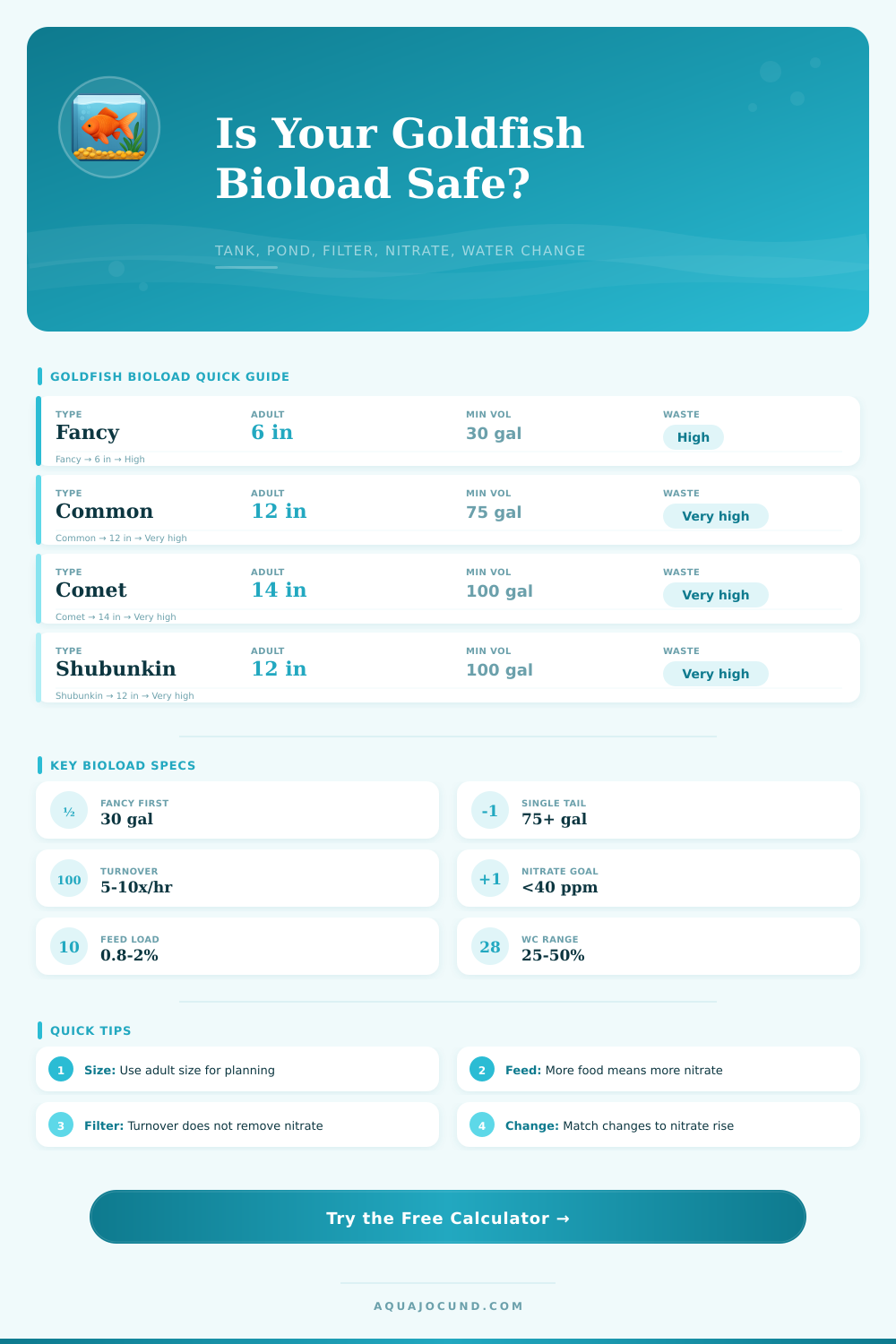
| Goldfish Type | Adult Size | Bioload Factor | Planning Volume | Turnover Target |
|---|---|---|---|---|
| Fancy goldfish | 5-7 in / 13-18 cm | High | 30 gal first, 15-20 gal each extra | 6x to 8x per hour |
| Ranchu / lionhead | 5-6 in / 13-15 cm | High | 30 gal first, 15-20 gal each extra | 6x to 8x per hour |
| Common goldfish | 10-12 in / 25-30 cm | Very high | 75 gal first, 30-50 gal each extra | 8x to 10x per hour |
| Comet goldfish | 12-14 in / 30-36 cm | Very high | 100 gal first, 40-60 gal each extra | 8x to 10x per hour |
| Shubunkin | 10-12 in / 25-30 cm | Very high | 100 gal first, 40-60 gal each extra | 8x to 10x per hour |
| Juvenile grow-out | 2-4 in / 5-10 cm | Rising fast | Size for the adult, not the juvenile | 8x to 10x per hour |
| Input | What It Changes | Calculator Use | Bioload Signal |
|---|---|---|---|
| Feeding level | Waste and nitrate production | Estimates grams of food per day from body mass | Heavy feeding raises risk quickly |
| Food protein | Nitrogen entering the system | Protein x 0.16 nitrogen x nitrate conversion | Higher protein creates more nitrate |
| Water volume | Dilution and stability | Converts nitrate mg into ppm rise | Small tanks concentrate waste faster |
| Water change size | Nitrate export | Models pre-change and post-change nitrate | Low export raises long-term nitrate |
| Turnover | Ammonia processing and oxygen delivery | Compares pump flow with volume | Low turnover increases risk |
| System | Dimensions | Volume | Goldfish Use |
|---|---|---|---|
| 29 gal tank | 30 x 12 x 18 in / 76 x 30 x 46 cm | 29 gal / 110 L | Short-term fancy pair only with strong changes |
| 40 breeder | 36 x 18 x 16 in / 91 x 46 x 41 cm | 40 gal / 151 L | Better footprint for fancy goldfish |
| 55 gal tank | 48 x 13 x 21 in / 122 x 33 x 53 cm | 55 gal / 208 L | Fancy trio with strong filtration |
| 75 gal tank | 48 x 18 x 21 in / 122 x 46 x 53 cm | 75 gal / 284 L | Fancy group or one single-tail juvenile |
| 125 gal tank | 72 x 18 x 22 in / 183 x 46 x 56 cm | 125 gal / 473 L | Large fancy group or limited single-tails |
| 500 gal pond | Custom pond basin | 500 gal / 1893 L | Several single-tail goldfish |
| 1000 gal pond | Custom pond basin | 1000 gal / 3785 L | Best for comets and shubunkins |
| Risk Band | Score Range | Main Cause | Typical Fix |
|---|---|---|---|
| Low | 0-39 | Volume, turnover, and nitrate export align | Keep the schedule steady |
| Moderate | 40-59 | One weak point, often nitrate or turnover | Increase water change size or flow |
| High | 60-79 | Goldfish load is above system capacity | Add volume, reduce feeding, or split stock |
| Critical | 80+ | Several limits are exceeded | Upgrade volume and filtration urgently |
Keeping your goldfish healthy over a long period of time involve managing the waste that it produces. While goldfish are a hardy species of fish, the nitrogen that they produce can be toxic to the water in which they lives. The nitrogen becomes toxic to the fish before the fish begin to exhibit any signs of stress, and the buildup of nitrogen in the water can lead to cloudy water, algae blooms within the aquarium, or the fish gasp at the surface of the water.
These problems are not with the goldfish, but in the fact that the waste that the fish adds to the water environment outpace the ability of that system to process the waste. The body shape of the goldfish have an impact upon the amount of waste that the fish produces. Goldfish with more rounded body shapes, such as fancy goldfish, will contain more mass within their bodies than goldfish of the same length but with more pointed bodies, such as comet goldfish.
How to Manage Goldfish Waste and Tank Size
Consequently, fancy goldfish will consume more food then comet goldfish. As a result, fancy goldfish will excrete more ammonia and nitrate than comet goldfish. Therefore, one should account for fancy goldfish in the calculation of the required volume of the tank in which they are to be keep.
Calculating the volume of the tank only in relation to the length of the goldfish is an error; length does not account for the body mass of the fish. Thus, calculators that account for these differences remove the need for guesses in relation to the number of gallon of water required to keep a tank populated with goldfish healthy. The feeding level of the goldfish impact the amount of nitrogen in the water.
A goldfish fed 2.5% of its body weight per day will produce more nitrogen than a goldfish fed only 0.8% of its body weight per day. Thus, one should take the feeding level of the goldfish into consideration when calculating the volume of the tank. Furthermore, the calculation should also account for the percentage of waste excreted by the goldfish; this percentage will indicate the amount of food that the goldfish eats, as well as the amount of food that is left uneaten in the tank.
Filtration turnover is a concept that those who care for their goldfish often misunderstand. Filtration turnover can be used to remove ammonia from the water, but it cannot be used to remove the nitrate that ammonia produce. Thus, the separation of these two concepts allow for the creation of a tool that calculates the expected range of nitrates in the water, indicating if the current rate of water changes for the tank is sustainable.
In addition to indoor aquariums, outdoor ponds also has different variables that must be accounted for. Ponds experience temperature swings that impact the metabolism of the goldfish in those ponds. Additionally, the plants in the pond may help to remove some of the nitrate from the pond, but the decaying leaves and food that is uneaten by the goldfish will contribute to the nitrogen waste that the pond produces.
Many pond owners change the water in their ponds with smaller percentages less often than aquarium owners change the water in their tanks. Calculators that take into account these different factors will allow owners of ponds to model the amount of nitrate that will be produced in their ponds, based off their actual habits regarding water changes. The number of fish that are to be stocked into the tank depends upon the amount of waste that the adult goldfish will produce.
The larger the volume of the tank in relation to the amount of waste that will be produced by the tanks inhabitants, the more stable the water chemistry will be. While the tables provided in these calculators can be used to decide the number of gallons of water that should be included in the tank in relation to the number of fish to be kept in the tank, the tables are merely guidelines. For instance, a single common goldfish may be maintained in a 75 gallon tank with excellent filtration with 50% water change each week.
However, the same species of goldfish in a 40 gallon tank with minimal water changes will reach safe levels for nitrate within a few weeks. The difference between these two scenarios is not in the goldfish species, but in the margin that is allowed for the tank. Risks associated with keeping goldfish in the tank can be calculated in relation to the volume of water in the tank, the turnover of the tanks water, the amount of nitrogen in the tank, the feeding habits of the goldfish, and the quality of the tanks filter.
Risk scores will indicate if the tanks conditions is aligned with each of those factors, but a high risk score indicates that one or more of those factors have been exceeded. Many aquarium owners and fishkeepers are unaware of the gap between the size of the tank that they have prepared for their juvenile goldfish and the size that the goldfish will reach when they reach adulthood. Juvenile goldfish often grow quite rapidly when fed well.
Thus, the tank that is adequate for a three inch goldfish may not be adequate for an eight inch goldfish. Therefore, the owner should plan the size of the tank according to the adult dimensions of the goldfish from the beginning. Additionally, success in managing a tank of goldfish is not indicated by the appearance of the tank on the first day of its establishment, but in relation to the stability of the water chemistry over a period of six month.
The value of calculating the amount of water changes that are required of a tank of goldfish is that these calculations allow for the owner of the aquarium to determine the best way to address rapidly increasing nitrates in the tank. For instance, if the nitrates in the tank are increasing rapidly, the owner may choose to increase the volume of water changes, to reduce the feeding of the goldfish to the tank, or to increase the amount of water in the tank. Additionally, if the turnover of the water in the tank is too low, the owner can decide to upgrade the filtration pump or media for the tank prior to the occurrence of ammonia spikes.
These calculations allow for these adjustments to be made with certainty, rather than with guesswork regarding whether these alterations will result in beneficial changes to the tank. Youll see that the calculations should of helped a lot.