🐟 Mesh Screen Top Calculator
Size aquarium screen frames, rail cuts, mesh sheet area, spline length, equipment cutouts, and jumper-safe gap tolerance.
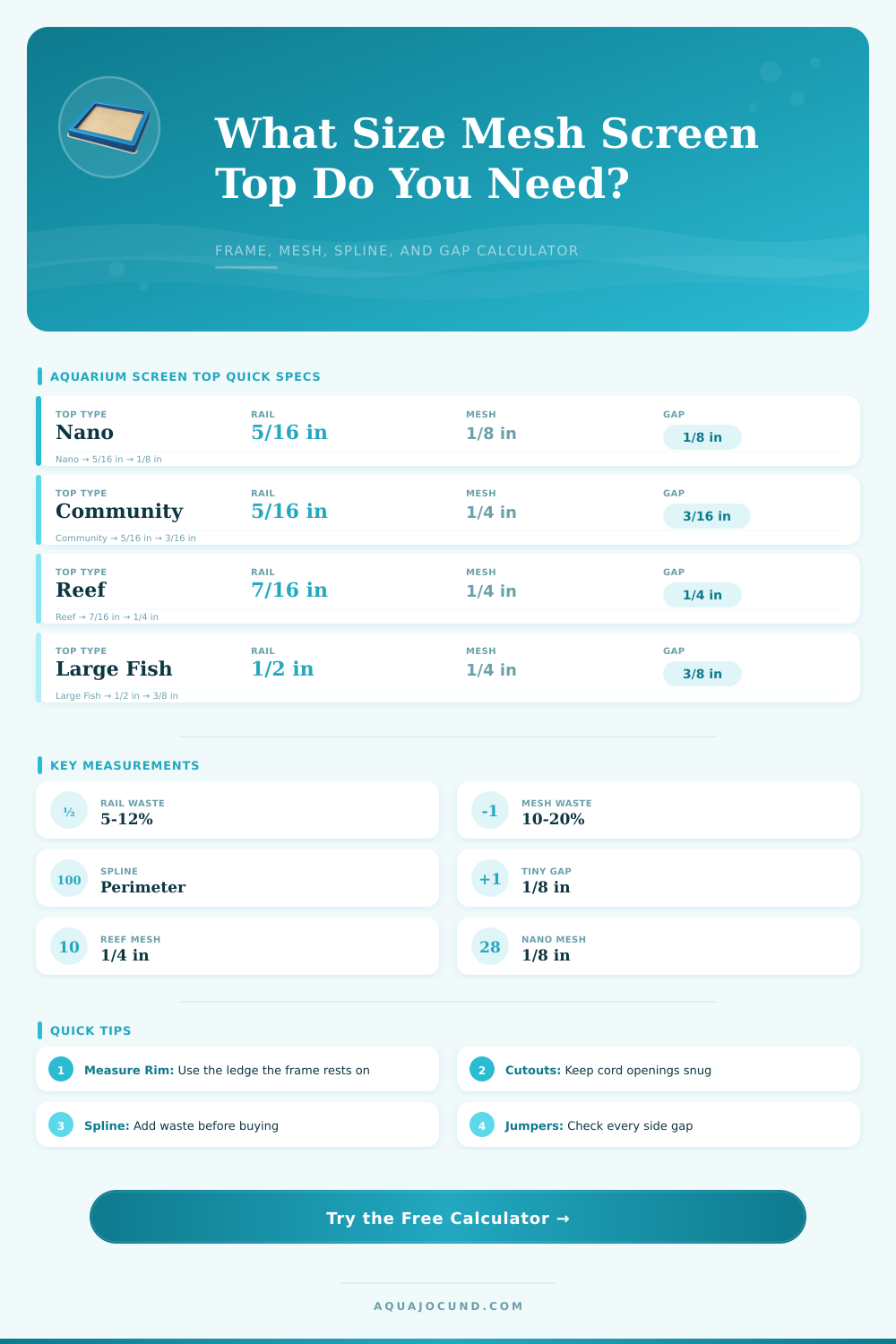
| Frame rail type | Typical width | Best aquarium use | Notes |
|---|---|---|---|
| Mini aluminum screen rail | 5/16 in | Nano to 29 gal | Light and low profile |
| Standard screen rail | 7/16 in | 40 breeder to 90 gal | Good stiffness for reef tops |
| Heavy screen rail | 1/2 in | Large tanks and cats | Less flex across long spans |
| Greenhouse or pond rail | 3/4 in | Ponds and very long lids | May block more light |
| Fish or tank type | Suggested mesh | Max side gap | Extra caution |
|---|---|---|---|
| Betta, killifish, nano rasboras | 1/8 in | 1/8 in | Cover cord slots tightly |
| Wrasses, firefish, gobies | 1/4 in | 3/16 in | Check overflow teeth and rear corners |
| Tetras, gourami, livebearers | 1/4 in | 1/4 in | Use snug feeder openings |
| Arowana, cichlids, large pond fish | 1/4 in | 3/8 in | Use stronger frame and clamps |
| Tank size | Common rim length | Common rim width | Typical screen approach |
|---|---|---|---|
| 5 gal rectangle | 16 in | 8 in | Single fine-mesh panel |
| 10 gal | 20 in | 10 in | Single 5/16 rail panel |
| 20 gal long | 30 in | 12 in | Single panel with snug rear cutouts |
| 29 gal | 30 in | 12 in | Single or hinged feeding notch |
| 40 breeder | 36 in | 18 in | Single reef-safe panel |
| 55 gal | 48 in | 13 in | Two panels reduce flex |
| 75 gal | 48 in | 18 in | Two panels around overflow |
| 125 gal | 72 in | 18 in | Two or three stiff panels |
| Opening | Typical size | Frame impact | Gap note |
|---|---|---|---|
| Filter return slot | 4 x 2 in | Add cutout perimeter to spline | Keep under fish tolerance |
| Heater or probe cords | 2 x 1 in | Small area loss | Use a grommet or notch cover |
| Overflow box | 6 x 4 in | Needs a clean rectangular opening | Rear corners are escape routes |
| Feeding port | 3 x 3 in | Optional framed insert | Use a lid or sliding cover |
- Measure the support ledge: For plastic-rim tanks, use the ledge that actually holds the frame, not the glass pane below it.
- Check each corner: Older tanks can be slightly out of square. Build to the smallest reliable length and width so the frame does not bind.
- Keep rail width in the formula: Wide frame rail reduces the open mesh area and can matter on planted tanks that need strong light.
- Cutouts create the risky gaps: Filter hoses, light arms, skimmer cups, and auto-feeder mounts often leave larger openings than the outer frame.
- Fine fish need fine tolerances: Betta, killifish, wrasses, gobies, and firefish deserve the smallest practical gap setting.
- Add waste before cutting: Mesh stretches and spline corners consume extra material. A normal DIY build should not be planned at zero waste.
Building an aquarium screen top require precise measurement to ensure that the screen top will apropriately fit the aquarium and prevent the fishes from escaping. The measurements of the aquarium should be taken from the rim of the aquarium rather than from the outer glass of the aquarium. If these measurement are taken from the outer glass of the aquarium instead, the screen top may be to large to fit within the aquarium, or may not fit correct upon placement upon the aquarium.
The calculator include different settings for measuring rimless aquariums or aquariums that have lips on the inside of the tank, since these types of tanks require different measurement than tanks that have a rim of the aquarium. Rim width is a decision that can impact the stability of the screen top, as well as the amount of light that can reach the fish within the aquarium. A narrow rail will result in a lighter screen top, but may lead to the screen top flex between the rails.
How to Measure and Build an Aquarium Screen Top
A wider rail indicate a stiffer screen top, which is beneficial for screen tops that must support heavy aquarium lights, or for screen tops that may be lean upon during tank maintenance. Rail width also relates to the length of the aquarium; longer tanks requires more stiffness in the screen top to avoid movement of the screen top once it is assembled. Mesh opening size can impact the safety of the fish within the aquarium, as well as the gas exchange within the water.
Fine mesh will prevent small fish from passing through the mesh, but will reduce the amount of gas exchange between the aquarium and the air. Coarser mesh allow for more gas exchange, but may not be as safely for fish that jump on the aquarium. These mesh openings should be compared with the fish within the aquarium with the mesh size calculator to ensure the mesh is safe for the fish.
The person makes cutouts for the heater cords or the water returns from the aquarium filter, but each of these cutouts create gaps in the screen top. Each cutout add to the length of the spline required to cover the screen top, as the spline will cover each cutout as well as the gaps within the screen top. Each cutout also may allow for gaps within the screen top that are more larger than the gaps between the outer frame of the aquarium screen tops.
The calculator indicate each of these cutouts and their individual lengths in the screen top, as well as the largest gap within the screen top prior to construction of the screen top. These cutouts should of been planned prior to ordering the screen top materials; otherwise, error may be made in cutting the screen top frame. A waste margin is necessary for the purchase of screen top materials due to the fact that the mesh will stretch with the spline placed into the mesh, as well as at the corner of the screen top.
By incorporating a waste margin for these variables into the calculations for the length of the mesh, you ensure that you dont run out of screen top mesh while constructing the aquarium screen top. The reference tables on the page provide information regarding the size of aquariums and the amount of screen top panels required for those aquariums. These table provide information as to why aquariums in the size of 125 gallons may require three panels of screen top, while those in the size of 29 gallons may only require one panel of screen top.
These tables help to ensure that the size of the screen top panels are purchased according to the size of the aquarium, removing guesswork in the purchase of screen top materials. In addition to the measurements made and calculated for the screen top, there is an additional step in the construction of the screen top: performing a physical inspection of the screen top. By placing your finger along each cutout or corner of the screen top, you can ensure that the gaps are safe for the fish in the aquarium.
Additionally, if an individual find a gap within the screen top that is too large for the species of fish in the aquarium, those gaps can be fixed with a small piece of mesh or a grommet cover. This will be easier than attempting to rebuild the screen top altogether.