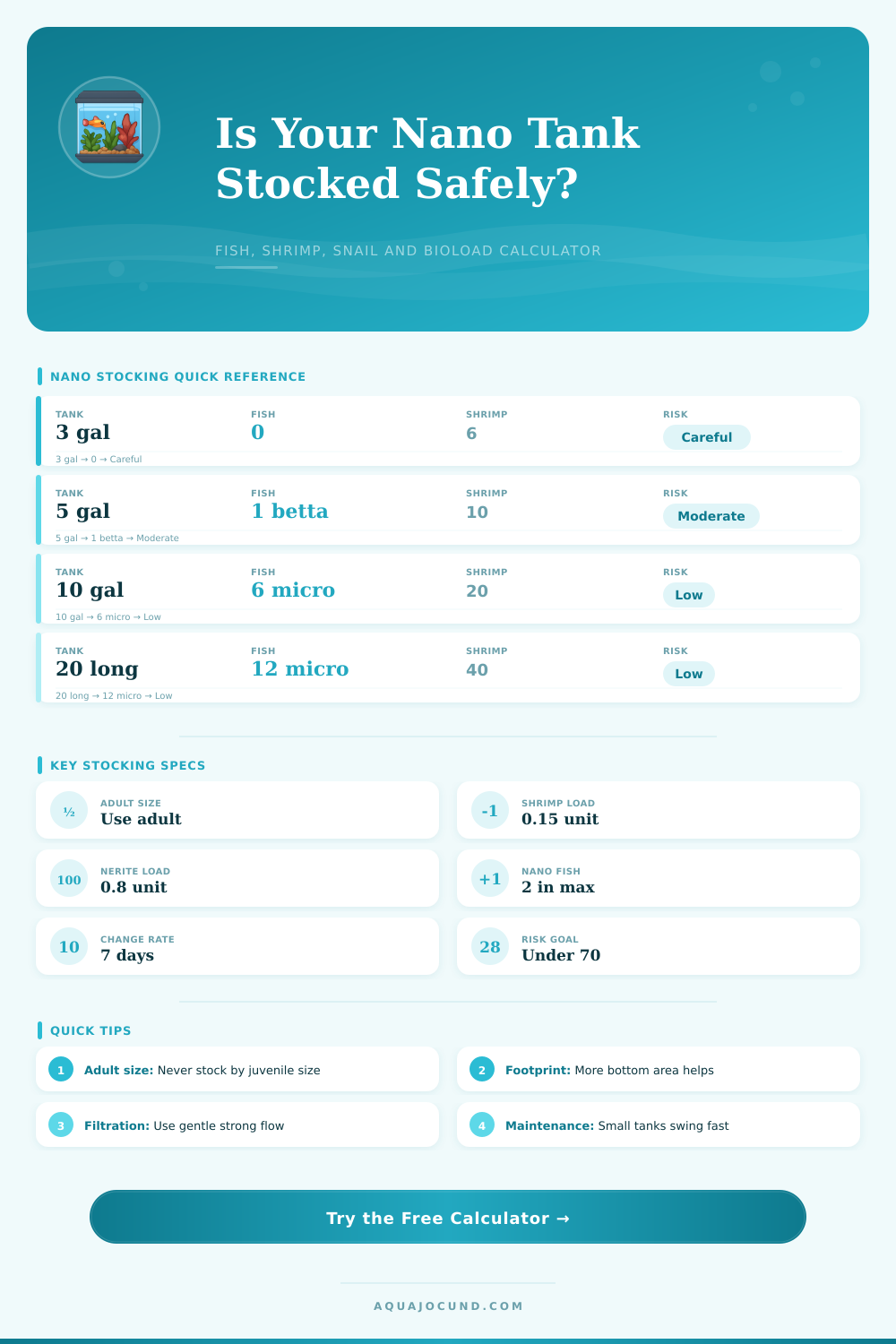
🐟 Nano Tank Stocking Calculator
Estimate safe fish, shrimp, and snail stocking from volume, footprint, filtration, adult size, and maintenance.
| Livestock | Adult Size | Minimum Tank | Group Rule | Bioload Notes |
|---|---|---|---|---|
| Betta | 2.5 in | 5 gal | Usually solo | Moderate bioload; avoid fin nippers. |
| Chili rasbora | 0.8 in | 8 to 10 gal | 6 or more | Low bioload but needs a school. |
| Endler | 1.2 in | 10 gal | 6 males or colony | Breeding can raise bioload fast. |
| Pygmy cory | 1.1 in | 10 gal | 6 or more | Footprint matters more than height. |
| Dwarf shrimp | 1.0 in | 2.5 gal | 6 or more | Very light load, sensitive to swings. |
| Nerite snail | 1.0 in | 5 gal | 1 per 5 gal | Great algae eater, noticeable waste. |
| Tank | Typical Dimensions | Footprint | Best Stocking Use |
|---|---|---|---|
| 3 gal cube | 10 x 10 x 10 in | 100 sq in | Shrimp only or temporary grow-out |
| 5.5 gal | 16 x 8 x 10 in | 128 sq in | Single betta or shrimp/snail tank |
| 6 gal cube | 12 x 12 x 12 in | 144 sq in | Shrimp colony or one tiny centerpiece |
| 10 gal | 20 x 10 x 12 in | 200 sq in | Betta mix or micro schooling group |
| 15 gal | 24 x 12 x 12 in | 288 sq in | Ricefish, endlers, or larger shrimp colony |
| 20 long | 30 x 12 x 12 in | 360 sq in | Best nano community footprint |
| Factor | Low Risk | Watch Zone | High Risk |
|---|---|---|---|
| Bioload score | 0 to 55 | 56 to 75 | 76+ |
| Adult fish size | Under 1.5 in | 1.5 to 2.5 in | Over 2.5 in |
| Tank volume | 10 gal or more | 5 to 9.9 gal | Under 5 gal |
| Maintenance | Weekly or more | 10 to 14 days | Monthly or irregular |
| Filter maturity | Seeded, mature media | New but cycled | Uncycled or weak flow |
Nano tanks should be stocked around full-grown size. A fish sold at half an inch may become too active, territorial, or waste-heavy once mature.
Small tanks have little dilution buffer. If your score lands near the watch zone, improve the plan with weekly water changes before adding animals.
Nano tanks may appears simple due to the fact that a nano tank requires only a few gallon of water, a few plants, and a few shrimp or fish. However, the limited volume of water in these tanks presents certain difficulity. The small volume of water make it so that water chemistry can change quickly.
Additionally, the small volume of water means that the oxygen levels will drops rapidy in the tank. Finally, the waste in the tank can reach high levels quick due to the small volume of water in which the waste is dissolve. Thus, stocking a nano tank require care.
How to Keep Bioload Low in a Nano Tank
When determining the number of fish that can live in a nano tank, it is important to consider the adult size of the fish rather than the current size of fish. The size of the fish will triple if the fish reaches its full adult size. Thus, the waste output of the fish will also triple.
By entering the length of the fish when it is grown to full size, the dimensions of the nano tank, and the maintenance of the nano tank, the bioload calculator can calculate the bioload score. The bioload score is a number that tell an individual if the fish in the nano tank will remain stable or if the tank will become unstable. Another consideration for those adding fish to a nano tank is the footprint of the tank.
Most of the fish native to nano tanks will spend most of their time on or near the bottom of the tank. A tall and narrow tank will have the same volume as a flat and wide tank. However, the tall and narrow tank will not provide the same amount of usable surface area for the fish to live upon.
By comparing the volume of a nano tank to the base area of the nano tank, the bioload calculator consider the effect that footprint will have upon the bioload of the tank. If the footprint of the tank is small, the bioload score will reflect the increased bioload that will result from the footprint of the tank. Another consideration for maintaining a nano tank is the strength of the filter for the tank and how often you should clean the filter.
The stronger the filter, the more waste that the filter can process. However, only if the filter is cleaned regular and if the filter media is mature will the increased strength of the filter result in the processing of more waste by the filter. The water changes that occur in the tank will also provide stability to the tank.
More frequent water changes are better for the nano tank than less frequent water changes. The owner of the nano tank will adjust the bioload score according to the water change frequency entered. Additionally, the density of the planted tanks also affects bioload.
Plants will consume nutrients and will produce oxygen. The consumption of the nutrients will lower the bioload of the tank, but only if the plants is established in the tank. Another factor to consider in adding animals to a nano tank is the fact that shrimp and snails will produce waste into the tank, even though these animals is small in number.
The calculator assigns different values to different types of snails. For example, a mystery snail will produce more waste than a ramshorn snail. Additionally, shrimp will produce less waste than snails.
However, an excessive number of shrimp will still increase the bioload of the tank. This factor can be tested in the bioload calculator by comparing, for example, the bioload of ten shrimp to the bioload of one fish. Many individuals will make mistake when adding animals to their nano tank.
Many individuals will treat their nano tank similar to a larger aquarium. For example, individuals may be unaware of the fact that some of the rules of thumb for twenty gallon tanks will not work in the nano tank. Additionally, the individual may only consider the fish that they wish to add to the nano tank, but ignore the fact that additional animals, such as shrimp and snails, will also increase the bioload.
The bioload calculator makes it easy for the individual to make these tradeoff. Due to the small size of a nano tank, the temperature of the water will experience more rapid changes in the tank. These rapid changes to the temperature will affect the metabolism of the inhabitants of the tank, and rapid changes to the temperature will also impact the waste that is produced by those tank inhabitants.
While the bioload calculator does not measure the temperature of the tank, the maintenance and planting modifiers account for the effect that rapid changes in the temperature will have upon the tank. For instance, if the temperature in the owners room changes rapid, then the bioload score that the calculator calculates should be conservative. The goal in calculating the bioload score is not to obtain a score of zero.
Any living thing in the nano tank will increase the bioload score of the tank. The goal is to ensure that the bioload score of the tank is kept at a level that will not develop into problem. If the bioload score is low, then there is time to add more animals to the tank or to change the water less often.
However, if the bioload score is high, then the number of animals in the tank will need to be reduce or the controllable factors in the tank will need to be improved. Providing consistent care for the nano tank will lead to the best outcome for the tanks inhabitants. Providing consistent care for a nano tank include providing consistent water changes, feeding the tank modestly, and maintaining the health of the tanks plants.
By providing consistent care for the nano tank, the bioload score can remain in the low-risk range.