🌿 Paludarium Volume Calculator
Estimate aquatic water volume, land volume, false bottom reserve, pump chamber capacity, and misting reserve from one layout.
| Material | Use | Solid Fraction | Typical Depth | Calculator Role |
|---|---|---|---|---|
| Bare Bottom | Open water | 0% | 0 in / 0 cm | No substrate displacement |
| Fine Sand | Shallow aquatic bed | 62% | 0.5-2 in / 1-5 cm | Subtracts packed grains |
| Rounded Gravel | Stream bed | 55% | 1-3 in / 3-8 cm | Leaves more pore water |
| Aquatic Soil | Planted water zone | 50% | 1-2.5 in / 3-6 cm | Moderate displacement |
| River Stone Bed | High flow edge | 70% | 1-4 in / 3-10 cm | High rock displacement |
| Rock Wall / Ledge | Hardscape bank | 85% | Custom | Very high displacement |
| Tank | Inside Dimensions | Fill Height | Land Share | Typical Aquatic Volume |
|---|---|---|---|---|
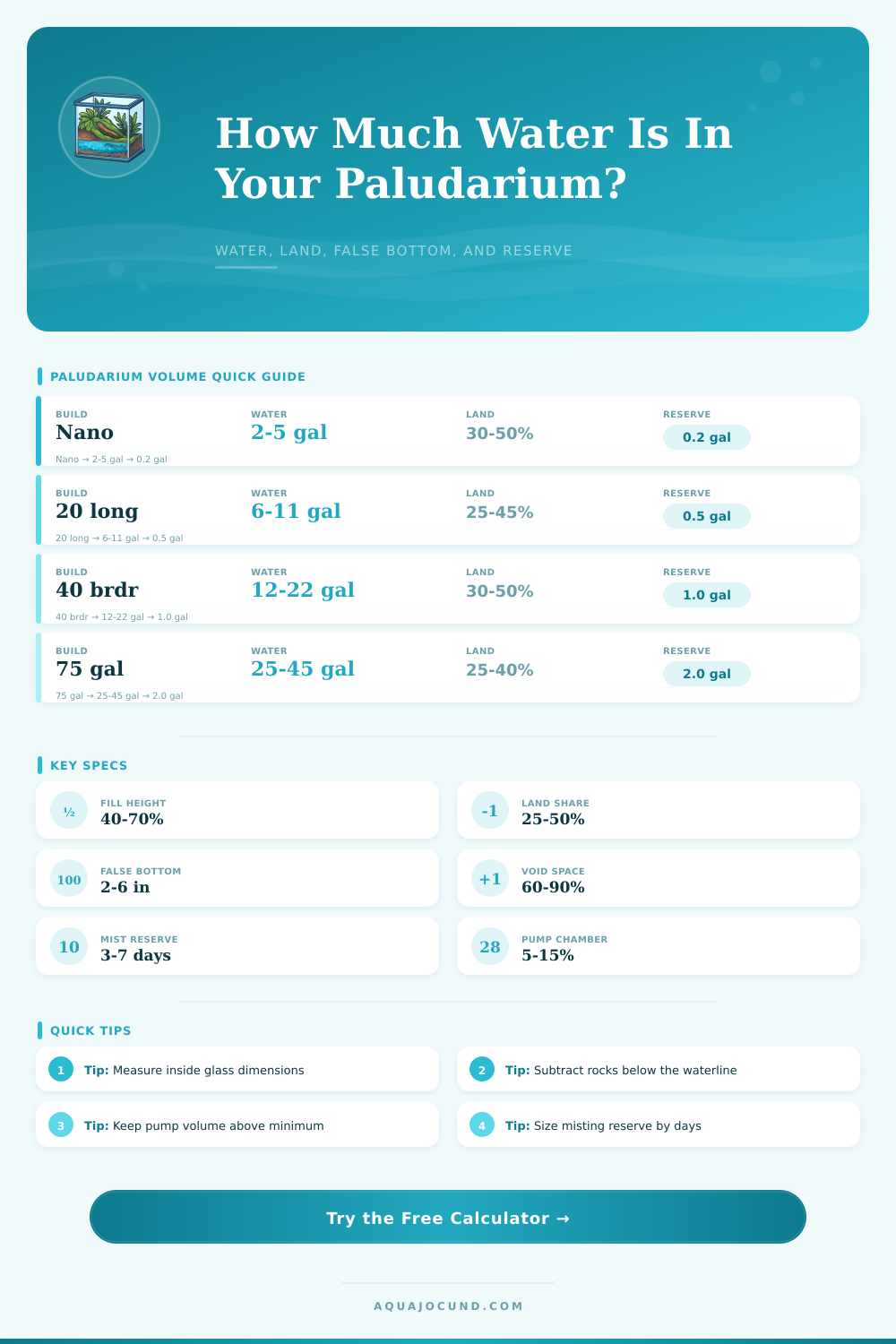
| 12 Gallon Long | 35.4 x 8.3 x 9.4 in / 90 x 21 x 24 cm | 4-6 in / 10-15 cm | 30-45% | 2-5 gal / 8-19 L |
| 20 Gallon Long | 30 x 12 x 12 in / 76 x 30 x 30 cm | 6-8 in / 15-20 cm | 25-45% | 6-11 gal / 23-42 L |
| 18 Inch Cube | 18 x 18 x 18 in / 46 x 46 x 46 cm | 5-9 in / 13-23 cm | 35-60% | 4-10 gal / 15-38 L |
| 40 Breeder | 36 x 18 x 17 in / 91 x 46 x 43 cm | 8-12 in / 20-30 cm | 30-50% | 12-22 gal / 45-83 L |
| 75 Gallon | 48 x 18 x 21 in / 122 x 46 x 53 cm | 10-15 in / 25-38 cm | 25-40% | 25-45 gal / 95-170 L |
| 125 Gallon | 72 x 18 x 22 in / 183 x 46 x 56 cm | 11-16 in / 28-41 cm | 25-40% | 40-75 gal / 151-284 L |
| Component | Common Range | Counts As Water? | Watch Point |
|---|---|---|---|
| Display aquatic section | Open water after displacement | Yes | Use this for aquatic livestock space |
| False bottom reserve | 60-90% void space | System reserve | Do not count solid supports as water |
| Pump chamber | 5-15% footprint | System reserve | Keep above pump minimum depth |
| Misting reservoir | 3-7 days of mist use | Separate reserve | Size from actual nozzle output |
| Rocks and wood | Direct volume estimate | No | Only subtract portions below waterline |
To build a paludarium, you has to calculate the volume of the water that will be available for the animal and the volume that will be taken up by the plants and hardscape. The advertised volume of the tank will not always be the amount of water that will be available for the animals. The volume that will actualy be available will be less than the advertised gallon rating due to the land area of the tank, the substrate, and the equipment that will be contained within the tank.
If you dont plan for how much of the tank will be taken up by these non-water element, you will not have enough water to accommodate your animals. The land section of the tank will take up some of the volume of the tank that would otherwise be able to be filled with water. For instance, a 40 gallon tank may only hold 20 gallon of water if the false bottom, pump chamber, and land area is all included.
How much water will be in a paludarium
A calculator can help to determine how much volume each of these element will take up in the tank. The calculator can determine the volume of each of these elements by treating the land area of the tank as a percentage of the total floor area of the tank. The total area of the tank impacts the actual volume of the tank that is taken up by the land; a long tank will hold less water with the same percentage of land than a tank that is close to cube-shape.
The false bottom of the tank is an area that is constructed beneath the land that holds water to supply the plants with water for wicking. The false bottom can displace the volume of the tank because the false bottom can hold fish that use the area for swimming. The solid material of the false bottom cannot be counted as a volume of water that is contained by the tank, but the reserve water of the false bottom can be counted as one.
Many people make this mistake when constructing a paludarium; they often do not remember to account for the void percentage of the false bottoms. The pump chamber is another element of the tank that can displace the volume of water from the tank. The chamber must be deep enough to contain the pump that circulates the water of the tank, but the depth of that tank take up part of the volume of the tank that is available to the animals.
Many calculators allow the user to introduce a safety margin for the volume that is calculated. A small safety margin can provide several gallon of water to the tank; these gallons of water are important to consider when determining the number of animals that will live within the tank. The amount of water that is contained within the system for misting the tank is called the misting reserve.
The amount of water that is required for misting the tank will depend upon the amount of misting that is performed each day and the number of days that the tank will operate without refilling the reservoir. The misting reserve is separate from the other volumes within the tank. Thus, a tank volume calculator can calculate the misting reserve separately to determine whether the misting schedule will fit into the capacity of the tank or whether an external reservoir will be needed to provide the water for misting.
Another variable that impacts the volume of water in the tank is the substrate that is placed into the tank. Substrate that is fine sand will be more dense than substrate that consist of rounded gravel; therefore, the sand will displace more water at the same depth than the rounded gravel. Rock walls and rock ledge will displace some of the water in the tank.
Material cards are available in many calculators that permit an individual to determine the solid fraction of different substrates. For instance, if an individual changes the substrate from sand to a bare-bottom substrate, there will be more volume to the tank due to the fact that a bare bottom does not displace the water in the tank. The third factor that can reduce the volume of water in the tank are the items that are placed within the tank and called the hardscape.
Rocks that are placed beneath the waterline will displace some of the water in the tank. Additionally, driftwood that is placed at an angle will displace some of the water in the tank. Background foam that extends into the area that is populated with water will also displace some of the tanks volume.
Each of these items should be accounted for in the calculation of the volume of water that will be contained in the tank; the inside measurements of the glass tank will be used for these calculations instead of the nominal size of the tank. By constructing a paludarium, an individual can compare two different layouts to determine the impact that each of those layouts will have upon the land and water volume within that tank. For instance, one individual may desire to have the land under forty percent of the tank to provide more space for the fish to swim in the tank.
Alternatively, another individual may want to include more land within the tank, such as constructing a land area that is taller than the water depth of the tank. In this case, the individual will rely upon the water that is contained within the false bottom of the tank and the volume of the pump chamber to provide the water that is required for the system. Overall, understanding how each of these elements contribute to the total volume of water that will be within the tank is important to ensure that the system is constructed in a way that will provide for both the plants and the animals that exist within the paludarium.
Should the paludarium be low on water, both the plants and the animals will experience stress. If there is too little open water for the animals to swim in the tank, the animals will also experience stress. Thus, an individual must make sure that they understands each of these elements to make sure that they understand the compromises that they have made in the construction of their paludarium.